Inside Skills England’s Standards Review Backlog
27 July 2026 · 7 min read

Inside Skills England’s Standards Review Backlog
Skills England wants every one of England’s 700 apprenticeship standards moved into its assessment reform process by 1 August 2026 — a deadline sector bodies, Ofqual’s own chief regulator and an independent review have all called unrealistic. Government guidance now confirms the transition will run through 2026 and into 2027, turning the standards backlog into a multi-year planning risk for every curriculum and quality team, not a one-off administrative story.
What Skills England actually announced
Since IfATE closed and its functions transferred to Skills England, the agency has taken on reform of end-point assessment across the entire apprenticeship standards suite. The scale of the ambition is not in question: Skills England confirmed in December 2025 that it intends to have all 700 standards entered into the reform process by 1 August 2026 (FE Week, 16 December 2025).
That is not 700 standards quietly reviewed and republished. It's 700 live products — each with its own end-point assessment plan, its own funding band, its own employer-facing progression route — being touched more or less simultaneously.
Why the sector says the deadline is unachievable
Providers and their representative bodies did not wait for the deadline to arrive before flagging the problem.
- At the FAB conference, sector representatives told Skills England officials directly that the timescale was "impossible" and "unmanageable" (FE Week, 11 December 2025).
- Ofqual's chief regulator, in the same reporting, acknowledged the schedule as "demanding" — a notably careful word from the regulator responsible for signing off the qualifications sitting underneath many of these standards.
- The Gatsby Charitable Foundation's independent review went further, concluding the original 1 August 2026 deadline "already looks unachievable" and warning that reform communication risks staying confined to insider groups rather than reaching the providers who have to act on it (FE News, 10 February 2026).
- GOV.UK's own guidance, updated 12 June 2026, now states plainly that the sector "will remain in a period of transition during 2026 and 2027" — an official admission that this is not a single deadline but a rolling one.
When the regulator, an independent charitable review and the government's own published guidance all point the same direction, it stops being sector grumbling and becomes a documented planning fact.
The scale, in numbers
Independent tracking gives a clearer picture of where things actually stand mid-reform, rather than where the original plan assumed they'd be.
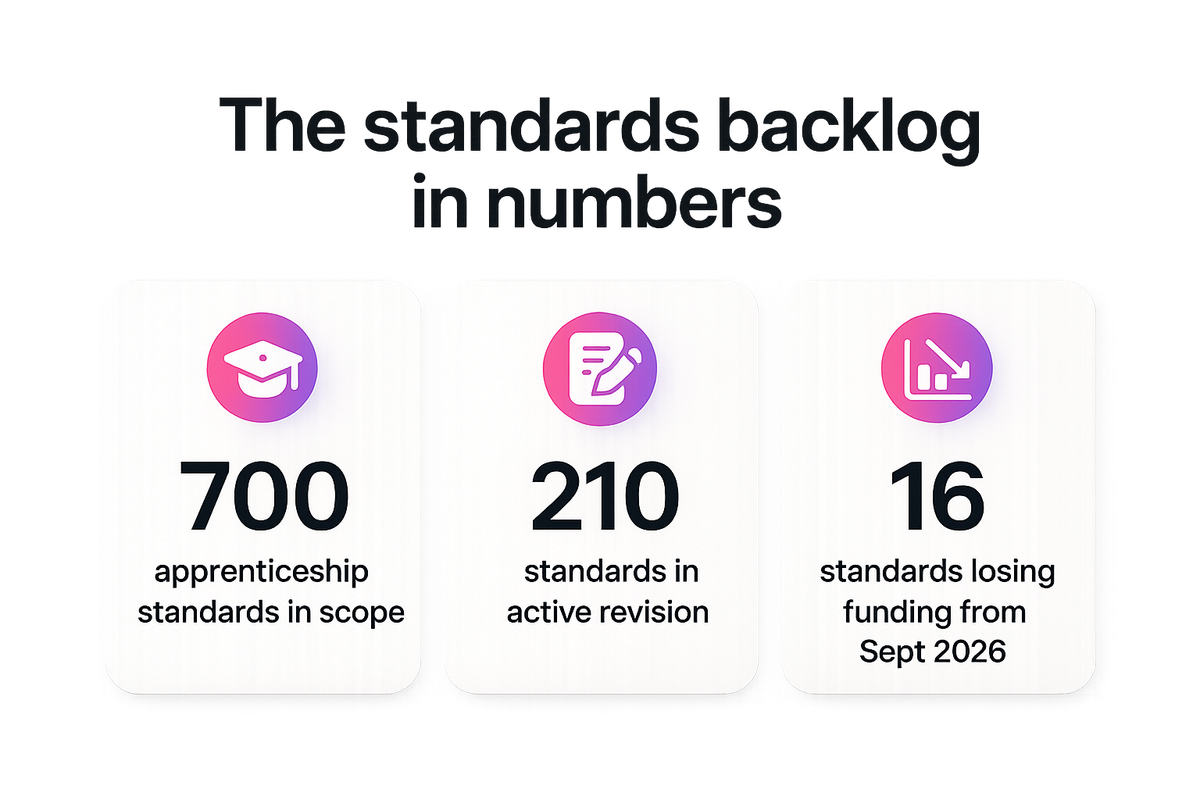
NCFE's live tracker recorded 210 of the 700 apprenticeship standards in active revision as of its March–April 2026 snapshot (NCFE, ongoing tracker; SRSCC, 20 April 2026). That's roughly three in ten standards mid-change at any given moment — each one a potential mismatch between what a provider is currently teaching and what the standard will require once revision lands.
The parallel funding cliff-edge
The standards backlog isn't the only moving part. A separate funding change is landing on an overlapping timeline.
- Funding is withdrawn for new starters on 16 confirmed standards from 1 September 2026 (SRSCC, 20 April 2026).
- An interim funding model is running for the rest of 2026 pending a permanent replacement — but the underlying data behind that interim model has not been disclosed (FE Week, 26 June 2026).
- FE Week has flagged the specific risk of standards being defunded without a flexible replacement route for employers who built progression pathways around them (FE Week, 27 February 2026).
- AELP has named backlogs and administrative burden as structural problems arising from the reform programme — not teething issues that will resolve on their own (Wired-Gov/NCFE, 10 June 2026).
Put together: a provider can have a standard mid-revision, its funding band about to change, and no visibility into the data behind the interim funding model that will govern it in the meantime.
What this means for curriculum and quality teams
For any Further Education college, independent training provider or apprenticeship training agency, this backlog isn't background noise. It's a direct exposure to inspection and funding risk, because:
- Assessment materials built against a standard's current version can be superseded mid-delivery, with no guarantee the change is communicated beyond specialist forums.
- A standard confirmed for defunding from 1 September 2026 may still have learners enrolled against it right up to that date.
- Ofsted's renewed inspection framework, in effect for FE and skills since 10 November 2025, sharpens the demand for learner-level evidence — which means gaps caused by standards drift are more likely to surface during inspection, not before it.
- Manual tracking of 700 standards, 210 of them moving, against funding rules that change on a rolling basis, is not a task most quality teams have the headcount to do reliably.
How providers are currently tracking this
Most of the tracking effort right now sits with sector bodies and specialist trackers — NCFE's snapshot, SRSCC's funding analysis, FE Week's reporting — rather than being built into providers' own quality systems. That's useful for awareness. It's not the same as knowing, at the level of an individual programme, whether the assessment materials in front of a class this term are still mapped to the version of the standard that will apply when that cohort completes.
That gap — between sector-level awareness and programme-level certainty — is exactly where curriculum and quality teams are exposed.
Key takeaways
- Skills England's target of moving all 700 apprenticeship standards into reform by 1 August 2026 has been called unachievable by an independent review, and government guidance now confirms transition runs through 2027.
- As of the March–April 2026 snapshot, 210 of 700 standards were in active revision, with 16 confirmed to lose funding for new starters from 1 September 2026.
- An interim funding model is covering the gap for the rest of 2026, but its underlying data has not been published.
- AELP has named backlog and administrative burden as structural, not temporary, problems in the reform programme.
- Providers relying on manual tracking of standards and funding status risk building curriculum on ground that shifts mid-year — a risk sharpened by Ofsted's renewed inspection framework and its demand for learner-level evidence.
Our take
A reform programme touching 700 standards at once was always going to strain the sector's capacity to track it — the surprise isn't that the deadline slipped, it's that the slippage is now documented in government guidance itself. That should change how providers plan. Treating standards currency as a periodic check-in, done when someone remembers, isn't enough when roughly three in ten standards are mid-revision at any point and funding withdrawal dates sit on a separate, overlapping calendar. The providers who come through this cleanly will be the ones who treat standards and funding status as something to monitor continuously, not something to re-verify only when an EQA visit or inspection forces the question.
FAQ
What is Skills England's target for the apprenticeship standards reform? Skills England set a target of 1 August 2026 for all 700 apprenticeship standards in England to have entered its assessment reform process (FE Week, 16 December 2025). Sector representatives and an independent review by the Gatsby Charitable Foundation have both said this deadline is unachievable.
How many apprenticeship standards are currently affected? NCFE's tracker recorded 210 of the 700 apprenticeship standards in active revision in its March–April 2026 snapshot, with 16 confirmed to lose funding for new starters from 1 September 2026 (NCFE; SRSCC, 20 April 2026).
Is this a short-term issue or a longer transition? GOV.UK guidance, updated 12 June 2026, confirms the sector will remain in a period of transition throughout 2026 and 2027 — meaning this is a multi-year planning problem rather than a single deadline to work around.
Why does the funding change matter alongside the standards backlog? Funding is withdrawn for new starters on 16 confirmed standards from 1 September 2026, while an interim funding model with undisclosed underlying data runs for the rest of 2026 (SRSCC, 20 April 2026; FE Week, 26 June 2026). Standards and funding status can change on different, overlapping timelines.
What has the sector said about the reform's pace? At the FAB conference, sector representatives called the timescale "impossible" and "unmanageable", and Ofqual's chief regulator described it as "demanding" (FE Week, 11 December 2025). AELP has separately named backlogs as a structural problem in the reform programme.
Worth asking your own quality team: if a standard you're currently delivering against moved into revision tomorrow, how quickly would you know?