Software for Standards for RTOs 2025 Compliance
6 September 2026 · 8 min read

Software for Standards for RTOs 2025 compliance needs to do one thing well: produce a mapping matrix that lets a validator trace every unit-of-competency requirement — element, performance criterion, evidence requirement — through to a specific assessment task, before that tool ever reaches a learner. The 2025 Standards, in force since 1 July 2025, make this pre-use check explicit. Drafting speed matters less than whether a qualified assessor can actually verify the mapping in front of them.
What changed under the Standards for RTOs 2025
The 2025 Standards for RTOs are enabled by the National Vocational Education and Training Regulator (Outcome Standards for Registered Training Organisations) Instrument 2025 and a related Compliance Standards instrument, both registered on the Federal Register of Legislation. They replace the 2015 Standards as the basis for registration and audit.
The procedural shift that matters most for buyers is timing. Validation of assessment tools and judgements must now happen *before* a tool is used with a learner, not only after the fact through a retrospective sample review. ASQA's Assessment Practice Guide defines validation as a systematic, planned, documented review — one whose findings are meant to feed back into improving the assessment system, not just tick a box.
ASQA's own 2025 Standards FAQ confirms RTOs must be able to demonstrate validation of practices and judgements at least once every five years per training product on scope, or more often where risk, product change, or feedback demands it. The Validation sample size calculator on ASQA's website still applies. None of this is new in spirit — validation has always been a Standards requirement — but the pre-use timing and the documentation expected around it are sharper than before.
Adding to the complexity, training package reform (TPOF 2025) is rolling out a new Application of Skills and Knowledge (ASK) unit format alongside traditional units of competency. Both formats will sit on training.gov.au at the same time for a transition period, which means mapping software has to handle both without forcing your team into two separate workflows.
What to look for in assessment coverage mapping software
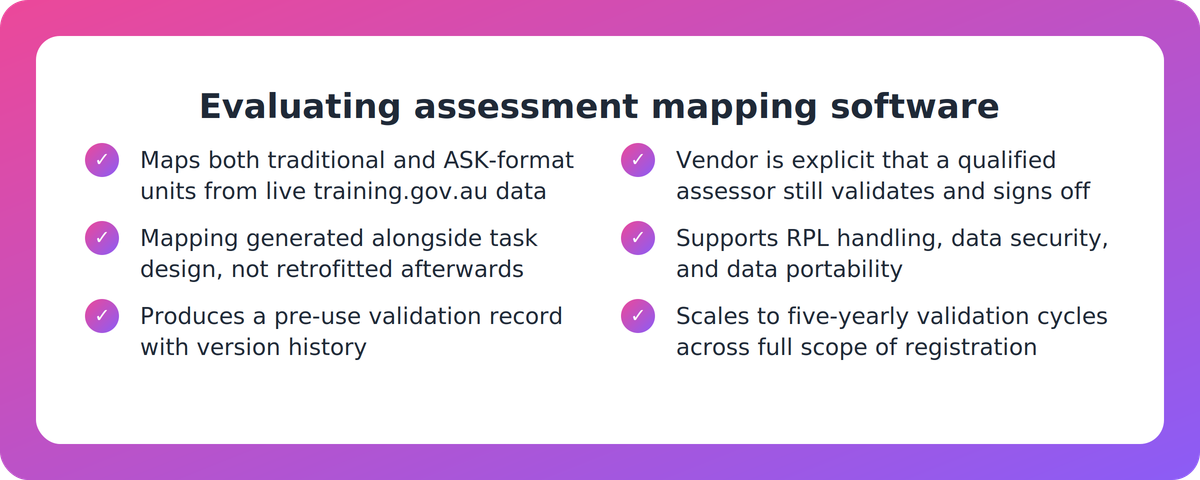
No regulator prescribes a fixed matrix template. What matters is that the mapping is accurate, complete, matches the assessment tool as it actually exists, and lets a validator trace any unit requirement through to the exact task and benchmark that addresses it. Judge software against that outcome, not against how polished the export looks.
Traditional units and ASK-format units, from live data
Confirm the tool pulls current requirements from training.gov.au rather than a static, once-imported template. Training packages change; a mapping tool that quietly goes stale is a bigger risk than one that's slightly less slick.
Mapping built alongside task design, not bolted on after
RTO Resource Australia's audit commentary and CAQA's analysis of pre-use review both point to the same root cause of failed mapping: it's written after the assessment tasks are finalised, so it tends to rationalise coverage rather than expose the gaps. A tool that generates or updates mapping as tasks are built — and re-checks it when a task is edited — closes that loop instead of papering over it.
An audit trail a validator can actually use
CAQA's list of pre-use review artefacts auditors expect includes: current tool sets, a mapping matrix to unit requirements, a signed pre-use review record with actions, industry consultation evidence, assessor calibration notes, version control or change logs, and post-delivery moderation outcomes. Software that produces version history alongside the mapping — not just a snapshot at the point of purchase — makes this evidence trail much easier to assemble when an auditor asks for it.
Can AI-generated mapping be trusted for pre-use validation?
AI can speed up the drafting of a mapping matrix, and it can flag where a task doesn't obviously address a performance criterion or evidence requirement. That's a genuine time saving over building a matrix from scratch in a spreadsheet.
It does not replace the validator. Under the Standards, a qualified assessor is still responsible for checking the mapping against the Principles of Assessment and Rules of Evidence, confirming the assessment tool actually does what the matrix claims, and making the final competency call. Whatever generates the first draft — a person, a spreadsheet macro, or an AI tool — the sign-off, the professional judgement, and the compliance accountability sit with the RTO's qualified staff, not the software.
Any vendor who implies otherwise is worth being sceptical of. VETos, for example, generates a mapping matrix from live training.gov.au data covering both traditional and ASK-format units, and updates that mapping when a task is adapted — but its own material is explicit that a qualified person still validates and signs off before use. That's the model to look for regardless of which tool you evaluate: mapping that's accurate and current, reviewed by a human who's accountable for the outcome.
What should you expect a validator or auditor to ask for?
Beyond the mapping matrix itself, be ready to produce:
- A pre-use review record showing who checked the mapping, when, and what actions followed.
- Version control or change logs showing the matrix reflects the assessment tool as it currently exists — not an earlier draft.
- Evidence of industry consultation feeding into the assessment design.
- Assessor calibration or moderation notes showing judgements are consistent across assessors.
- A clear line from each unit's elements, performance criteria and evidence requirements to a specific task and benchmark.
Superficial or after-the-fact mapping remains one of the most common findings in ASQA audits, according to RTO Resource Australia's review of course materials. Software choice can reduce that risk, but it can't eliminate the need for someone competent to check the work.
Key takeaways
- Pre-use validation — checking assessment tools *before* they're used with a learner — is the procedural shift under the 2025 Standards that buyers should weigh most heavily.
- Mapping software should cover both traditional units and the new ASK format from current training.gov.au data, since both will coexist on scope during the TPOF 2025 transition.
- Mapping generated alongside task design, and updated when tasks change, avoids the retrofit problem that causes most flawed mapping.
- A qualified assessor still validates every mapping against the Principles of Assessment and Rules of Evidence and makes the final competency call — no tool changes that.
- Ask any vendor for version history, change logs, and a pre-use review record — these are the artefacts auditors actually want to see.
Our take
Most of the marketing around assessment software leans on speed — drafts in minutes, not weeks. Under the 2025 Standards, speed is the least interesting claim a vendor can make. The harder, more useful question is whether the mapping the tool produces is something a validator can actually pick up and trust, and whether it stays current as your assessment tools change. Buy for that, and treat the drafting speed as a bonus rather than the main event.
FAQ
What does the Standards for RTOs 2025 actually require for assessment coverage mapping, and how is that different from the 2015 Standards? The 2025 Standards require validation of assessment tools and judgements to happen before a tool is used with a learner, documented as a systematic, planned review — not only checked retrospectively after delivery. RTOs must still be able to demonstrate this validation at least once every five years per training product on scope, or more often where risk or product change warrants it, per ASQA's guidance.
What should RTOs look for in software that maps assessments to units of competency, given both traditional and ASK-format units now exist under TPOF 2025? Look for a tool that sources mapping from current training.gov.au data and handles both traditional units and the new Application of Skills and Knowledge (ASK) format without a separate workflow, since both will sit on scope during the training package reform transition period.
Can AI-generated mapping be trusted for pre-use validation, or does a qualified assessor still need to check it? AI can speed up drafting a mapping matrix, but a qualified assessor is still accountable for validating that mapping against the Principles of Assessment and Rules of Evidence and for making the final competency judgement — the Standards don't allow that responsibility to shift to software.
What documentation will an ASQA auditor or validator expect to see alongside the mapping matrix? Expect to produce a pre-use review record with sign-offs and actions, version control or change logs, evidence of industry consultation, assessor calibration notes, and post-delivery moderation outcomes, alongside the matrix itself, based on the pre-use review artefacts industry commentary from CAQA describes auditors checking.
Is there one required mapping matrix format ASQA expects RTOs to use? No. ASQA doesn't prescribe a fixed template — what matters is that the mapping is accurate, complete, matches the assessment tool as it currently exists, and lets a validator trace any unit requirement through to the specific task and benchmark that addresses it.
If you're evaluating assessment mapping software for the 2025 Standards, start by asking any vendor to show you a real mapping matrix and pre-use review record — not just a demo of how fast it drafts. VETos is one option built around that pre-use mapping requirement, but whichever tool you choose, the compliance obligation and the final sign-off stay with your qualified assessors.