Standards for RTOs 2025 Compliance Calendar Guide
13 October 2026 · 7 min read
A compliance calendar built only from dates will miss the obligations most likely to hurt you. Under the Standards for RTOs 2025, the Annual Declaration on Compliance is a date. Fit and proper person disclosure and material change notification are continuing duties that can fire on any ordinary Tuesday. Your calendar needs owners and triggers, not just deadlines.
Why this lands on your desk
You own the declaration. In 2026 it is made against the 2025 Standards, which took effect on 1 July 2025. ASQA no longer requires a specific self-assessment tool, so how your RTO monitors compliance is now your design decision, and yours to defend.
The second pressure is interpretation. ASQA's Practice Guides, published in final form on 17 June 2025, are not prescriptive. They offer examples of actions, known risks to quality outcomes and self-assurance questions. They do not tell you what "demonstrating compliance" looks like at your RTO. You decide, and you need to explain the decision to an auditor.
The third is that ASQA describes fit and proper person obligations as continuing, relying on timely and accurate disclosure. Failing the Fit and Proper Person Requirements (FPPRs) or the material change notification obligation is non-compliance with the 2025 Standards. No annual review cycle catches that for you.
One honest caveat: we found no authoritative audit outcome statistics under the 2025 Standards. The case for a standing calendar here rests on how the obligations are built, not on published failure rates.
Map the calendar to the instruments, not to one document
The 2025 Standards are not a single document. They have three components:
- Outcome Standards (legislation).
- Compliance Requirements (legislation), which include the Fit and Proper Person Requirements and the NRT Logo Conditions of Use Policy.
- Credential Policy, an enforceable policy on the credentials needed to deliver, assess and validate.
The Data Provision Requirements Instrument 2020 also applies. DEWR says compliance and administrative requirements were moved out of the Outcome Standards, so a calendar organised around the old habit of "the Standards" as one list will have gaps.
A practical first step: give each instrument its own section in your register. For every obligation, record the owner, the evidence that shows it is met, the review frequency, and the event that should prompt an unscheduled look. Also confirm which regulator covers you. ASQA regulates most RTOs, but the Productivity Commission notes that RTOs regulated by the Victorian and Western Australian state regulators are the exception.
Two kinds of entries: dated tasks and event triggers
Dated tasks
These are the easy half. The Annual Declaration on Compliance is the anchor. One consultancy-sourced source puts the 2026 window at 3–31 March; confirm that with ASQA, and confirm the 2027 dates once ASQA publishes them. The declaration confirms the RTO has monitored its compliance with the NVR Act, including the Outcome Standards and Compliance Requirements. Your monitoring record is the thing that makes that statement true.
Data obligations also belong here, and they keep moving. The Data Provision Requirements (Data Streamlining) Amendment Instrument 2026 was released on 10 July 2026 and takes effect from 1 October 2026. A National VET Regulator (VET Data System Information) Determination 2026 was registered on 7 September 2026. Put a recurring check of ASQA's recent legislative changes page in the calendar, with a named person responsible for reading it and recording what changed.
Event triggers
These are the entries most calendars lack. A change of governing person is the clearest example: it should start an FPPR check and a material change assessment, not wait for a quarterly review. The same logic applies to anything that could count as a material change.
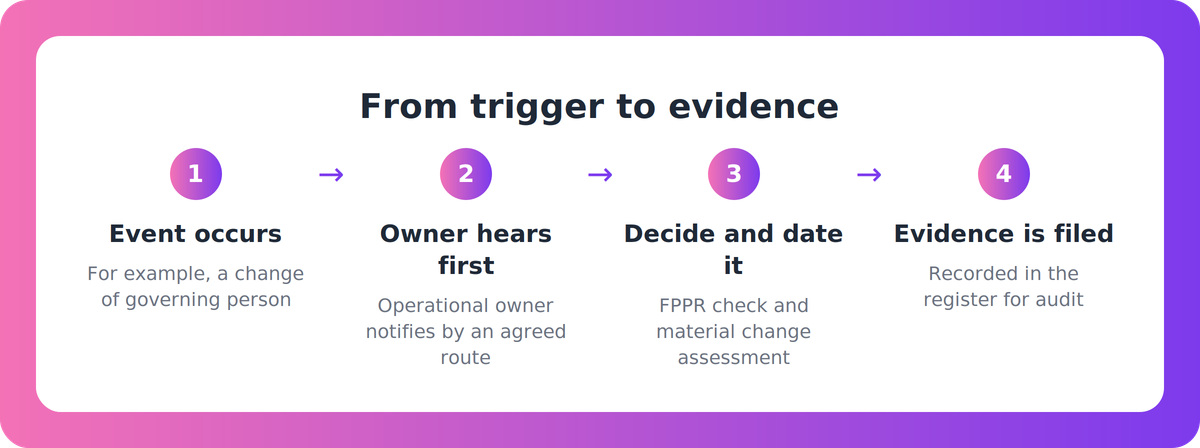
For each trigger, write down four things:
- What event sets it off, in plain words that a non-compliance person would recognise.
- Who hears about it first, and how.
- What you decide, and by when.
- Where the evidence lands.
The fourth point is where the bottleneck problem starts. If every trigger routes through you, you are the single point of failure. Give operational owners the first move and keep your role as reviewer.
Turn the Practice Guides into scheduled reviews
The self-assurance questions in the Practice Guides are free prompts for internal reviews. Assign a guide, or a section of one, to each month or quarter. The reviewer answers the questions with evidence, notes any gap, and logs the action.
This gives you a defensible position when interpretation is challenged. You can show what you asked, what you found and what you changed. It also moves you off reactive mode. A summary of ASQA's March 2026 update, written by an RTO and not published by ASQA, says ASQA often sees reactive systems where improvement happens only when something goes wrong. Treat that as indicative and verify it. The direction of travel is still sensible.
The same summary says the RTO stays fully responsible for third-party arrangements. If you use partners, add a scheduled check of how they are performing against your obligations. Again, verify the point against ASQA's own material before you rely on it.
Watch the transition rule
Providers must show compliance against the Standards in effect when a decision is made. If an audit begun under the 2015 Standards runs past 1 July 2025, ASQA may ask for additional evidence against the revised Standards. If you have any audit or rectification still open from that period, give it its own calendar line and an owner.
Our take
The flexibility in the 2025 framework is a trap for tidy minds. With no mandated self-assessment tool and non-prescriptive guidance, it is tempting to treat the calendar as paperwork that satisfies the declaration. We think the better stance is to treat it as an early-warning system. Dates tell you what is coming. Triggers tell you what has just happened.
A good week under this model is quiet. Owners log events, you review exceptions, and nobody scrambles. A bad week is the one where you learn about a governing person change from the finance team a month late. The calendar exists to prevent that second kind of week.
Key takeaways
- The 2025 Standards sit across Outcome Standards, Compliance Requirements and the Credential Policy, with the Data Provision Requirements Instrument 2020 also applying. Map your calendar to each.
- Combine dated tasks, such as the Annual Declaration on Compliance and data instrument changes, with event triggers, such as a change of governing person.
- FPPR disclosure and material change notification are continuing obligations. Failing them is non-compliance with the 2025 Standards.
- Use the Practice Guides' self-assurance questions as prompts for scheduled internal reviews.
- Every entry needs a named owner and an evidence trail, so you are the reviewer and not the bottleneck.
FAQ
Do I still need a specific self-assessment tool for the 2026 declaration?
No. ASQA no longer requires the specific self-assessment tool used before the 2025 Standards. The declaration confirms that the RTO has monitored its compliance, so you need a monitoring approach you can show and defend.
What belongs in a compliance calendar beyond the annual declaration?
Data instrument checks, scheduled reviews based on the Practice Guides' self-assurance questions, third-party monitoring and event triggers such as a change of governing person. Each should have an owner, a frequency or trigger, and an evidence location.
Are the Practice Guides enough to tell me what compliance looks like?
No. They are not prescriptive and must be read alongside the legislation. They give examples of actions, known risks and self-assurance questions. Deciding what demonstrating compliance means for your RTO is your call.
How often should I check for legislative changes?
Often enough that nothing lands unnoticed. ASQA's recent legislative changes page is the reference point, and the data instruments released in 2026 show the pace. Set a recurring review with a named reader and record what you found.
One question worth sitting with: if a governing person changed today, who would know by tomorrow, and where would the evidence be?