Quality vs Throughput Under the Standards for RTOs 2025
8 September 2026 · 7 min read

The Standards for RTOs 2025 quietly closed a loophole RTO Managers have leaned on for years: the idea that you could run hard on completions or run hard on compliance, but not both at once. ASQA now treats both as the same outcome. If your numbers move independently of each other, that gap is the finding.
Why this lands on your desk, not your compliance team's
Completion rates are the KPI you answer for internally and to funders. Under the old 2015 Standards, an auditor mostly checked paperwork at a point in time. Under the 2025 Standards, ASQA's outcomes-based design means it's watching what happens to learners after enrolment — whether they finish, whether they're job-ready, whether the assessment that got them there actually held up.
That shift matters because ASQA's enforcement has become fewer audits but sharper ones. Cancellations, suspensions and conditions are up. And the removal of the current industry experience requirement for trainers — a genuine concession to the trainer shortage — doesn't reduce your risk. It moves that risk from the trainer's résumé onto your own supervision and validation processes. You now own the proof that a trainer without current industry currency is still delivering rigorous assessment. That's not a compliance team problem. That's a you problem.
What the 2025 Standards actually changed
The Standards for RTOs 2025 commenced on 1 July 2025, replacing the 2015 Standards, after sector feedback that the old framework's mix of quality expectations and prescriptive compliance rules pushed RTOs to chase paperwork at the expense of good practice that actually delivers for learners and employers, according to ASQA.
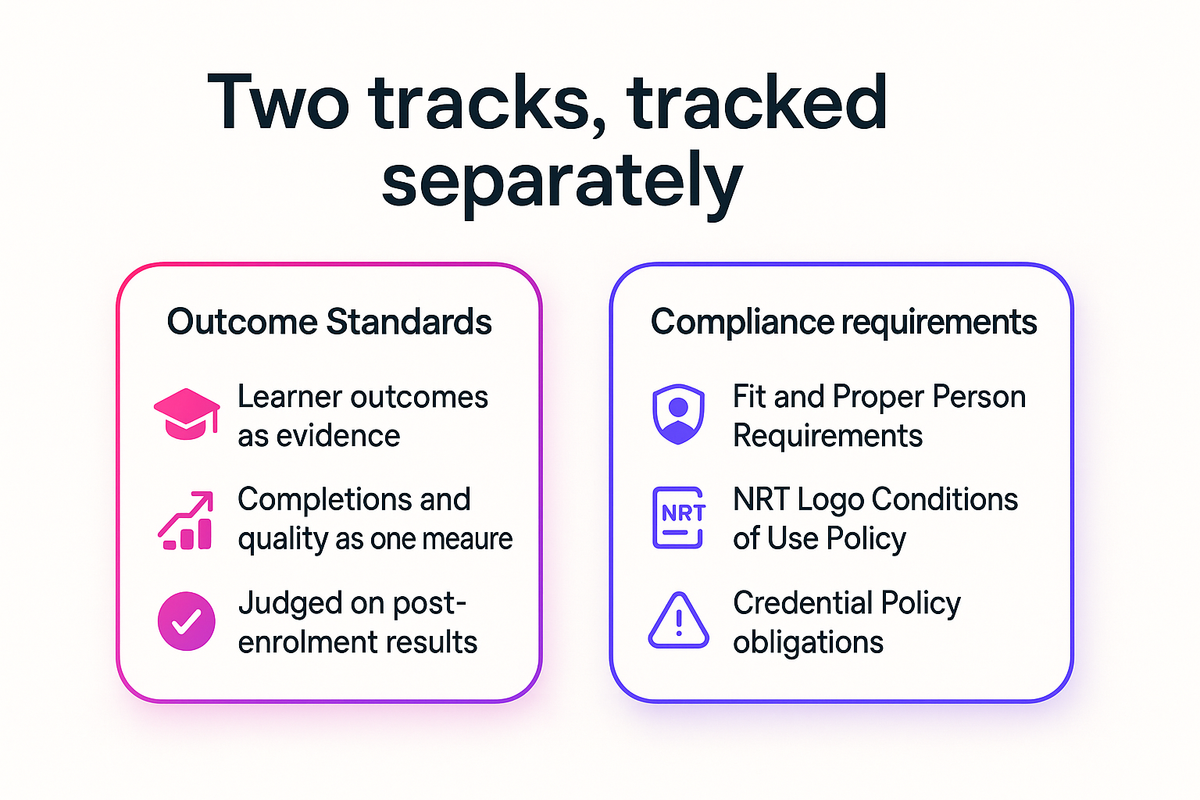
The redesign separates the sector's obligations into distinct tracks: Outcome Standards, which are outcome-focused legislation, and Compliance requirements, which include the Fit and Proper Person Requirements, the NRT Logo Conditions of Use Policy, and a separate Credential Policy. That structural split is the point. ASQA is no longer willing to let a tidy compliance file substitute for evidence that learners are actually being skilled up.
Sharper enforcement, fewer audits, bigger consequences
Don't mistake ASQA's more targeted approach for a lighter touch. Its own regulation reporting shows over 36,000 students have received letters of intent to cancel their qualifications, with more than 33,000 cancellations already executed. Regulators have also cancelled over 7,500 qualifications and statements of attainment issued by providers found critically non-compliant.
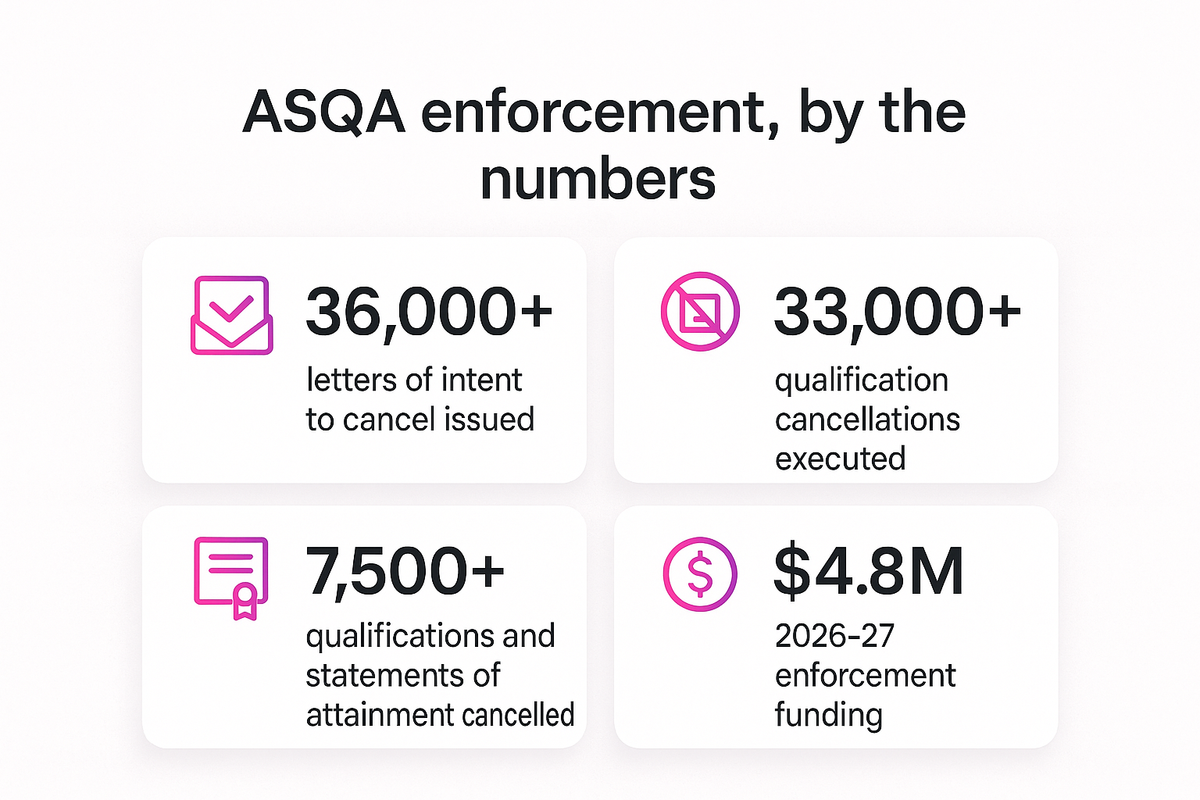
Government is backing this with money, not just rhetoric: $4.7 million was invested in 2025-26 for a surge in fraud and quality enforcement activity, with a further $4.8 million committed for 2026-27 to keep it running. That's not a one-off compliance blitz — it's a sustained enforcement posture.
ASQA is also running targeted quality reviews of workplace assessments in Individual Support, Carpentry, and Early Childhood Education and Care. If any of these sit in your scope, treat this as a direct signal about where the next knock on the door is likely to land — not a generic industry update to skim past.
The trainer flexibility that isn't free
Easing the current industry experience requirement for trainers was a sensible response to a real problem: RTOs genuinely can't always find trainers with recent, hands-on industry currency in every unit of competency they deliver. But the Standards didn't remove the expectation of rigour — they relocated it. Your internal validation processes are now the primary evidence that assessment quality hasn't slipped just because a trainer's currency looks different on paper. If your validation cycle is thin, inconsistent, or something you get to when there's time, that's exactly where a targeted review will find you exposed.
Throughput is under pressure at the worst possible time
Here's the part that makes this a genuine trade-off, not just a compliance headache. NCVER data shows total VET qualification completions fell 4.8% in 2025, to 845,165, driven largely by an 11.3% drop in domestic fee-for-service completions. Apprenticeship completion rates remain historically low at around 55%, even though trade apprenticeship completions actually rose 9% — more than 51,000 — in the year to March 2025.
Commencements are the bigger worry. Apprenticeship commencements fell almost 10% for trades and over 18% for non-trades in the 12 months to September 2025. Jobs and Skills Australia reports 139 occupations have been in ongoing shortage since 2021, with trades vacancy fill rates sitting at only 57%. Your mandate — getting skilled people into work — is under strain from the pipeline end, right as ASQA scrutiny tightens from the compliance end. Neither pressure is going to ease off to make room for the other.
Key takeaways
- The Standards for RTOs 2025 replaced the 2015 Standards on 1 July 2025 and structurally split Outcome Standards from Compliance requirements — ASQA now tracks quality and completions as one story, not two.
- ASQA's enforcement is more surgical: 36,000+ cancellation notices issued, 33,000+ cancellations executed, and 7,500+ qualifications and statements of attainment cancelled from critically non-compliant providers.
- Targeted quality reviews are currently running on workplace assessments in Individual Support, Carpentry, and Early Childhood Education and Care — high-volume qualifications for many RTOs.
- Removing the current industry experience requirement for trainers shifts assessment-rigour risk onto your internal supervision and validation processes, not the trainer's CV.
- Completions fell 4.8% in 2025 and apprenticeship commencements are dropping sharply, even as 139 occupations sit in ongoing national shortage — throughput and compliance failures now compound each other.
Our take
The old defence — "our numbers are strong, don't worry about the paperwork" or its inverse, "our file is spotless, don't worry about completions" — no longer works under either half of the 2025 Standards. ASQA built this framework specifically to make that defence untenable. The RTO Managers who come out ahead here won't be the ones who pick a lane between quality and throughput. They'll be the ones who can show, with evidence, that their completions and their assessment rigour rise together — because under this regime, that's the only story ASQA is willing to accept.
FAQ
Did the Standards for RTOs 2025 fully replace the 2015 Standards? Yes. The Standards for RTOs 2025 commenced on 1 July 2025 and replaced the 2015 Standards for RTOs in full, following sector feedback that the previous framework overemphasised prescriptive compliance at the expense of outcomes, according to ASQA.
What's the practical difference between Outcome Standards and Compliance requirements? Outcome Standards are outcome-focused legislation judging what learners actually achieve. Compliance requirements are separate obligations — including the Fit and Proper Person Requirements and the NRT Logo Conditions of Use Policy — plus a distinct Credential Policy. ASQA now tracks these as related but separate tests, so passing one doesn't cover the other.
Does removing the current industry experience requirement for trainers lower our compliance risk? No — it relocates it. The flexibility addresses the trainer shortage, but the 2025 Standards expect RTOs to prove assessment rigour through their own supervision and validation processes, making internal quality assurance more important, not less.
Which qualifications should we watch most closely right now? ASQA is currently running targeted quality reviews of workplace assessments in Individual Support, Carpentry, and Early Childhood Education and Care. If you deliver any of these at scale, expect closer scrutiny of assessment evidence in the near term.
Worth sitting with this week: if ASQA pulled your completion data and your last validation cycle side by side, would they tell the same story about the quality of what you're delivering?