Standards for RTOs 2025 Software: A Buyer's Guide
21 July 2026 · 8 min read

If you're an RTO trying to work out what software actually helps you meet the Standards for RTOs 2025, the short answer is: no single tool does the whole job. You need software that maps assessment coverage to training package requirements, supports the Standard 1.3 obligation to review assessment tools before use, and produces audit-ready evidence — usually a combination of a student management system, an assessment platform, and increasingly an AI-assisted compliance-content tool, working alongside your own validation processes, not instead of them.
What counts as "Standards for RTOs 2025 software"?
The Standards for RTOs 2025 commenced 1 July 2025, replacing the 2015 Standards. They comprise three enforceable components — the Outcome Standards, the Compliance Requirements, and the Credential Policy — all binding through legislative instruments, with the Credential Policy tied to entries on the National Training Register, per ASQA and the Department of Employment and Workplace Relations.
ASQA has published 19 Practice Guides to help providers interpret the requirements. They're not prescriptive checklists — they include self-assurance questions and terms with specific legal meaning, which is itself a signal about the kind of software that helps: tools that surface evidence and reasoning, not just store documents.
No vendor honestly markets a single product as "the Standards for RTOs 2025 software." What buyers usually mean by the term is a stack: student management, assessment and compliance-content tools that together let an RTO demonstrate outcomes rather than just archive paperwork.
Why Standard 1.3 changes what you should be buying
The 2025 Standards shift emphasis from tick-box documentation toward demonstrated outcomes and evidence of practice. The clearest example is Standard 1.3, which introduces an obligation to review assessment tools before use — replacing the rigid, calendar-based validation cycles many RTOs built their processes around with a risk-based approach.
That's a meaningful change for software selection. A platform that only logs when a validation meeting happened, after the fact, no longer covers the requirement on its own. Buyers should be asking whether a tool actively supports reviewing and mapping an assessment tool before it's used with a learner — not just recording that a review eventually took place.
The stakes are real. Industry data cited by eSkilled puts non-compliance findings at roughly 78% of RTO performance assessments in 2024–25, often tied to gaps in trainer competency records, validation processes and record-keeping — exactly the areas software is supposed to help with.
The RTO software categories, and what each actually covers
Industry buyer's guides, including those from Cloud Assess, generally group the market into:
- Learning management systems (LMS) — content delivery, learner engagement, and progress tracking.
- Student management systems (SMS) — enrolments, AVETMISS reporting, USI validation, certificate issuance.
- Dedicated assessment platforms — building, delivering and marking assessment tools, sometimes with mapping features.
- CRM and all-in-one RTO management systems — combining SMS and CRM functions, sometimes bundling basic LMS.
- AI/GenAI compliance-and-content tools — a newer category generating and mapping assessment and training content against training package requirements, with compliance documentation as an output.
None of these categories is a full compliance solution on its own. An LMS won't validate your assessment tools. An SMS won't map unit-of-competency coverage. Most RTOs run at least two of these types together, and increasingly a third for compliance-content generation.
What to weigh before you buy: an evaluation checklist
Whichever category — or combination — you're looking at, the same questions apply:
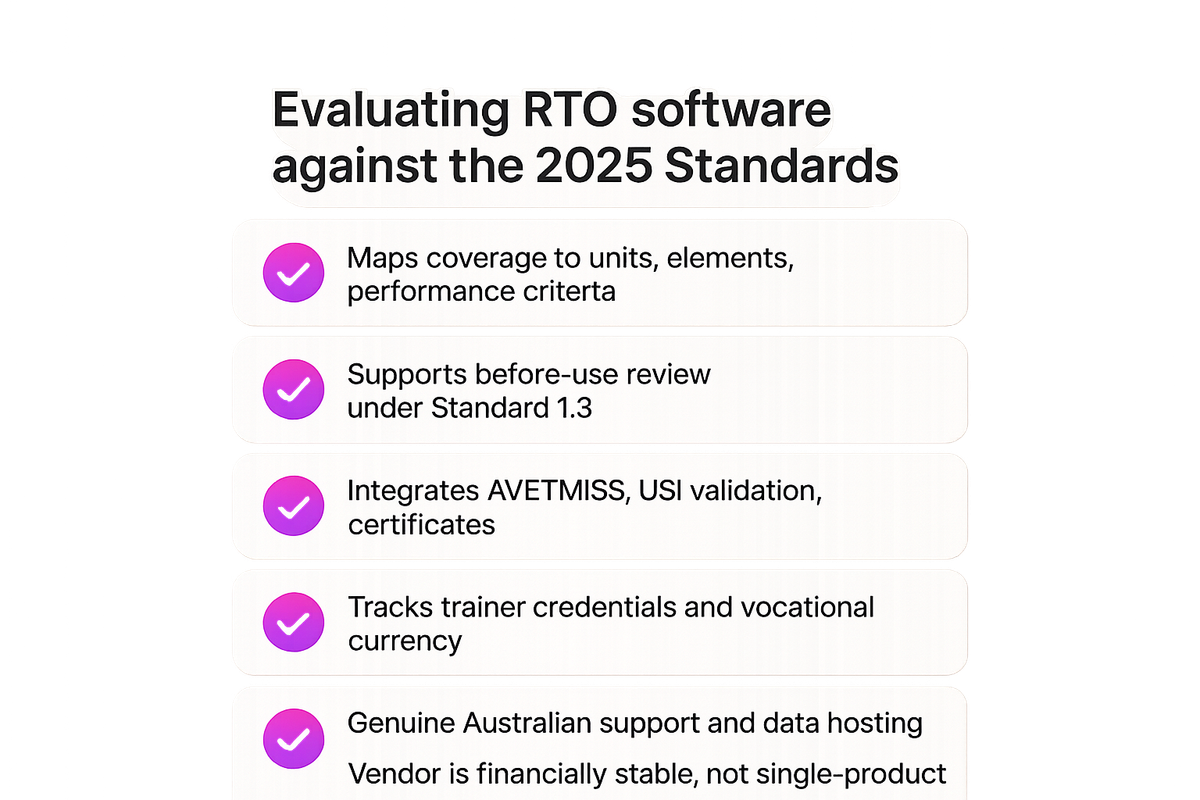
- Does it map content or assessment coverage to specific units, elements and performance criteria, in a form an ASQA auditor could actually review?
- Does it support reviewing and validating assessment tools *before* use, in line with Standard 1.3, not only after the fact?
- Does it integrate AVETMISS reporting, USI validation and certificate management, or will it need to sit alongside a separate SMS?
- Does it track trainer and assessor credentials and vocational currency in a way that aligns with the Credential Policy?
- Is there a genuine Australian presence — local support hours, Australian references, and clarity on where your data is hosted?
- Is the vendor financially stable, and not solely dependent on this one product?
Vendor stability matters more than it might seem. RTO software history includes providers that were acquired, pivoted, or shut down, leaving customers to migrate compliance-critical data under time pressure. Ask directly about ownership, funding, and how long the company has serviced Australian RTOs.
Does software replace validation, or just support it?
No platform — AI-based or otherwise — removes the requirement for a qualified assessor and validator to review and sign off assessment tools before they go anywhere near a learner. That's a human accountability, not a software feature. What good software can do is make that review faster and better evidenced: surfacing gaps in coverage, flagging inconsistent judgements between assessors, and generating the documentation a validator needs to do their job properly.
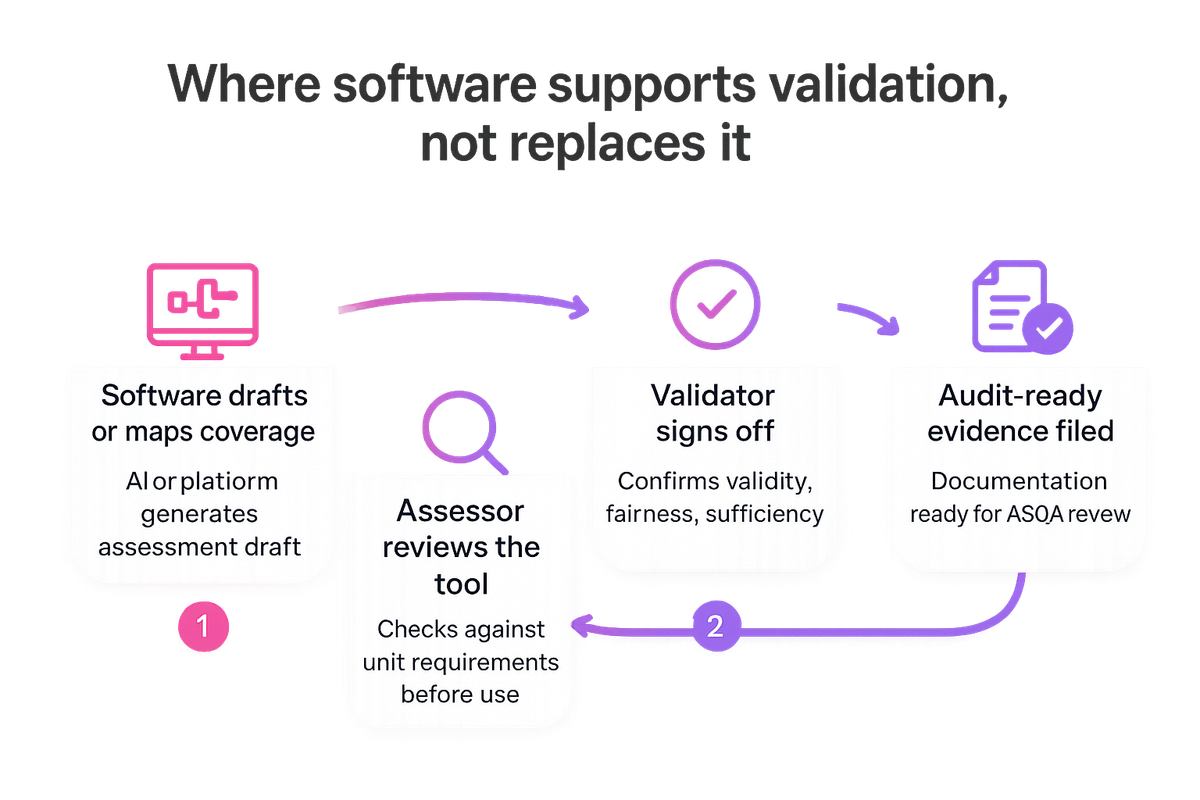
If a vendor implies its AI output can be used directly with learners without a qualified person checking it against the unit of competency and your own quality processes, that's a red flag, not a compliance shortcut.
Where AI-assisted platforms like VETos fit
Supahuman's VETos is one example of the newer AI-assisted compliance-content category. It's built specifically around Australian training packages and ASQA's requirements, modelling a scope — training package, qualifications, units, elements and performance criteria — as one connected structure, so assessments stay mapped and traceable back to coverage. That speaks directly to the kind of before-use review Standard 1.3 asks for.
On its site, VETos describes generating outputs like Training and Assessment Strategies, LLN evidence, assessment maps and validation materials aligned to AQF Levels 1–6, aimed at reducing the manual effort RTOs currently put into building these from scratch. It also describes a moderation engine that compares assessor judgements for consistency and flags discrepancies against ASQA audit expectations — producing moderation-ready reports intended to support, not stand in for, an assessor's or validator's own judgement. An Audit Events feature is described as tracking activity inside the workspace, aimed at the record-keeping gaps ASQA data links to non-compliance findings.
Supahuman states its infrastructure runs on AWS in Australia and that it operates from a Sydney office — relevant if local hosting and support are on your checklist. As with any newer entrant, weigh that against your own due diligence on vendor stability and references, the same way you would for any other RTO software.
Key takeaways
- The Standards for RTOs 2025, commenced 1 July 2025, reward demonstrated outcomes and evidence of practice, not just stored documents — that changes what "compliance software" needs to do.
- Standard 1.3 requires reviewing assessment tools before use; look for software that supports that review directly, not just after-the-fact record-keeping.
- RTO software splits into LMS, SMS, assessment platforms, all-in-one systems and a newer AI/GenAI compliance-content category — most RTOs need more than one.
- Whatever you buy, a qualified assessor and validator still has to review and sign off assessment tools before learners see them; software supports that judgement, it doesn't replace it.
- Check vendor stability, Australian support hours and data hosting alongside features — the compliance-content category is young, and due diligence matters as much as functionality.
Our take
The 2025 Standards reward RTOs that can show their working, not just their paperwork, and software that only produces static documents is going to look thin in front of an auditor asking self-assurance questions. The AI-assisted compliance-content category is genuinely useful for the mapping and drafting grind that's eaten assessor time for years, but it's still early — vendor track records are short, and the accountability for validation hasn't moved, and shouldn't. Buy for the evidence trail you can show an auditor, not the demo.
FAQ
What software actually helps an RTO meet the Standards for RTOs 2025? No single product covers everything. Most RTOs combine a student management system for AVETMISS, USI and certificate functions, an assessment or LMS platform for delivery, and increasingly an AI-assisted compliance-content tool for unit-of-competency mapping and validation support — chosen against what Standard 1.3 and the broader 2025 Standards actually require.
Does compliance software replace the need for assessment validation? No. Under the Standards for RTOs 2025, a qualified assessor and validator must still review and sign off assessment tools before use. Software can surface gaps, flag inconsistencies and generate documentation faster, but the validation decision remains a human, accountable one.
What should RTOs look for given the new Standard 1.3 requirement? Look for tools that support reviewing assessment tools before use, not just recording that a validation meeting happened afterwards. That means coverage mapping to units, elements and performance criteria in a form an auditor can actually check.
Is it worth trusting an AI-based compliance platform? Weigh it like any RTO software purchase: check for a genuine Australian presence, local support hours, clarity on data hosting, and vendor financial stability. Confirm any AI-generated content still routes through a qualified assessor for review before it reaches learners.
Do RTOs still need a separate student management system if they buy an AI compliance tool? Often yes. AI/GenAI compliance-content tools generally focus on assessment mapping, drafting and validation support rather than AVETMISS reporting, USI validation or certificate issuance — functions that typically still sit in a dedicated SMS.