T Levels, V Levels: A Comparison Providers Can't Skip
22 July 2026 · 7 min read

T Levels, V Levels: A Comparison Providers Can't Skip
England's post-16 technical qualifications landscape is being reformed and dismantled at the same time. V Levels, Foundation Certificates and Occupational Certificates are being introduced from September 2027 alongside T Levels, while 153 existing level 3 qualifications — including widely-used BTECs — are losing funding, and the regulatory framework underpinning it all is still being finalised. For FE colleges and independent training providers, that means committing to curriculum and evidence trails against rules that haven't settled.
What's Actually Changing in Post-16 Qualifications?
The post-16 level 3 landscape is moving from a crowded field of applied general and technical qualifications towards three defined pathways: A levels, T Levels, and the new V Levels sitting alongside Foundation and Occupational Certificates. Ofqual's Qualification Reform Hub confirms that tranche 1 of these new qualifications — V Levels, Foundation Certificates and Occupational Certificates — is due to be teachable from September 2027. Awarding organisations can now apply for recognition to deliver them.
But the regulatory scaffolding is still being built. Ofqual's Criteria for Recognition consultation only closed on 2 July 2026, with decisions still pending. Providers and awarding organisations are being asked to plan delivery for a qualification whose regulatory rulebook isn't yet confirmed.
Where T Levels fit into this
T Levels continue as the flagship technical route, largely unaffected in structure by this reform. The change sits alongside them: V Levels are pitched as a broader, less occupationally-specific alternative for students who don't want the T Level's employer-set project and extended industry placement, filling the gap left as applied general qualifications are phased out.
Why Is This a Compliance Problem, Not Just a Curriculum One?
The Department for Education published final subject content for the first V Levels on 16 July 2026 — but it did so despite clear sector disagreement. FE Week reported that only 45% of respondents to the digital systems and data V Level consultation felt the proposed content would fully or mostly enable students to meet the qualification's aims. The DfE proceeded regardless.
That matters for two reasons:
- Curriculum teams now have to build delivery and assessment materials against content that a majority of consultees didn't fully endorse — with limited time to iterate before September 2027 teaching starts.
- Providers were required to submit a Strategic Transition Planning Statement to the DfE by 6 July 2026, effectively committing to transition plans before the regulatory and funding picture was finalised.
On top of that, 153 level 3 qualifications are being defunded. Awarding organisations had until 22 June 2026 to contest inclusion via QFAST, with outcomes due in July 2026 — leaving providers planning the 2026/27 academic year without full certainty over which qualifications will still attract funding.
The Sixth Form Colleges Association's Protect Student Choice campaign has warned this sequencing is backwards: confirming BTEC defunding ahead of V Levels being fully developed risks leaving what it calls a 'large qualifications gap' for students moving through the changeover.
The Equity Data Ofsted Will Want to See
This isn't an abstract administrative problem — the defunding list has a distinct demographic shape. FE Week's analysis of the affected cohorts shows:
- The Digital Level 3 cohort losing funding is 88% male, 59% ethnic minority, and 18% SEND.
- The Education and Early Years Level 2 cohort losing funding is 96% female.
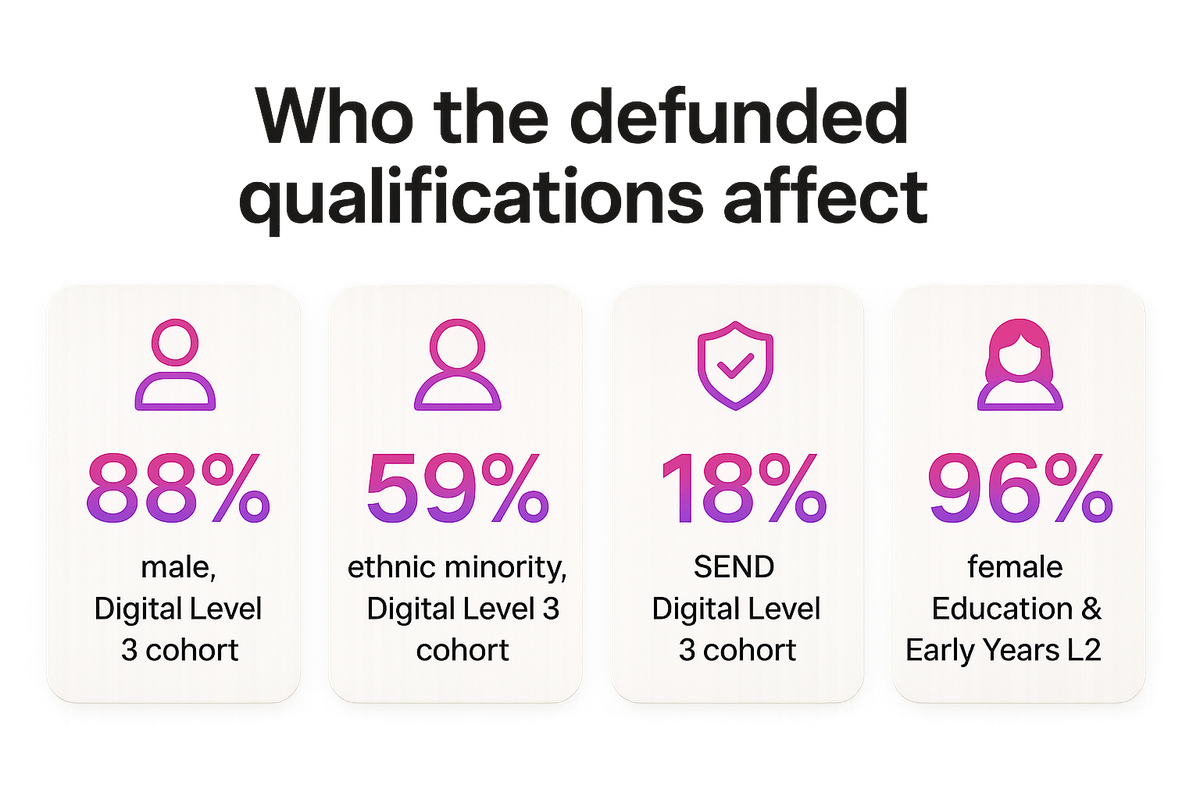
That data lands directly in the path of Ofsted's renewed inspection framework, which sharpened its focus on inclusion, disadvantage and SEND evidence when it took effect for FE and skills from 10 November 2025. Providers now need to be able to show not just that they've replaced a defunded qualification with a new pathway, but that they've thought through who is affected and how continuity of provision is protected for those learners specifically.
A Rolling Reform, Not a One-Off Transition
The temptation is to treat this as a single, contained transition: map the current qualifications to their replacements, update the curriculum, done. That's not what's happening.
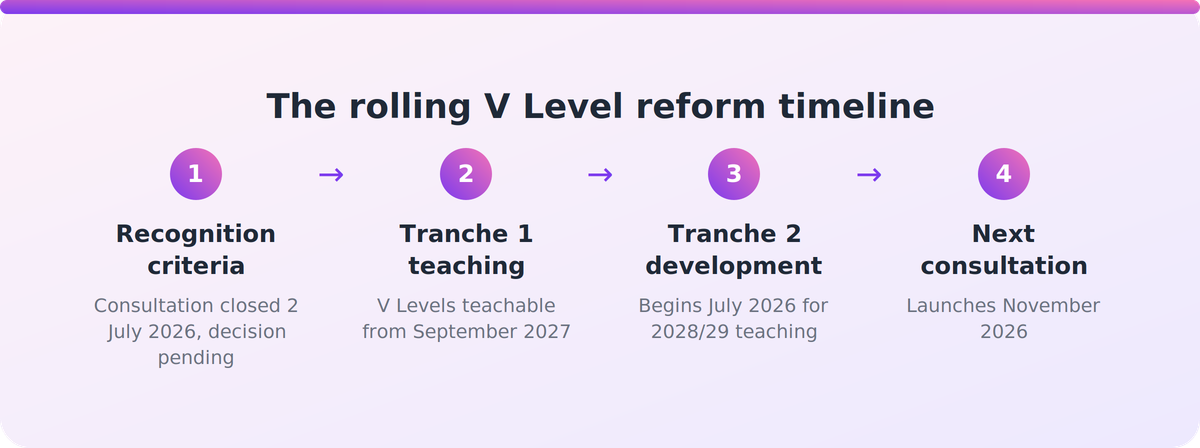
GOV.UK's post-16 pathways implementation plan confirms content development for a further tranche of V Levels, Foundation Certificates and Occupational Certificates — for teaching from 2028/29 — begins in July 2026, with another content consultation launching in November 2026. Providers face repeated re-mapping cycles stacked on top of each other, not a single changeover.
That has direct implications for how curriculum and quality teams operate:
- Evidence trails need to survive multiple qualification versions, not just one migration.
- Assessment coverage checks become a recurring task, not a one-off project ahead of a single go-live date.
- Staff time gets consumed by re-mapping just as inspection expectations around inclusion and SEND evidence are rising.
Key Takeaways
- V Levels, Foundation Certificates and Occupational Certificates are due to be teachable from September 2027, but Ofqual's recognition criteria weren't confirmed as the consultation closed on 2 July 2026.
- The DfE published final V Level subject content on 16 July 2026 despite only 45% consultation support for the digital systems and data content.
- 153 level 3 qualifications, including BTECs, are losing funding, with outcomes of the QFAST contestation process due in July 2026 — after providers had already committed to Strategic Transition Planning Statements on 6 July 2026.
- Defunded cohorts show sharp gender, ethnicity and SEND skews that intersect directly with Ofsted's renewed focus on inclusion and disadvantage evidence.
- A further reform tranche for 2028/29 is already in development, meaning this is a multi-year, recurring compliance cycle rather than a single transition.
Our Take
The sequencing here is the real story: providers are being asked to commit to transition plans and build curriculum before the regulatory and funding detail is settled, and to do it again for the next tranche before the first one has even reached its first cohort. That's not a criticism of any single decision — reform of this scale was never going to be tidy — but it does mean the manual mapping work sitting on a handful of experienced curriculum and quality staff isn't a one-off spike to absorb. It's becoming a permanent feature of the job. Providers who treat each tranche as a separate fire drill will keep losing capacity to re-mapping; those who build a standing process for tracking which standard, qualification or funding rule currently applies — and keeping assessment coverage evidence current against it — will handle the next consultation with far less disruption than this one.
A reader working through their own transition planning might reasonably ask: what does our evidence trail actually look like the day Ofqual confirms recognition criteria, and are we ready to show it?
FAQ
What are V Levels and when do they start? V Levels are new post-16 level 3 qualifications sitting alongside A levels and T Levels, designed to replace many applied general qualifications. Tranche 1 — V Levels, Foundation Certificates and Occupational Certificates — is due to be teachable from September 2027, according to Ofqual's Qualification Reform Hub.
How do V Levels differ from T Levels? T Levels remain the established technical route with an employer-set project and industry placement. V Levels are being introduced as a broader, less occupationally-specific alternative, intended to fill the space left as applied general qualifications like many BTECs lose funding.
Which qualifications are losing funding, and when will providers know for sure? A total of 153 level 3 qualifications are being defunded. Awarding organisations had until 22 June 2026 to contest inclusion via QFAST, with outcomes due in July 2026 — after providers had already had to submit Strategic Transition Planning Statements to the DfE by 6 July 2026.
Why does the defunding list matter for Ofsted inspections? FE Week's analysis shows the defunded cohorts have distinct demographic profiles — for example, the Digital Level 3 cohort is 88% male, 59% ethnic minority and 18% SEND, while the Education and Early Years Level 2 cohort is 96% female. That intersects directly with Ofsted's renewed framework, in effect from 10 November 2025, which sharpened its focus on inclusion, disadvantage and SEND evidence.
Is this a one-off transition or an ongoing process? It's ongoing. GOV.UK's post-16 pathways implementation plan confirms a further tranche of V Levels, Foundation Certificates and Occupational Certificates, for teaching from 2028/29, with content development beginning in July 2026 and another consultation launching in November 2026.