Why Australia's TAE Trainer Shortage Isn't a People Problem
27 July 2026 · 7 min read

Australia's vocational education sector doesn't have a trainer attraction problem so much as a trainer pathway problem. Jobs and Skills Australia has quantified an 11–18% decline in VET teacher numbers over the past decade and projects the sector needs 3,800 more VET teachers within five years — and mounting evidence suggests the Certificate IV Training and Assessment (TAE) itself, now layered with a new Credential Policy under the Standards for RTOs 2025, is discouraging the industry experts the sector most needs.
What the workforce data actually shows
How bad is the VET trainer shortage, really? Jobs and Skills Australia's VET Workforce Study (October 2024) puts hard numbers on what practitioners have felt for years:
- VET teacher numbers have fallen 11–18% over the past decade.
- Australia needs roughly 3,800 additional VET teachers over the next five years to meet demand.
- Vacancy fill rates for VET roles are lagging behind schools and universities, meaning positions sit open longer.
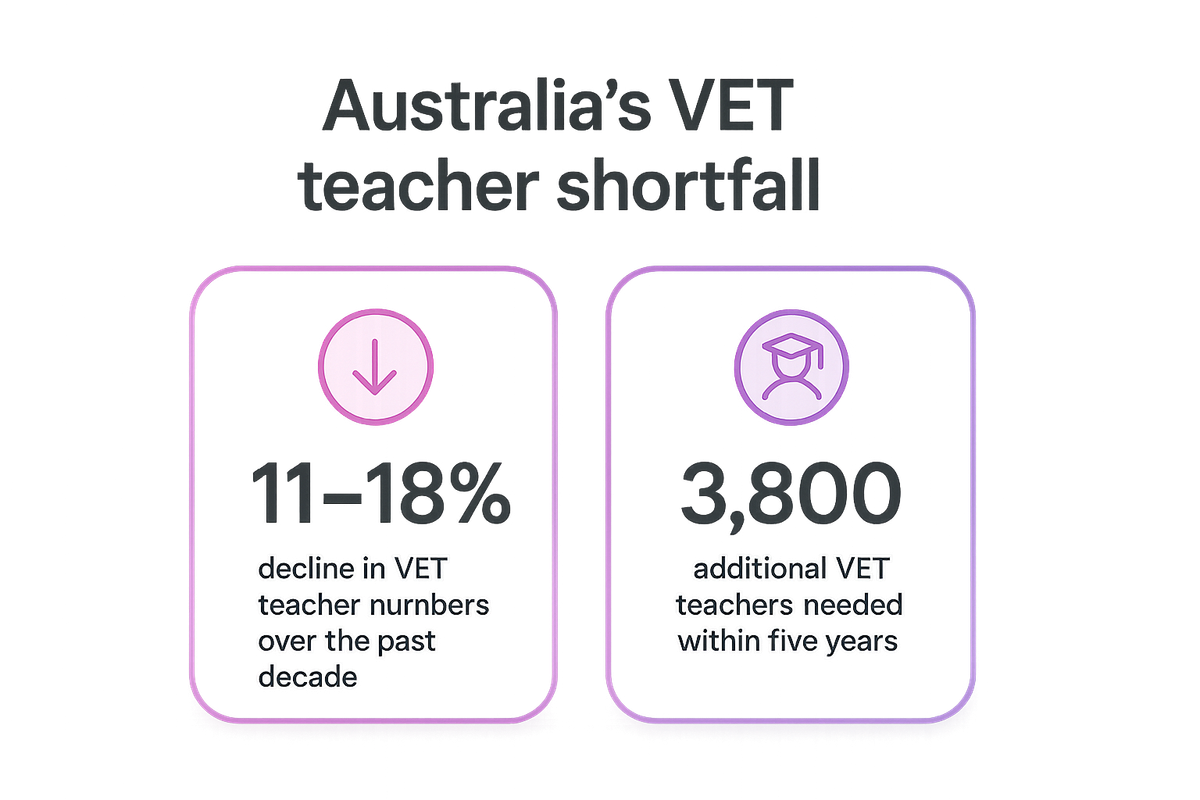
Those figures come from a national study, not a single RTO's anecdote, and Jobs and Skills Australia has kept the issue alive — extending the research with a First Nations VET Workforce Research Paper in March 2026. This is not a problem the sector has quietly resolved. It's an active, evolving policy priority.
Why the Certificate IV TAE is the structural bottleneck
Is the Certificate IV TAE actually stopping industry experts from becoming trainers? Independent research says yes, more than salary or job attractiveness ever did.
Jobs and Skills Councils — including Skills Insight and Industry Skills Australia — have specifically flagged the cost and complexity of the Certificate IV TAE as a deterrent, particularly for professionals in regional, rural and remote areas who would otherwise bring current industry expertise straight into a classroom or workshop. NCVER's research on attracting industry experts into VET practitioner roles goes further, naming the suitability of the TAE qualification pathway itself — not pay, not prestige — as the unresolved structural issue.
This isn't a fresh complaint. The training package was substantially revised once already: Version 5 of TAE was endorsed by Skills Ministers in November 2022, after the Education Industry Reference Committee formally judged the previous version 'not fit for purpose'. That a second wave of shortage indicators has emerged since suggests the redesign addressed symptoms rather than the underlying design problem — how a working tradesperson, nurse, or technician gets from 'expert in their field' to 'competent, currency-evidenced trainer' without the process itself becoming the barrier.
The Credential Policy adds a fresh compliance layer
What changed for RTOs on 1 July 2025? The Standards for RTOs 2025 replaced the old Schedule 1 trainer and assessor qualification rules with a new Credential Policy. Under the previous approach, holding the right qualification was largely the test. Under the Credential Policy, RTOs must demonstrate that trainers maintain ongoing industry currency and effective pedagogical practice — evidence, not just a certificate on file.
For providers, this is a legitimate quality improvement in principle. In practice, it lands at the worst possible moment:
- RTOs are still interpreting exactly what 'ongoing currency evidence' and 'pedagogical practice evidence' need to look like in an ASQA audit.
- The compliance burden of proving trainer currency now sits on top of an already discouraging entry pathway for new trainers.
- Regional and remote providers, who most need industry experts to step into training roles, face the same national requirements with fewer local candidates to draw from.
The result is a squeeze from both ends: fewer people willing to start the journey into training, and more evidence required of the people already there.
What Jobs and Skills Councils are trying instead
What's actually being done about this? Jobs and Skills Councils are exploring simpler entry pathways and co-delivery models that let industry professionals contribute to training while staying employed in their trade or profession — rather than requiring a full career pivot before they can teach a single unit of competency. That signals a quiet but important admission: the traditional model of qualify-first, then train, doesn't scale to current demand, especially outside major metro RTOs.
This is also where the practical shape of trainer development matters more than the policy debate. If the barrier is the cost and complexity of building assessment evidence and pedagogical skill, then anything that makes realistic, role-specific practice faster and cheaper to produce — rather than slower and more expensive — works with the direction Jobs and Skills Councils are already heading, not against it. Scenario-based practice, coached role plays, and simulation-driven skill-building have traditionally required instructional designers and facilitators that regional RTOs and corporate L&D teams alike can't always afford to hire. That cost structure is precisely what's under scrutiny.
Key takeaways
- Jobs and Skills Australia projects Australia needs 3,800 more VET teachers within five years, after an 11–18% decline in VET teacher numbers over the past decade.
- From 1 July 2025, the Standards for RTOs 2025 Credential Policy requires ongoing evidence of trainer currency and pedagogical practice, replacing the old Schedule 1 rules.
- Jobs and Skills Councils and NCVER research both point to the Certificate IV TAE's cost and complexity — not salary or role appeal — as the real deterrent for industry experts, especially regionally.
- TAE Version 5 was endorsed in November 2022 after the prior version was judged 'not fit for purpose', yet shortage indicators have persisted since.
- Jobs and Skills Councils are now exploring simpler entry pathways and co-delivery models rather than waiting for another full training package rewrite.
Our take
Treating this as a recruitment marketing problem — better ads for trainer roles, higher pay bands — misreads the evidence. The data says the pathway itself is the obstacle: a qualification process that's expensive and slow to complete, now paired with a compliance regime that demands continuous proof of currency. Fixing the shortage means making it genuinely fast and low-cost for a working industry expert to build the practical teaching and assessment skill the Credential Policy now expects — not adding more paperwork to an already daunting entry point. RTOs that find ways to develop trainer capability through realistic, role-specific practice rather than lengthy content-heavy induction will be better placed to both meet the Credential Policy's currency requirements and actually attract the industry experts the sector is short of.
Wondering how your own trainer induction and currency evidence would hold up if ASQA asked for proof today, not just a qualification on file? That's the conversation worth having before the next audit cycle, not during it.
FAQ
Is Australia's VET trainer shortage confirmed by government data? Yes. Jobs and Skills Australia's VET Workforce Study (October 2024) found VET teacher numbers fell 11–18% over the past decade and projects a need for 3,800 additional VET teachers over the next five years, with vacancy fill rates lagging schools and universities.
What changed with the Standards for RTOs 2025 and trainer qualifications? From 1 July 2025, the old Schedule 1 trainer and assessor qualification rules were replaced by a Credential Policy. RTOs must now demonstrate trainers hold ongoing industry currency and evidence of effective pedagogical practice, not just a qualification record.
Why is the Certificate IV TAE described as a barrier rather than a solution? Jobs and Skills Councils, including Skills Insight and Industry Skills Australia, and NCVER research on attracting industry experts into VET roles both identify the cost and complexity of the Certificate IV TAE — separate from salary or job appeal — as an active deterrent, particularly in regional, rural and remote areas.
Wasn't the TAE training package already fixed? It was revised once. Version 5 was endorsed by Skills Ministers in November 2022 after the Education Industry Reference Committee found the earlier version 'not fit for purpose'. Shortage indicators have continued since, suggesting the pathway design issue wasn't fully resolved.
What are Jobs and Skills Councils proposing instead of another full rewrite? They're exploring simpler entry pathways and co-delivery models that let industry professionals contribute to training while remaining employed in their industry, rather than requiring a full qualification before they can teach at all.