TAS Document Version Control: Why 'Latest' Is a Compliance Risk
17 September 2026 · 6 min read

Your shared drive says version 4.2 is current. Your enrolment records say cohort 14 started under version 3.8. Neither fact is wrong on its own — but together they're the audit finding that costs you a rectification notice, or a place on ASQA's watch list under the Standards for RTOs 2025.
Why this lands on your desk
You're not being asked to file paperwork. You're being asked to sign your name to it.
The 2026 Annual Declaration on Compliance is the first full reporting cycle run entirely under the 2025 Standards, and it requires the person legally responsible for the RTO to declare compliance — cohort by cohort, document by document. If you're the Compliance Manager, you're almost certainly the one who has to be sure that declaration holds up before anyone signs it.
At the same time, the strengthened National Vocational Education and Training Regulator Act extends fit-and-proper-person obligations to High Managerial Agents, which increasingly captures compliance roles, not just the CEO or board. Scattered evidence and undocumented TAS changes used to be an operational headache. Now they're personal exposure.
And TAS is not a minor line item. Sector commentary, including CAQA Compliance, continues to flag the Training and Assessment Strategy as one of the most frequently cited non-compliances under Standard 1 — despite the Standards not naming TAS explicitly. It's a document every auditor knows to pull, and it's the one most likely to have quietly drifted out of sync with what's actually happening in delivery.
The ground shifted on 1 July 2025
The Standards for RTOs 2025 commenced on 1 July 2025, replacing the 2015 Standards, and restructured RTO obligations into three separate documents rather than one. That restructuring alone creates version-control exposure: policies, TAS templates, and evidence libraries built against the old structure now need to be re-mapped, not just re-dated.
ASQA has been explicit that 2026 audits assess evidence against the 2025 Standards, not legacy policies or historical practice. That means an RTO still running a TAS template built for the 2015 Standards — even one that's technically "current" on the drive — is walking into an audit with the wrong yardstick already applied against it.
The deeper shift is philosophical, not just structural. ASQA's Practice Guides describe a move from RTOs simply holding written policies to demonstrating that systems operate as documented in real delivery contexts. Asserting currency isn't enough anymore. You need to show it.
What the first wave of audits is already showing
Early performance data reported by Skills Education put real numbers behind the transition risk: 89 reviews conducted between July 2025 and January 2026, a 62% compliance rate, and 212 serious matters under investigation. That's not a sector coasting through a standards update. That's a sector getting caught out by exactly the kind of document drift that TAS version control is meant to prevent.
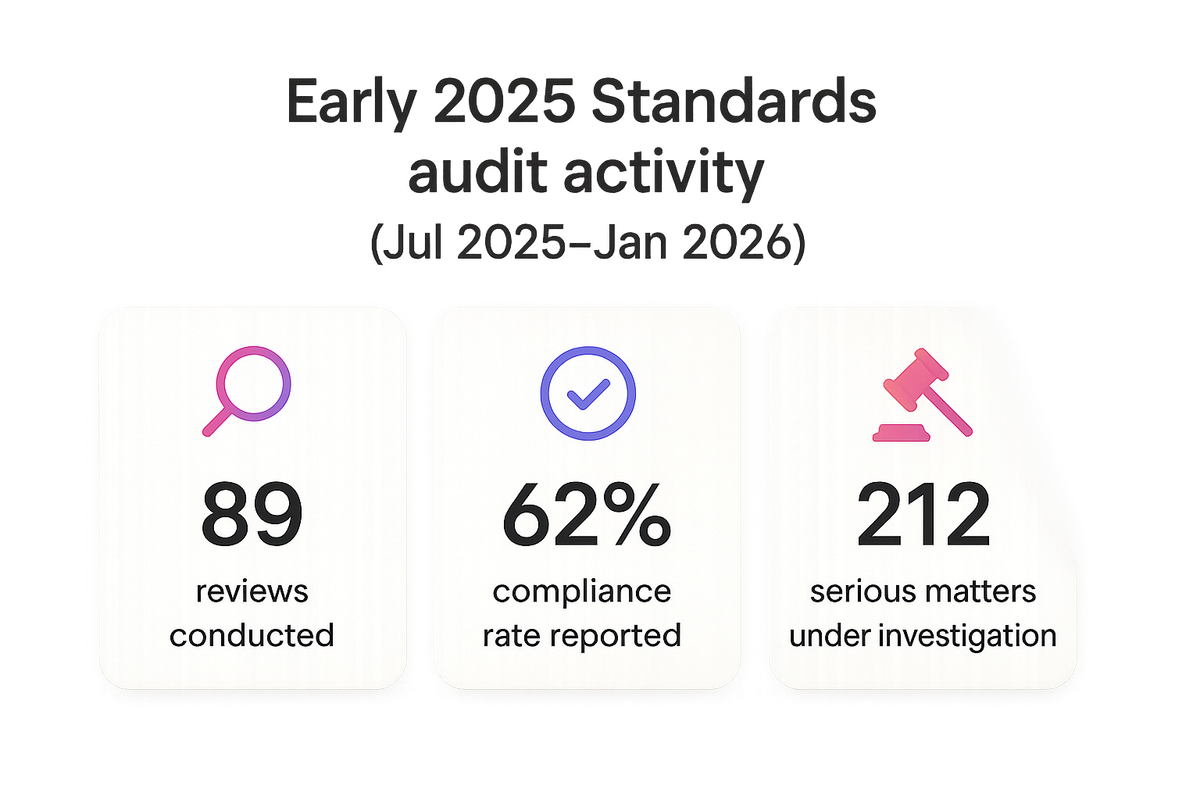
If a majority of reviewed providers are landing on the wrong side of compliance this early in the cycle, the safe assumption is that document currency — TAS included — is a live contributor, not a footnote.
What auditors actually want to see
CAQA Compliance describes what a defensible TAS record looks like in practical terms: version history, documented change rationale, and evidence that staff were briefed on updates. Critically, every active cohort needs to be traceable back to the exact TAS version that governed their commencement — not the version that happens to be open on the shared drive today.
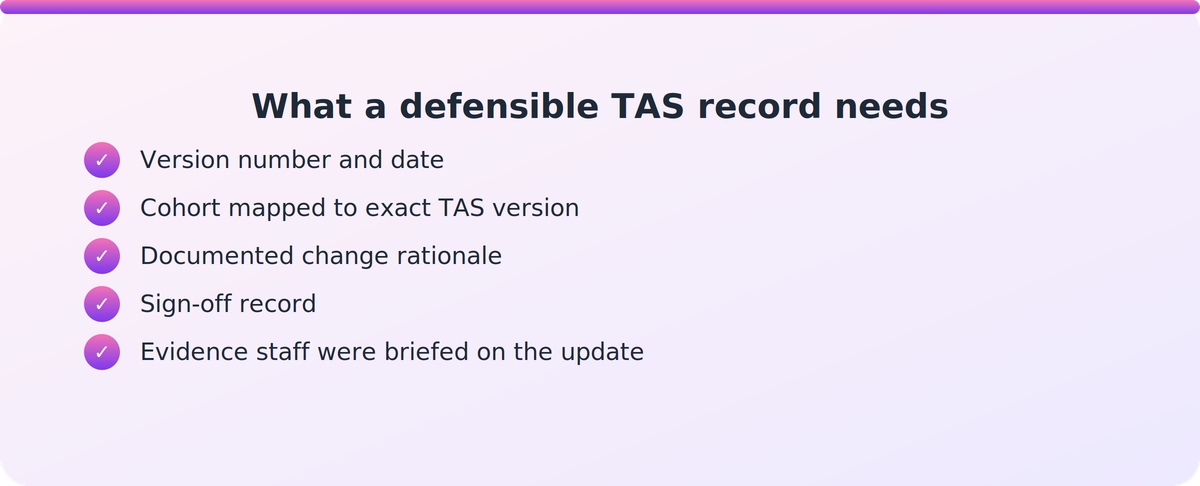
That's a materially different bar than "the TAS is up to date." It's a bar of lineage: this cohort, this version, this date, this reason for change, this sign-off.
The 2026 declaration raises the stakes further
The 2026 Annual Declaration on Compliance ties document currency directly to a signed accountability instrument for the first time under the new framework. Commentary from advisory firms like ANK Corp warns specifically against declaring compliance without a recent internal gap analysis — because the declaration is only as good as the evidence trail behind it.
ASQA's enforcement toolkit backs this up. Under the NVETR Act, ASQA now has infringement notices, enforceable undertakings, and civil penalties available, alongside registration cancellation. Regulatory action has already affected more than 29,000 qualifications from non-compliant providers. Version control isn't a filing preference anymore — it's the evidence that stands between a routine audit and a cancellation notice.
Key takeaways
- The Standards for RTOs 2025, in force since 1 July 2025, are the only benchmark ASQA audits against in 2026 — a TAS built for the old structure is a finding waiting to happen, regardless of its file date.
- Early sector data (89 reviews, 62% compliance rate, 212 serious matters under investigation) suggests document currency, including TAS, is a live driver of non-compliance during this transition.
- Auditors expect traceable lineage: version history, change rationale, staff briefing records, and a clear mapping of which TAS version governed which cohort.
- The 2026 Annual Declaration on Compliance puts personal accountability on record — meaning the Compliance Manager needs proof, not confidence, before that declaration is signed.
- Strengthened NVETR Act powers and fit-and-proper-person obligations extend real consequences to compliance roles, not just the RTO's registered entity.
Our take
Version control on TAS documents has always been treated as filing hygiene — something you clean up before an audit, not something you maintain as a matter of course. The 2025 Standards, combined with the 2026 declaration cycle, make that approach untenable.
The practical fix isn't more paperwork. It's treating every TAS change the way you'd treat a change to a controlled quality document in any regulated industry: dated, reasoned, signed off, and mapped to exactly who it applies to. If you can't answer "which version governed this cohort, and why did it change" in under a minute, that's your actual audit risk — not the content of the TAS itself.
FAQ
What counts as a TAS version change under the Standards for RTOs 2025? Any amendment that alters delivery mode, assessment approach, duration, resourcing, or trainer allocation should be treated as a new version with its own date, rationale, and sign-off — not an edit to the existing file. CAQA Compliance frames this as maintaining version history and change rationale as core evidence, not optional documentation.
Does every TAS review need to be logged, even minor ones? Yes, in effect. Auditors under the 2025 Standards are testing whether your system operates as documented, which means even small updates need a record showing what changed, when, and who approved it — otherwise you can't demonstrate the traceable lineage auditors are now looking for.
How does the 2026 Annual Declaration on Compliance change TAS record-keeping specifically? It ties document currency to a signed, personal accountability instrument for the first time under the new framework. Advisory commentary warns against declaring compliance without a recent internal gap analysis, which puts pressure on Compliance Managers to have TAS version evidence ready before, not during, the declaration process.
What happens if a cohort was trained under an outdated TAS version? That's exactly the scenario ASQA's audit approach is designed to surface — evidence assessed against the 2025 Standards, not the version that was current when the cohort started. Sector data showing a 62% compliance rate and 212 serious matters under investigation in the first reporting window suggests this gap is already being found across the sector.