Why the TEC Reporting Process Is a Funding Risk Now
6 August 2026 · 7 min read

Most Operations leaders still talk about the TEC reporting cycle the way you'd talk about tax time: painful, predictable, survivable. That framing is out of date. The reporting calendar hasn't changed shape, but the rules underneath it have, the funding stakes attached to it have, and the organisations you exchange data with are themselves mid-restructure — which means a manual, person-dependent reporting process isn't just inefficient anymore. It's a compliance and funding exposure sitting in plain sight.
Why this lands on your desk
You own the systems and people that make enrolments, delivery, finance and reporting talk to each other. When the Single Data Return (SDR) window opens, or a Student Services Fees report is due, it's your team that has to pull the data together — usually from three or four systems that were never designed to reconcile with each other.
This isn't a once-a-year project you can staff up for. TEC requires the SDR three times a year through the STEO system from any tertiary education organisation receiving Student Achievement Component or Youth Guarantee funding, or with students on Student Loans or Allowances. That's three separate capacity spikes to plan into your team's calendar, every year, indefinitely.
Stacked on top of that: NZQA requires completed qualifications to be reported within two months of completion (QE1 reporting), and PTEs must send their Student Services Fees report to TEC within 14 days of issuing it to students. Both are hard deadlines. Neither forgives a process that depends on one compliance officer remembering to chase academic staff for completion data, or finance flagging a fee change to enrolments after the fact.
The reporting calendar you're actually running
Written down, the recurring obligations look manageable. Run operationally, across disconnected student management, finance and LMS systems, they compound.
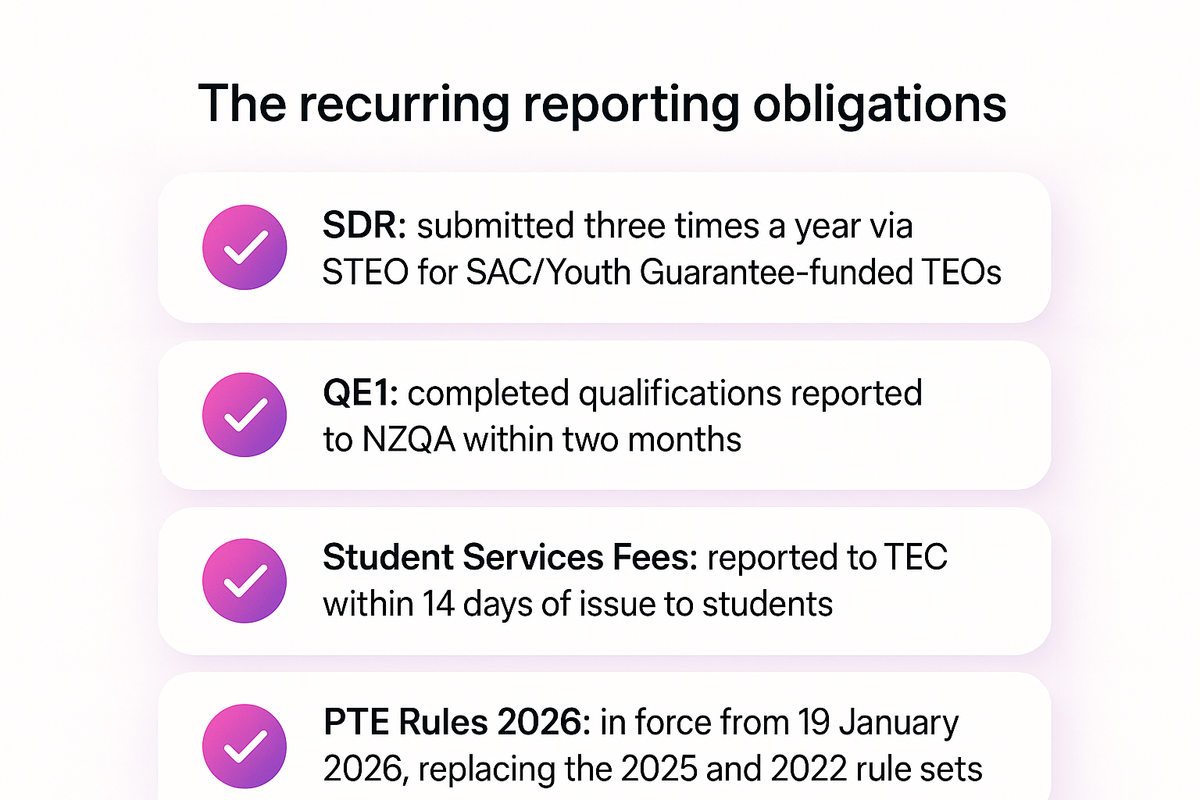
The risk isn't any single deadline. It's that these obligations run concurrently, draw on the same finance and compliance staff, and each depends on data captured correctly weeks or months earlier — enrolment status, funding eligibility, fee changes, completion dates. If that data entry was inconsistent when it happened, the reporting deadline is just when the inconsistency becomes visible.
The rules underneath are moving too
If you built your current reporting workflow around the existing PTE registration rules, you now have a re-validation job on your hands. The Private Training Establishment Rules 2026 come into force on 19 January 2026, replacing both the 2025 PTE Registration Rules and the 2022 Enrolment and Academic Records Rules.
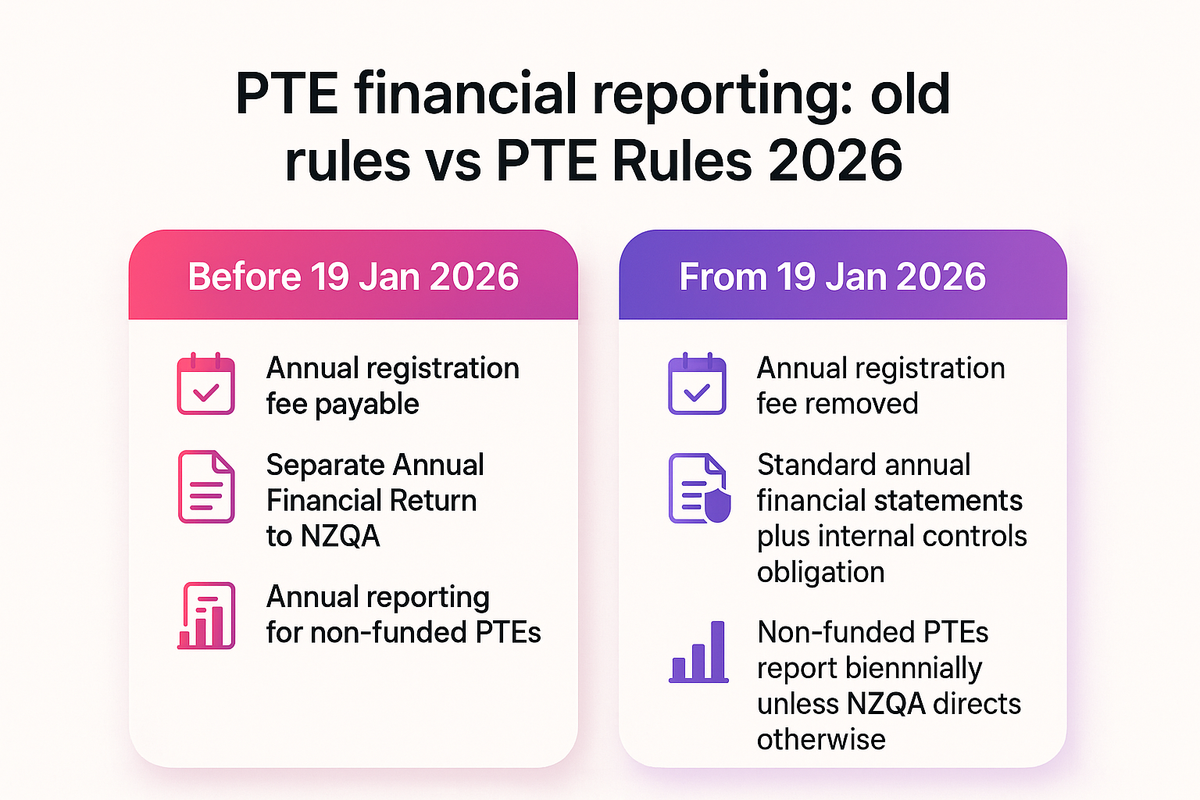
The changes aren't cosmetic. PTEs will no longer submit a separate Annual Financial Return to NZQA — instead, they provide standard annual financial statements, alongside an explicit obligation to maintain adequate internal financial controls. Non-funded PTEs move from annual to biennial reporting unless NZQA directs otherwise. The annual registration fee is removed entirely.
Every process, template and calendar reminder your team built around the old cadence needs checking against the new one before the January deadline — not after.
Before 19 January 2026 vs from 19 January 2026
At the same time, the wider sector context your data flows into is shifting. From 1 January 2026, Te Pūkenga is disestablished and transitions to NZIST, ten regional polytechnics are re-established, and Workforce Development Councils are replaced by Industry Skills Boards. If your organisation exchanges enrolment, cross-crediting or work-based training data with any of these counterpart bodies, you're now reconciling against entities that are themselves being rebuilt. That's a fresh source of process fragility layered on top of your own routine reporting.
When manual reporting becomes a funding problem
Here's the part that should change how you prioritise this. TEC has flagged a third consecutive year in which funding won't cover all domestic enrolment demand, and it has said 2027 funding decisions will weigh evidence of pass rates, financial performance and contribution to the national course network. Reporting accuracy has moved from a compliance checkbox to a direct input into whether your organisation gets funded at the level it needs.
A recent TEC audit made the mechanism concrete: a training organisation was found not to have reported unfunded students enrolled in micro-credentials as part of its SDR submission. That's not a case of falsified data — it's the predictable outcome of a data process with a gap in it, surfaced the moment someone checked. Any provider running reporting through disconnected systems and manual reconciliation has an equivalent gap somewhere. The only question is whether it's been found yet.
What a resilient reporting process actually looks like
Surviving reporting week isn't the bar anymore. The bar is a process that keeps working when a compliance officer leaves, when NZQA changes a rule set, or when a counterpart organisation restructures mid-year. That means:
- Enrolment, funding-eligibility and completion data captured once, correctly, at the point of entry — not corrected retrospectively before a submission deadline.
- Reporting logic documented as a process, not held in one person's head or one person's spreadsheet macros.
- A live checklist against current rule sets (PTE Rules 2026 included) rather than a workflow inherited from whoever built it three years ago.
- Enough slack in team capacity around SDR, QE1 and Student Services Fees deadlines that they're planned work, not emergency work.
None of that requires new systems. It requires treating reporting as infrastructure you're accountable for, not an event your team endures.
Key takeaways
- The SDR runs three times a year via STEO for any TEO with SAC, Youth Guarantee, or Student Loan/Allowance-linked students — plan team capacity around three peaks, not one.
- NZQA's QE1 deadline (two months post-completion) and TEC's 14-day Student Services Fees deadline are both short and unforgiving of manual handoffs between enrolment, finance and compliance.
- The PTE Rules 2026, in force 19 January 2026, change financial reporting cadence and remove the Annual Financial Return — every existing reporting workflow needs re-checking against them.
- TEC's 2027 funding decisions will weigh financial performance and pass rate evidence, so reporting accuracy is now tied to funding outcomes, not just audit outcomes.
- The VET reform reshaping Te Pūkenga, polytechnics and Workforce Development Councils from 1 January 2026 means the organisations on the other end of your data exchanges are also in flux.
Our take
The sector conversation about reporting tends to focus on the deadline itself — get the SDR in, get the QE1 filed, breathe out. We think that's the wrong unit of analysis. The deadline is just where a process either holds or doesn't. If your reporting depends on one person's knowledge of where the data lives and how it reconciles, you don't have a reporting problem — you have a resilience problem that reporting deadlines happen to expose three or four times a year. Fixing that isn't about buying anything. It's about deciding, deliberately, that reporting is a designed process worth owning at the operations level, not a task you delegate and hope holds together.
FAQ
How often is the Single Data Return due, and who has to submit it? TEC requires the SDR three times a year through the STEO system, from any tertiary education organisation receiving Student Achievement Component or Youth Guarantee funding, or with students on Student Loans or Allowances.
What happens if we miss the NZQA QE1 completions deadline? NZQA requires completed qualifications to be reported no later than two months after completion. Missing this deadline is one of the most common exposures for providers whose completion data sits in disconnected systems or depends on manual chasing between academic and compliance staff.
Do the PTE Rules 2026 actually change our financial reporting obligations? Yes. From 19 January 2026, PTEs no longer submit a separate Annual Financial Return to NZQA — they provide standard annual financial statements and must maintain adequate internal financial controls. Non-funded PTEs also move to biennial reporting unless NZQA directs otherwise.
How does the VET reform affect our day-to-day reporting relationships? From 1 January 2026, Te Pūkenga is disestablished and transitions to NZIST, ten regional polytechnics are re-established, and Workforce Development Councils are replaced by Industry Skills Boards. Any provider exchanging enrolment, cross-crediting or work-based training data with these bodies is reconciling against organisations that are themselves being restructured, which adds a new layer of process risk on top of routine TEC and NZQA reporting.