Trainer Assessor Currency Requirements: The Quiet Clock
11 October 2026 · 6 min read
Trainer and assessor currency has no renewal date under the Standards for RTOs 2025. It's an ongoing, per-unit obligation, so evidence that satisfied an auditor at hire can quietly go stale. ASQA is now testing whether RTOs actively and continuously verify currency, not just whether a file exists.
Why does currency have no expiry date?
Because it was never meant to be a one-off check. The 2025 Standards require training to be delivered by people with current industry skills and knowledge relevant to the training product. Practitioner guides commonly cite this as Standard 3.3, though numbering varies between sources (3.1, 3.2 and 3.3 all appear), so check any quote against ASQA's Standards text and the Trainer and Assessor Competencies Practice Guide.
The obligation attaches to each trainer and each unit of competency they deliver. A trainer who is current in one unit isn't automatically current in the next.
That creates the gap. A file can look fine on the day someone is hired. Twelve months later, nobody has asked whether it still does.
What is ASQA focusing on right now?
Trainer and assessor suitability. Specialised VET Services reports that ASQA's September 2026 Top 5 areas of concern lists unsuitable or unqualified trainers and assessors first. The same source reportedly had it fourth in the March and May 2026 slide. Coastwide Training frames it as a workforce-management failure, including trainers delivering units they aren't vocationally competent in.
Both are secondary sources, and we haven't verified the ranking against an ASQA primary document. Treat the direction of travel as the useful signal.
The wider context supports it. According to eSkills Australia, ASQA's 2026–27 priorities include the quality and fitness-for-purpose of training and the integrity of qualifications and competency outcomes. The Sector (5 October 2026) also points to ASQA following up on timeliness, citing a May 2026 Statement of Regulatory Expectations on material change notifications.
What does thin currency evidence look like?
ASQA has been specific. At the sector workshop in Brisbane on 11 March 2026, as noted by Skills Education, ASQA cited two examples:
- A WhatsApp screenshot about helping organise soup for an event, offered as evidence of commercial cookery currency.
- The same trainer scheduled to multiple classes at the same time, in some cases in several states at once.
The first is weak evidence. The second is a timetable that doesn't survive a basic look. eSkills Australia lists trainer or assessor activity that appears operationally implausible as a warning sign worth catching in internal review.
It also shows that auditors can test currency from the timetable, not only from the trainer file.
What does good currency evidence look like?
There's no prescribed format. VET Resources and axcelerate both stress the same point: currency is demonstrated, not claimed. "20 years' experience" isn't currency. A resume or a certificate in a folder isn't enough either.
The question in ASQA's practice guide is whether you can show how your industry engagement practices are used to determine currency and identify gaps. In practice, that means evidence you can lay out clearly per trainer and per unit.
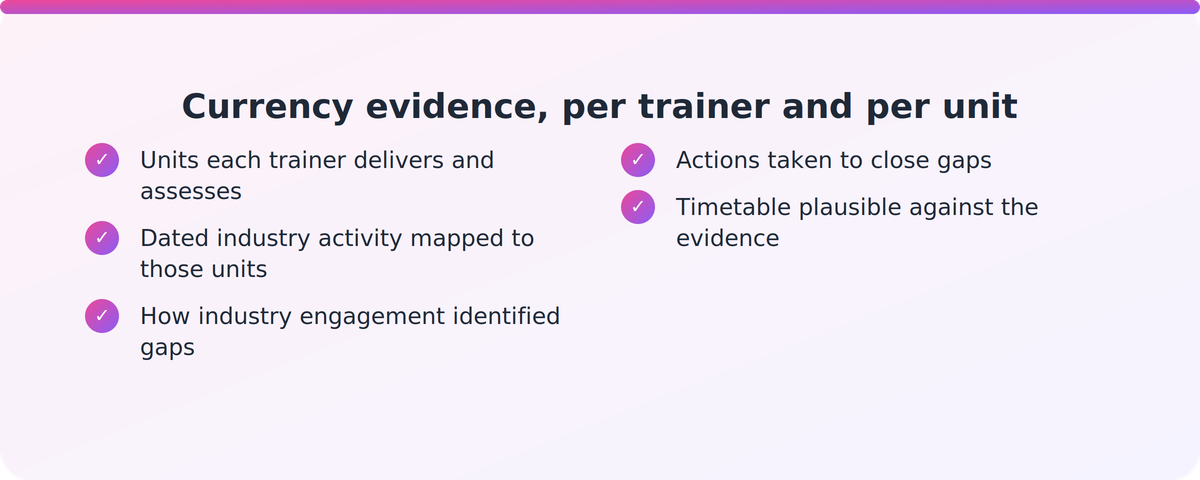
A practical evidence checklist
- Which units each trainer or assessor delivers and assesses
- Dated, relevant industry activity mapped to those units
- How your industry engagement practices identified any gaps
- What was done to close those gaps, and when
- A timetable that is plausible against all of the above
None of this needs to be elaborate. It needs to be current, specific and findable.
Does currency apply to industry experts too?
Yes. The 2025 Standards FAQs v3.0 (1 October 2025) say currency applies even to a fully qualified trainer who is directing an industry expert. Experts engaged to support trainers also need current industry competencies.
This catches RTOs that treat guest experts as an informal extra. If they contribute to delivery, they belong in the same verification process.
Where does AI change the picture?
It raises the stakes on record accuracy. ASQA has said AI cannot make assessment decisions or complete validation where qualified people are required. That is our reading of the research rather than verified ASQA wording, so confirm it against ASQA's own guidance.
If we take it at face value, AI can speed up drafting and mapping, but a qualified, current person still has to own the decision. Knowing exactly who is current for which unit becomes the foundation of any AI-assisted workflow, not a side task.
Key takeaways
- Currency has no renewal date. It's an ongoing, per-unit obligation, so a file adequate at hire can go stale unnoticed.
- Practitioner summaries place unsuitable or unqualified trainers and assessors first in ASQA's September 2026 areas of concern. Verify this against ASQA before quoting it.
- Informal screenshots and implausible timetabling are the examples ASQA has used for weak evidence.
- Currency applies to industry experts supporting delivery, not just to the lead trainer.
- Standard numbering varies across sources. Check quotes against the Standards text and practice guides.
Our take
Most RTOs treat currency as an onboarding task and an annual tidy-up. The 2025 Standards and ASQA's examples point somewhere else: verification as a routine, tied to the timetable. The RTOs that will be comfortable at audit are the ones that can show, on any given day, which trainer is current for which unit and what the evidence is. A trainer-to-unit register that someone owns and reviews on a set cadence is a modest fix against a risk that's now sitting at the top of the regulator's list.
A useful test to run this week: pick one trainer and one unit, and see how long it takes to produce the evidence.
FAQ
Do trainer and assessor currency requirements expire?
There's no renewal date in the Standards for RTOs 2025. Currency is an ongoing obligation, assessed per unit of competency delivered. An RTO needs to be able to show current evidence when asked, not evidence from the point of hire.
Is a resume enough to prove industry currency?
No. VET Resources and axcelerate both note that claims like "20 years' experience" aren't currency. There's no prescribed format, but the RTO must be able to show clear, ongoing evidence of current industry skills and knowledge relevant to each unit.
What kind of currency evidence has ASQA criticised?
At its Brisbane sector workshop on 11 March 2026, ASQA reportedly cited a WhatsApp screenshot about organising soup for an event, offered as commercial cookery currency. It also cited the same trainer scheduled to multiple classes at once, sometimes in several states.
Does currency apply to industry experts who support trainers?
Yes. The 2025 Standards FAQs v3.0 (1 October 2025) state that currency applies even where a fully qualified trainer is directing an industry expert. Experts engaged to support trainers also need current industry competencies.
Which standard covers trainer and assessor currency?
Sources commonly cite Standard 3.3, but some commentary references 3.1 or 3.2. Confirm the exact wording and numbering in ASQA's Standards text and the Trainer and Assessor Competencies Practice Guide before using it in policy or audit documents.