Trainer Burnout: Why Your Best RTO Assessors Quit First
26 July 2026 · 7 min read

Your most compliance-literate assessors are exactly the people the Standards for RTOs 2025 lean on hardest for validation and evidence-based moderation — and exactly the people with the easiest path out, into industry roles or higher education. When admin crowds out coaching time, it isn't your weakest trainers who walk first. It's your best.
Why this lands on your desk
You own trainer capability, currency and workload. That means you carry the risk when the workforce data and the compliance settings pull in opposite directions.
Jobs and Skills Australia's own analysis shows the VET teaching workforce is older than the general workforce, more casualised, and paid less than teachers in other education sectors — with many leaving for better-paid roles in industry or higher education the moment the job stops paying off in either money or job satisfaction. At the same time, you're accountable for validation and moderation quality under the 2025 Standards, which expect risk-based sampling and a documented trail from validation findings through to implementation evidence. That work falls hardest on your most experienced assessors' time, not your newest hires'.
You're also judged on completion and outcome metrics. Sector reporting on administrative load — up to 50–60% of trainer workload according to a 2025 Skills Insight workforce report — is time taken directly from the contact and coaching hours that drive those outcomes. Every experienced assessor who burns out and leaves is now materially harder to replace than in past cycles, because the pipeline behind them is thinner than it used to be.
The Standards for RTOs 2025 raise the validation bar
The Standards for RTOs 2025 commenced 1 July 2025, replacing the 2015 Standards, with a restructured Credential Policy that largely retains prior TAE-based credentialing requirements while repackaging compliance and governance expectations (ASQA, DEWR).
Practitioner commentary on the sector — not ASQA's own published wording, and worth treating as interpretation rather than regulation — describes validation expectations shifting toward a closed-loop model: risk-based sample sizing, documented reasoning for those samples, recorded improvement actions, and monitoring of whether those actions actually changed anything. That's a step up from filing a validation report and moving on. It's also a step up in hours, and those hours land squarely with the assessors who understand the training package well enough to do it properly.
The workforce data behind the shortage
Jobs and Skills Australia reports VET teachers have been in national shortage for the last two years, in every state and territory, with the strongest demand concentrated in fields that are also on the broader skills shortage list — electricians, carpenters, early childhood educators among them. The same analysis projects 3,800 additional VET teachers needed over the next five years, alongside 21% employment growth in the occupation by 2033.
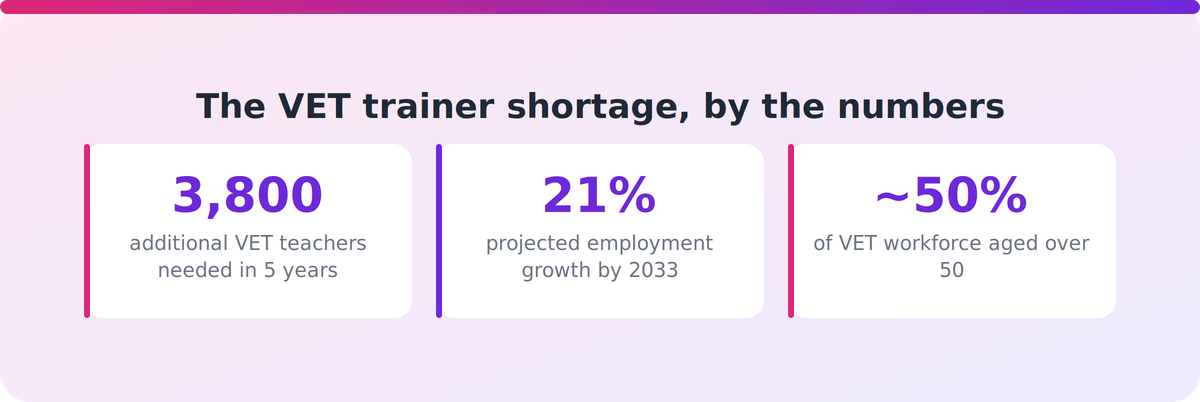
Layer the demographics on top. Almost half the VET workforce is aged over 50, compared with around 30% across all Australian workers. It's a workforce closer to retirement than the sector as a whole, propped up by casual contracts, and competing for talent against industry roles and higher education positions that often pay better.
Where the hours actually go
A 2025 Skills Insight workforce report names administrative burden as one of the biggest threats to RTO viability, with many RTOs reporting 50–60% of workload spent on administration rather than teaching — cited directly as a driver of trainer frustration and attrition.
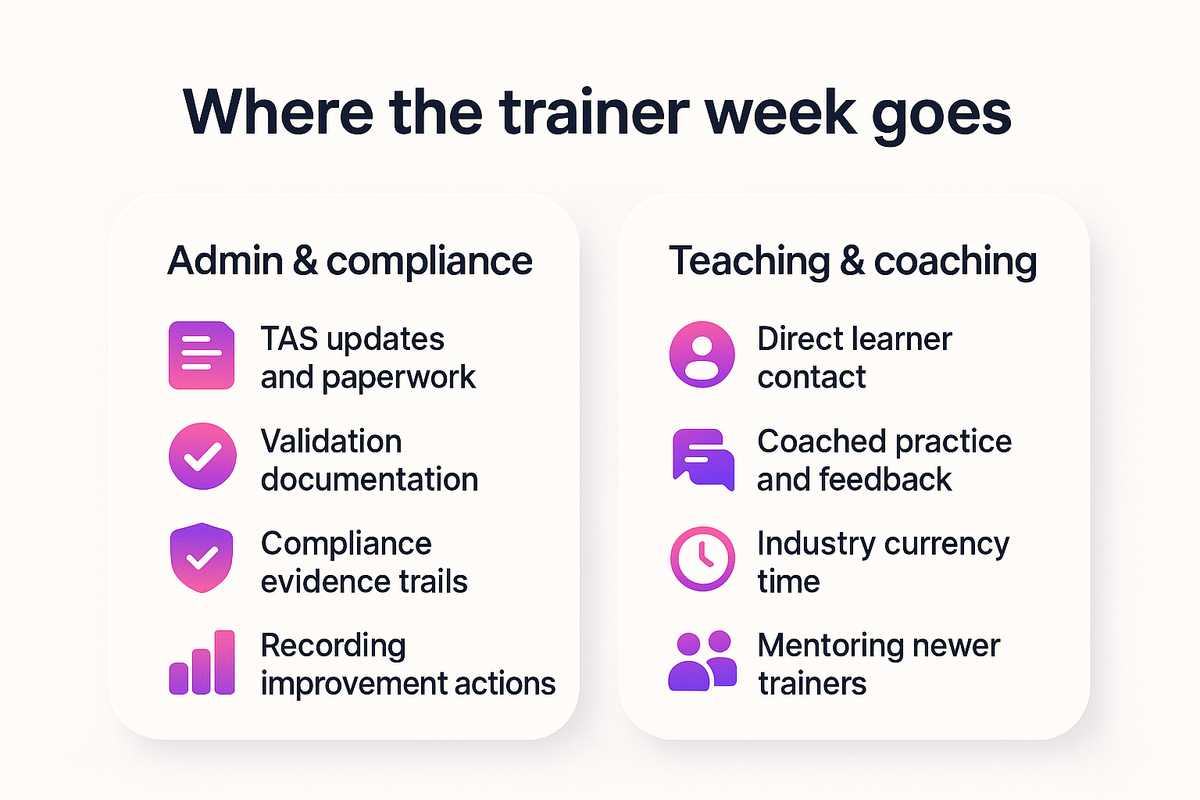
NCVER research into recruiting industry experts into VET found the compliance demands of the Certificate IV TAE and its associated paperwork came up almost universally in interviews. One interviewee described the process as like climbing Mount Everest backwards. That's not a retention problem alone — it's a recruitment problem, discouraging capable industry practitioners from ever becoming assessors in the first place.
The national VET Workforce Blueprint names reducing administrative and compliance burden as an explicit workforce priority — Opportunity 7 in that document. That's a signal worth sitting with: this is recognised at a systemic level as a structural issue, not something you're failing to solve on your own.
What it means for completion and quality
NCVER completion data shows overall qualification completion for 2020 commencers rose slightly to 49.0%, up from 47.5% for 2019 commencers. But apprenticeship and traineeship completions fell to 47.9%, down 2.5 percentage points — a cohort more dependent on sustained trainer contact and workplace-based coaching than most.
Interestingly, learners who don't complete still report relatively high satisfaction and goal achievement — 75.4% and 76.2% respectively, per VET Student Outcomes 2025. That points toward timing of intervention, not training quality alone, as a lever on completion. If your most experienced trainers are stretched thin on admin precisely when a learner needs early, targeted coaching, that's a visibility and capacity problem as much as a design one.
Key takeaways
- The Standards for RTOs 2025 push validation toward a closed-loop model — risk-based sampling, documented reasoning, recorded improvement actions — and that load falls hardest on your most experienced assessors.
- Jobs and Skills Australia projects 3,800 additional VET teachers needed nationally within five years, against a workforce that's older, more casualised, and lower-paid than other education sectors.
- Sector reporting puts administrative load at 50–60% of trainer workload, directly cited as a driver of frustration and attrition — not a wellbeing footnote.
- Apprenticeship and traineeship completions fell 2.5 percentage points even as overall completion ticked up slightly, a reminder that sustained trainer capacity matters most for the cohorts least able to self-manage.
- The VET Workforce Blueprint already names admin reduction as a national priority — this is a structural issue, not a gap in your own management.
Our take
Most burnout conversations in RTOs get framed as a wellbeing initiative — an EAP referral, a wellness afternoon, a survey. That's not wrong, but it misses where the actual risk sits. Under the 2025 Standards, validation and moderation quality is now a direct function of whether your most capable assessors have the time and headspace to do that work properly. If they don't, the paperwork still gets filed — it just gets thinner, later, and less connected to what's actually happening in the training room.
The uncomfortable truth in the workforce data is that your best assessors are the ones industry and higher education want back. They're also the ones you're now asking to carry the heaviest compliance load, because they're the only ones qualified to do it well. If admin keeps eating into coaching and delivery time, the exit isn't random. It's selective, and it selects against you.
FAQ
Is trainer burnout actually a compliance risk under the Standards for RTOs 2025, or is it just a wellbeing issue? Both, but the compliance angle is often underweighted. The 2025 Standards expect a documented, closed-loop approach to validation — risk-based sampling, recorded reasoning, tracked improvement actions — and that work depends on your most experienced, industry-current assessors having the time to do it well. When those assessors are overloaded or leave, validation rigour is what quietly erodes first.
How many additional VET trainers does Australia need, and by when? Jobs and Skills Australia projects 3,800 additional VET teachers needed over the next five years, alongside 21% employment growth in the occupation by 2033. VET teachers have been in national shortage, in every state and territory, for the last two years.
What's actually driving the administrative burden on RTO trainers? A 2025 Skills Insight workforce report found many RTOs report 50–60% of trainer workload goes to administration rather than teaching. NCVER research into recruiting industry experts also found Certificate IV TAE compliance paperwork was raised almost universally as a deterrent, with one interviewee comparing it to climbing Mount Everest backwards.
Does trainer burnout affect completion rates the same way across all learner cohorts? No. NCVER data shows apprenticeship and traineeship completions fell 2.5 percentage points for 2020 commencers even as overall completion rose slightly — these cohorts rely more heavily on sustained trainer contact. Notably, part-completers still report relatively high satisfaction and goal achievement, which points to the timing of trainer support, not just its quality, as a factor worth examining.