Trainer Burnout in RTOs: A Head of Training's Blind Spot
30 July 2026 · 7 min read

Trainer burnout doesn't appear on your compliance risk register, but it's already showing up in your audit findings and your completion data. Assessment practice remains the single largest category of ASQA non-compliance, and a shrinking, overloaded trainer workforce is a big part of why judgements start to drift.
You already report against both of these numbers. What's less obvious is that they're the same problem, seen from two different reporting lines.
Why this hits your desk
Trainer capability, currency and workload sit on your ledger, not HR's. When sector workforce research names the cost and complexity of the Certificate IV in Training and Assessment (TAE), and the rising time cost of maintaining vocational currency amid fast-moving technology, as active reasons people leave or avoid the profession, that's a delivery capacity problem you have to plan around.
Validation and moderation quality is a personal accountability for this role. Assessment practice has been the largest single category of ASQA non-compliance findings — 34% of all findings in 2022–23 — and that risk multiplies when your assessors are stretched thin and making inconsistent calls under time pressure.
The Standards for RTOs 2025, which commenced 1 July 2025, now judge providers on demonstrated outcomes and evidence of practice rather than the volume of policy documents on file. That means your decisions about cutting low-value training and assessment strategy (TAS) paperwork are no longer just a mercy to your team — they're now part of your audit strategy.
And completion rates sit under your scrutiny too. NCVER's data shows a genuinely mixed picture: overall VET qualification completion rates keep improving, but the 4-year completion rate for non-trade apprentices and trainees fell to 42.7% for the 2021 cohort — its third consecutive decline — while 6-year trade completions rose to 58.7%. Support and engagement quality, which depends directly on trainer capacity, is one of the levers NCVER points to for explaining that variation.
The audit trail already exists
No regulator has published a national figure for VET trainer burnout or turnover — the sector is, frankly, under-measured on this. But the evidence trail runs through adjacent data that Heads of Training already track: assessment non-compliance rates, workforce shortage research, and completion figures.
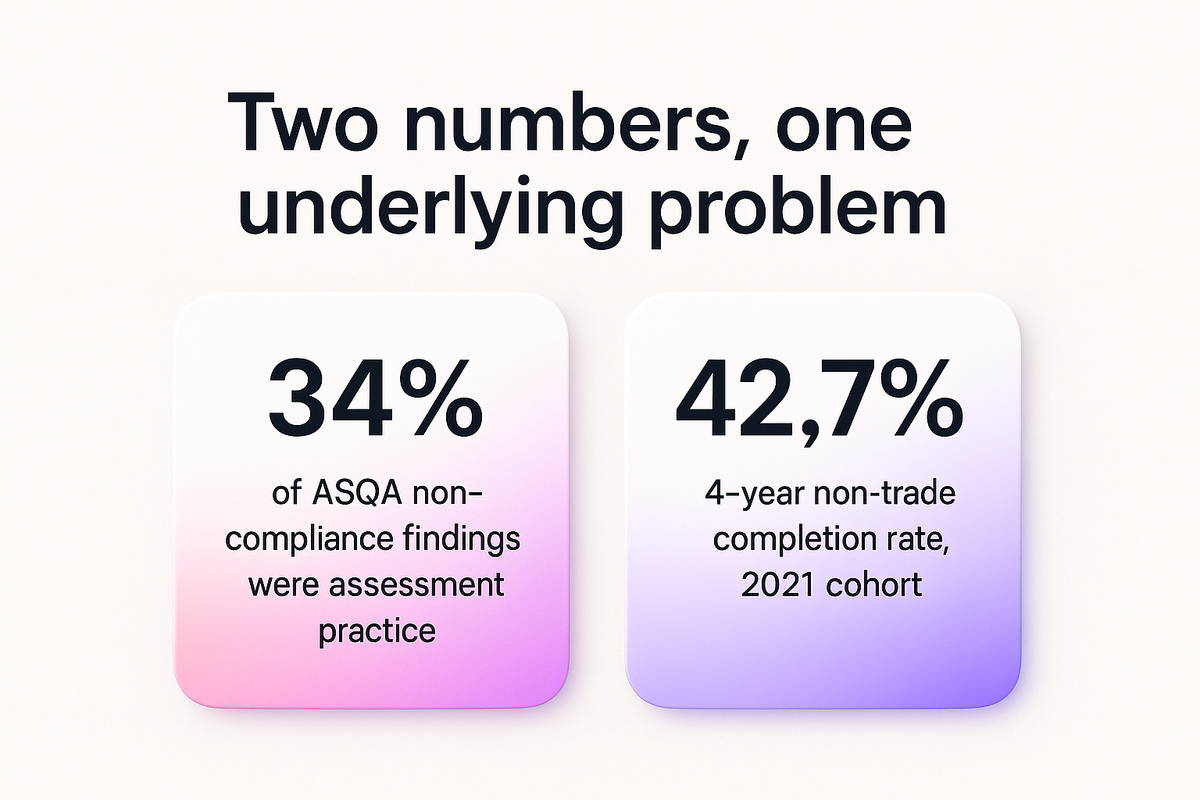
Put those three together and the shape is unmistakable. Overloaded assessors produce inconsistent judgements. Inconsistent judgements show up as assessment non-compliance — still the largest single audit failure category in the sector. And learners who don't get consistent support or timely feedback are the ones most likely to disengage before completion, particularly in non-trade qualifications where the four-year completion trend has now declined three years running.
What the new Standards actually reward
The shift under the Standards for RTOs 2025 is structural, not cosmetic. ASQA's own guidance is explicit that audits now focus on outcomes and evidence of practice, not the existence of a policy document. Validation, in particular, has moved from a periodic document check to a continuous, risk-based view of whether assessment judgements stay fair, consistent and defensible across every trainer and every learner cohort.
That's a much harder standard to hold if your trainer team is overstretched, high-turnover, or relying on casual staff who never get properly inducted into your assessment approach. Consistency across trainers has always mattered for validation; under the new Standards, it's the thing being tested directly.
Regulators clearly understand the workforce pressure sits behind this. Ahead of the full 2025 Standards, Skills Ministers fast-tracked changes allowing qualified secondary teachers to deliver VET training under supervision, and the 2025 Standards removed the requirement for trainers to hold current industry experience. Both changes exist because the trainer pipeline is under real strain — not as a favour to providers, but because the regulator needs enough qualified people in the system to keep assessment quality defensible.
The paperwork trap you can actually fix
Sector workforce research has directly linked administrative burden to trainer attrition — bureaucratic inefficiency frustrating trainers and pulling them away from the industry-relevant work they actually want to do. If your trainers are spending delivery hours reformatting TAS documents, chasing version control across duplicated materials, or rebuilding assessment tools for different cohorts, that's time not spent on the things that actually protect your validation outcomes: consistent marking, timely feedback, and genuine engagement with struggling learners.
The 2025 Standards give you regulatory cover to cut that load. Outcomes-based audit focus means a leaner, well-evidenced TAS is not a compliance risk — it's the point. If your quality system still rewards documentation volume over demonstrated consistency, it's working against both your trainers and your audit position at the same time.
Key takeaways
- Assessment practice remains the largest single category of ASQA non-compliance findings (34% in 2022–23) — trainer workload and consistency is a direct driver, not a side issue.
- The Standards for RTOs 2025 shifted audit focus to demonstrated outcomes and evidence of practice, giving Heads of Training regulatory room to cut low-value TAS paperwork.
- Validation now tests whether assessment judgements stay consistent and defensible across every trainer and cohort — a much harder bar with an overstretched or high-turnover team.
- Regulators have already acted on trainer shortage pressure, fast-tracking supervised secondary-teacher delivery and removing the current industry experience requirement in the 2025 Standards.
- NCVER data shows the 4-year non-trade apprentice and trainee completion rate fell to 42.7% for the 2021 cohort, its third consecutive decline — a trend tied to support and engagement quality.
Our take
Treating trainer sustainability as a wellbeing initiative undersells what's actually at stake. The evidence — thin as it is on burnout specifically — points to a compliance and completions problem hiding behind a workforce problem. If you're managing trainer capacity purely as a rostering exercise, you're missing the audit and outcomes case for doing it properly. The RTOs that come out ahead under the Standards for RTOs 2025 won't be the ones with the thickest policy folders. They'll be the ones whose trainers had enough time and consistency to make defensible judgements, cohort after cohort.
FAQ
Is trainer burnout actually measured by ASQA or NCVER? No. There's no published national figure specific to VET trainer burnout or turnover. The evidence exists indirectly through ASQA's non-compliance data, workforce shortage research from bodies like Skills Insight and Industry Skills Australia, and NCVER completion statistics — together they point to the same underlying pressure.
Does the Standards for RTOs 2025 actually reduce paperwork requirements? The Standards shift audit emphasis from the existence of policies and documents to demonstrated outcomes and evidence of practice. That doesn't remove all documentation obligations, but it changes what counts as strong evidence at audit — favouring quality and consistency of practice over volume of paperwork.
Why did ASQA remove the current industry experience requirement for trainers? The Department of Employment and Workplace Relations introduced this as an early relief measure ahead of the full 2025 Standards, alongside fast-tracking supervised delivery by qualified secondary teachers, specifically to ease pressure on a shrinking trainer pipeline.
What's the single biggest thing driving assessment non-compliance findings? Assessment practice was the largest category of ASQA non-compliance findings in 2022–23, accounting for 34% of all findings. Inconsistent judgements across trainers — often linked to workload and lack of standardisation — is a key contributor.
Worth sitting with this week: when you next look at your trainer roster and your TAS documentation side by side, which one is actually protecting your validation outcomes — and which one is just protecting a filing habit from an older version of the Standards?