Trainer Capacity Planning for NZ PTE Operations Leaders
22 September 2026 · 7 min read
Trainer capacity used to be a scheduling headache: who's free, who's qualified, who covers the Tuesday cohort. In 2026 it's a financial exposure. With TEC funding close to 99% of forecast tertiary volume and workplace training funding cut by roughly 8%, every idle trainer hour is a line item you now have to explain, not just fill.
Why this hits your desk
For years, trainer capacity sat mostly with the training or academic team: build the timetable, plug the gaps, done. That model assumed funded volume was elastic enough to absorb a slow term or an under-filled class. It isn't anymore.
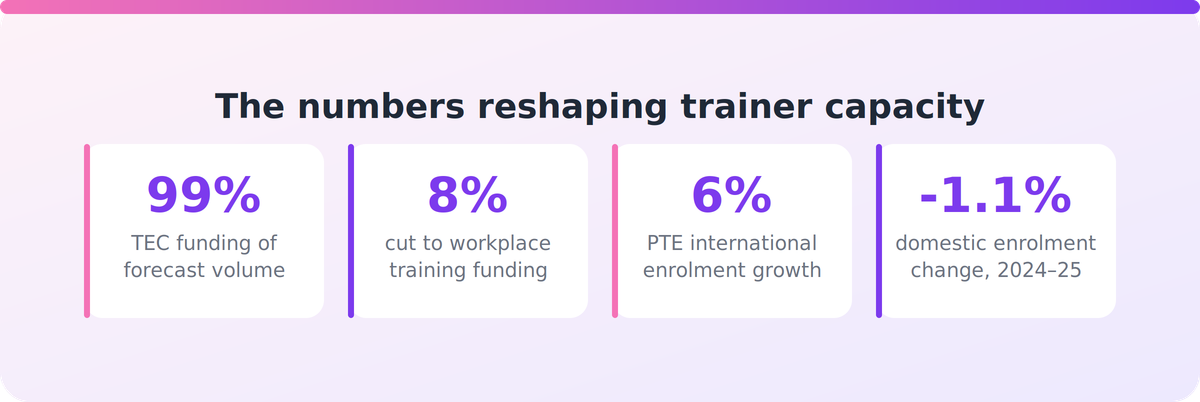
TEC is funding close to 99% of forecast tertiary volume across 2025 and 2026, alongside a roughly 3% ongoing increase in Youth Guarantee places. The gap between what you timetable and what you actually deliver against funded EFTS has almost no room to hide. If trainers are booked but cohorts don't fill, that shortfall lands as a funding and reporting problem on your desk, not just a rostering one.
At the same time, TEC's June 2025 decision to remove extra funding for Māori and Pasifika vocational enrolments and cut workplace training funding by around 8% of its budget squeezes the margin you had for underused capacity. Cost-per-EFTS used to be a finance-team abstraction. It's now something you defend line by line, because the money that used to absorb inefficiency is gone.
Meanwhile, international enrolments are growing — up 8% nationally between January and April 2026, with PTEs specifically up 6% — while domestic enrolments fell 1.1%, from 399,685 in 2024 to 395,095 in 2025. That's a genuine test of whether your delivery model can flex between a softening domestic base and a growing international one without simply hiring your way through it.
The compliance calendar just moved under you
The Private Training Establishment Registration Rules 2026 came into force on 19 January 2026, replacing both the 2025 registration rules and the 2022 PTE Enrolment and Academic Records Rules. If your resourcing and reporting processes were built against the old rules, they need re-checking, not assumed to still fit.
Layer on the wider system reset: Te Pūkenga is being disestablished, with full disestablishment targeted for March 2027; Workforce Development Councils are being replaced by Industry Skills Boards; and new industry-led PTEs are emerging to take on work-based training delivery. Each shift changes who you partner with, compete with, or deliver alongside — which changes the assumptions your capacity plan was built on, whether or not anyone has revisited it.
The reporting plumbing itself is mid-transition too. The Single Data Return and Data Exchange Platform are shifting format, including a move to .csv files in 2025, adding short-term friction to a cycle that ultimately depends on the same trainer and delivery data you use to plan capacity. Get that data wrong, and both the funding return and the capacity model are wrong together.
Financial viability reporting raises the stakes
TEC's financial viability reporting is graduated by funding size: independent review for PTEs receiving under $5 million in TEC funding, full audit for those receiving $5 million or more. Either way, utilisation and delivery-cost data isn't just an internal management tool anymore — it needs to hold up to an external standard.
If your only record of trainer utilisation lives in a rostering spreadsheet one person maintains, it won't survive contact with an audit or independent review. The data needs to be structured and traceable back to funded delivery — the same trail that supports your Single Data Return.
Providers can lift tuition and training fees by up to 6% in 2026, which offers some room to protect margin on revenue. But a fee increase doesn't buy back inefficient delivery. If cost-per-EFTS is climbing because trainer hours are booked but not aligned to funded delivery, a fee rise just delays the reckoning.
Rebuilding the model, not refreshing it
Three assumptions in most existing capacity plans are worth re-examining:
- That funded volume has slack in it. At close to 99% funding of forecast volume, it mostly doesn't. Track funded EFTS closely, term by term, rather than assuming a buffer will absorb variance.
- That trainer supply maps to the old system. With Te Pūkenga winding down and Industry Skills Boards replacing Workforce Development Councils, who delivers particular work-based training — and under what arrangement — is shifting under you.
- That domestic and international cohorts behave the same way. Domestic enrolments are softening while international enrolments, including within the PTE sector specifically, are growing faster. A single blended utilisation figure hides which side of the business is actually driving trainer demand.
A model built for this environment tracks funded volume by programme, trainer hours actually delivered against that volume, and the compliance trail — Single Data Return, financial viability reporting, PTE registration obligations — together, not separately. When those three live in different systems maintained by different people on different cycles, reconciliation becomes the work that eats your week, and the numbers you present to the board are only as good as your last manual cross-check.
Key takeaways
- TEC funding close to 99% of forecast volume for 2025–2026 means timetabled trainer hours and funded, deliverable capacity need to be modelled together, not tracked separately.
- The roughly 8% cut to workplace training funding, plus removal of extra Māori and Pasifika funding, tightens the margin for under-utilised trainer capacity — cost-per-EFTS is now a live operational metric.
- The Private Training Establishment Registration Rules 2026 (in force from 19 January 2026) replace the 2025 registration rules and the 2022 PTE Enrolment and Academic Records Rules — worth a direct check against current resourcing processes.
- Financial viability reporting is graduated by TEC funding size (independent review under $5 million, full audit at $5 million or more), so utilisation data needs to be structured and defensible.
- Te Pūkenga's disestablishment (targeted for March 2027) and the shift from Workforce Development Councils to Industry Skills Boards mean the delivery landscape your capacity plan assumes is worth revisiting, not taking for granted.
Our take
The instinct in a squeeze is to protect the timetable — keep classes running, keep trainers busy, worry about the numbers at reporting time. That's backwards. In a system funding close to 99% of forecast volume, the numbers are what you protect first; the timetable follows from them.
The providers that come through this reset in reasonable shape will treat trainer capacity as a number they can explain at any point in the term, not one they discover during a Single Data Return submission or a financial viability review. That means the underlying data — funded volume, delivered hours, compliance status — needs to live somewhere it can be checked without a week of reconciliation, freeing your team to spend that time improving delivery instead of proving it happened.
FAQ
How does TEC's near-99% funding-to-volume ratio change trainer capacity planning? It removes the buffer that used to absorb scheduling variance. With TEC funding close to 99% of forecast tertiary volume for 2025 and 2026, actual delivered hours against trainer capacity determine whether funding commitments are met or under-delivered — a gap operations now needs to track closely rather than assume will balance out.
Do the Private Training Establishment Registration Rules 2026 change what we need to report on trainer resourcing? The 2026 rules, in force from 19 January 2026, replace the 2025 registration rules and the 2022 PTE Enrolment and Academic Records Rules. Check your resourcing and reporting processes directly against the new rules rather than assuming continuity from the previous versions.
What triggers a full audit versus an independent review for financial viability reporting? TEC's financial viability reporting for PTEs is graduated by funding size: PTEs receiving under $5 million in TEC funding face independent review, while those receiving $5 million or more require a full audit.
Should we plan trainer capacity differently for domestic versus international cohorts? Yes. Domestic tertiary enrolments fell 1.1% between 2024 and 2025, while international enrolments grew 8% nationally in early 2026, with PTEs specifically up 6%. A single blended utilisation figure can mask which cohort is actually driving demand on trainer capacity.