Trainer Capacity Planning for RTO COOs: Measure Utilisation
4 October 2026 · 6 min read
Most RTOs can give you enrolments, completions and trainer headcount to the decimal. Very few can say what share of a trainer's paid week goes to delivery, assessment, feedback, evidence and admin. That gap is why trainer capacity planning in an RTO still defaults to hiring in step with enrolments, and why it is getting harder to defend.
Why this lands on your desk
You own the link between enrolment volume and trainer headcount. When enrolments rise, someone asks for another trainer, and the request usually lands with you.
The 2025 Standards make that conversation harder. ASQA's Standards FAQs (version 3, December 2025) say providers must show training is structured and paced so students can progress, with enough time for instruction, practice, feedback and assessment. They set no ratio and no utilisation target. So the operational meaning of "enough" sits with you, and you will be asked to explain it.
The Standards ask for pace, not a ratio
That silence is not a loophole. It means each RTO has to define its own capacity logic and be able to defend it to an auditor, a board or a funder.
A defensible answer starts with evidence about how trainer time is spent. "We have one trainer for every X students" is not that evidence. I could not find an official Australian benchmark for trainer utilisation in the research behind this piece, so treat any figure you see quoted without a source with suspicion.
Contact hours are the visible tip
Timetabled sessions are the part of trainer load everyone can see. The regulator's wording points to more. Feedback, practice and assessment all take time that rarely appears on a timetable.
This is our reading of the language, not an ASQA metric. But it matches what most operations leaders already suspect. A trainer with a full timetable may have no spare capacity at all, while another with a lighter one may be carrying heavy marking and evidence work.
If you only measure contact hours, you will misjudge both.
Five questions about where trainer hours go
This is a diagnostic, not a formula. For a typical fortnight, ask:
- How many paid hours go to timetabled delivery?
- How many go to assessment and marking, and how long does feedback take to reach learners?
- How many go to collecting, checking and filing evidence?
- How many go to administration, such as rolls, emails and rework from data errors?
- Which of those hours could be released, shared or redistributed without lowering quality?
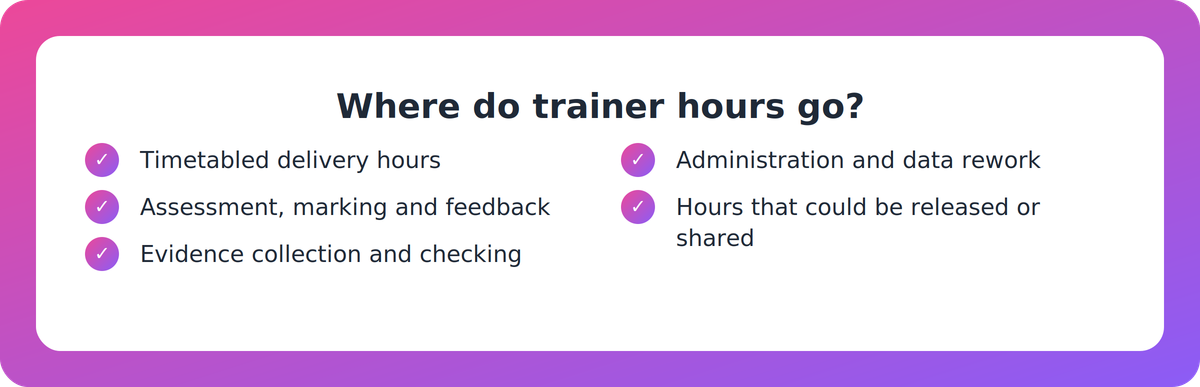
Sample a few trainers across different course types and compare. The spread between them is usually more revealing than the average.
Why headcount-by-enrolment is getting blunter
Two pressures are pulling in different directions.
Supply is tight. A vendor summary of the Productivity Commission's Report on Government Services 2026, published by CAQA, describes a VET workforce of over 110,000, almost half aged 50 or over, and a national shortage of VET teachers. It cites about 3,800 additional teachers needed over five years and roughly 21% employment growth to 2033, attributed to Jobs and Skills Australia. We have not verified these against the primary documents, so treat them as indicative. The direction is still clear. A capacity plan that assumes you can simply hire your way out is fragile.
Demand is shifting. NCVER's *Total VET students and courses 2025* reports 5.1 million students in nationally recognised VET, up 1,585 on 2024. Qualification students fell by 108,360 while short courses grew. A short course and a full qualification are likely to carry very different trainer-hour profiles. Total enrolments can hold steady while the workload underneath them changes.
Sizing a delivery model on enrolment totals alone can therefore mislead in both directions.
Use the data transition to build the base layer
Reporting is changing under you, and you can turn that into an advantage. ASQA states that the 2026 Data Streamlining Instrument takes effect from 1 October 2026 and introduces a requirement to maintain a VET data system. NCVER says all RTOs must report under the new VET Information Standard by January 2029. Some consultancy commentary describes more frequent, event-based submission. That is unofficial, so verify timing and detail with NCVER.
If your delivery, assessment and trainer records have to be cleaner anyway, the same structured data can feed a utilisation view. Two practical starting points:
- Your trainer skills and currency matrix. Providers must show each trainer has current training-and-assessment skills and current industry skills relevant to what they deliver. ASQA says there is no prescribed way to keep this evidence. A well-kept matrix can double as a map of who can deliver what, which is the base layer of any capacity model.
- Your delivery and assessment records. If they are structured and consistent, you can start tagging hours to the five buckets above without a separate project.
ASQA's Statement of Intent 2026 also lists supporting sector capability and capacity among its 2025–26 objectives. That does not set a trainer-load measure. It does suggest capacity will stay on the regulator's radar.
Key takeaways
- The 2025 Standards require training to be paced with enough time for instruction, practice, feedback and assessment, but set no ratio or utilisation benchmark. Operations has to define "enough".
- Contact hours capture only part of trainer load. Assessment, feedback, evidence and admin sit alongside them (our analytical framing, not an ASQA metric).
- Workforce figures from the CAQA summary of RoGS 2026 are indicative and unverified, but they point to ongoing supply risk.
- Qualification enrolments fell by 108,360 in 2025 while short courses grew, so enrolment totals alone are a poor proxy for workload.
- The data system requirement from 1 October 2026 is a chance to build the records a utilisation view needs.
Our take
Headcount is the easiest capacity measure to count and the least informative. We think the COOs who do best over the next few years will be the ones who can say, with evidence, where trainer hours go and what could be released, shared or redesigned before anyone is hired.
You don't need a perfect model to start. A one-fortnight time sample across three trainers and two course types will tell you more than another year of headcount-per-enrolment ratios. What would you find if you ran it next week?
FAQ
Does ASQA set a trainer-to-student ratio or utilisation target?
No. ASQA's 2025 Standards FAQs (version 3) require training to be structured and paced with sufficient time for instruction, practice, feedback and assessment, but they set no ratio or utilisation figure. Each RTO must define and defend its own capacity logic.
What should trainer utilisation include beyond contact hours?
At minimum, delivery, assessment and marking, feedback, evidence handling and administration. The Standards' wording on instruction, practice, feedback and assessment suggests work beyond timetabled sessions. This is an analytical framing, not an ASQA metric.
How does the VET data reporting change affect capacity planning?
ASQA says the 2026 Data Streamlining Instrument takes effect from 1 October 2026 and requires RTOs to maintain a VET data system. NCVER says all RTOs must report under the new VET Information Standard by January 2029. Cleaner delivery and trainer records can also support utilisation analysis.
Can a trainer skills matrix help with capacity planning?
Yes. ASQA requires evidence that trainers are appropriately credentialled with current training-and-assessment and industry skills, and prescribes no format. A well-maintained matrix shows who can deliver what, which is the base layer of a capacity model.