Trainer Currency Evidence: What Compliance Managers Now Owe ASQA
20 September 2026 · 7 min read
The Standards for RTOs 2025 didn't tighten the rules on trainer and assessor currency — they took the rulebook away. There's no prescribed evidence format, no annual box to tick, just an open-ended expectation that you can prove currency at any moment, not reconstruct it before audit week. That's a fundamentally different job.
Why this lands on your desk
Trainer and assessor currency now sits inside Quality Area 3 (VET workforce) and a standalone Credential Policy under the Standards for RTOs 2025 — a genuinely new architecture, not a refresh of old clauses. ASQA has confirmed there is no mandated format for retaining this evidence. That design risk sits entirely with you.
That matters because ASQA's Trainer and Assessor Competencies Practice Guide names specific, recognised failure modes: no mechanism for regular, meaningful industry engagement to confirm currency; no system to authenticate credentials; and unaddressed gaps in trainer skills or industry knowledge. These aren't hypothetical. They're the exact early-warning signals a Compliance Manager is judged on catching before ASQA does.
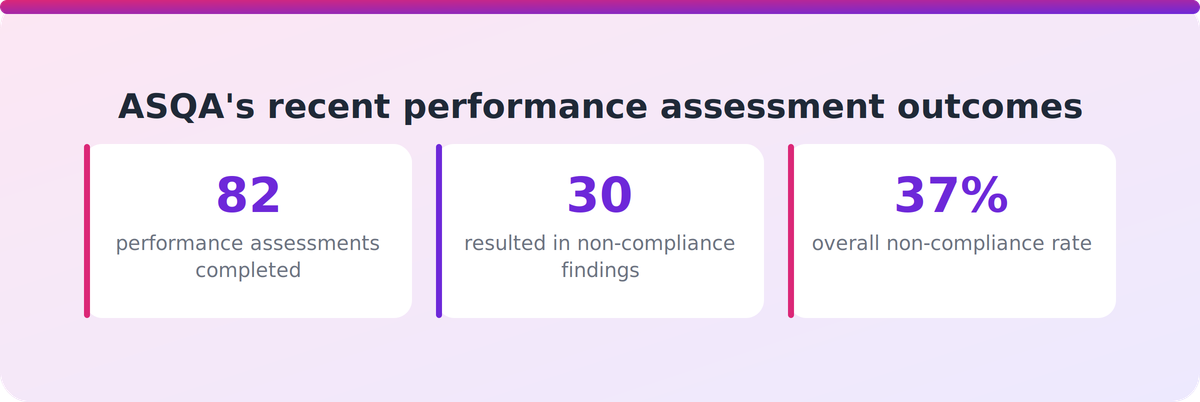
And the base rate is not comforting. ASQA's recent performance assessments show 82 assessments resulted in 30 non-compliance findings — a 37% rate — plus six Agreements to Rectify, with cancellation decisions affecting more than 7,500 qualifications and statements of attainment issued by critically non-compliant providers. Assessment practice has historically been the largest single failure category in RTO audits. Trainer and assessor currency evidence sits right in the middle of that risk.
What actually changed under the 2025 Standards
Before, currency evidence tended to live as a point-in-time artefact: a CPD certificate, a signed declaration, a credential scan filed once and revisited at audit. The 2015 Standards were interpreted, in practice, as a documentation exercise — prove the file exists and you'd largely satisfied the requirement.
The 2025 Standards, and the self-assurance model ASQA built following its post-2020 Rapid Review, ask a different question: does your system actually work, continuously, and would it catch a problem before an auditor does? That shift — from checking inputs like files and policies to assessing whether providers can demonstrate their own quality assurance is functioning — is why a compliant-looking folder is no longer the finish line.
The 'very recent past' test
ASQA's own guidance on the Rules of Evidence uses a deliberately loose phrase: currency must be evidenced as sufficient in "the very recent past", assessed at the time an assessment decision is made — not at the time a file was last updated. ASQA's own illustrative example is telling: a trainer with ten years of industry experience but no recent hands-on exposure to contemporary methods does not automatically meet the standard, no matter how impressive the CV looks on paper.
That's the trap for compliance functions built around document collection. A trainer file can look immaculate — quals scanned, insurance current, a CPD log from eighteen months ago — and still fail the actual test, because currency is a moving target tied to the moment of assessment, not the moment of filing.
The one place the burden actually eased
There's a genuine easing worth noting, because it's easy to miss in a piece about tightening obligations. Under the 2025 Standards, trainers no longer need to hold the exact qualification they deliver. That sounds like relief, but it isn't a free pass — it shifts the compliance weight further away from static credentials and further onto evidenced, ongoing practice. You've traded one paperwork problem for a harder evidentiary one.
The workforce reality behind the evidence gap
This isn't happening in a vacuum. National VET workforce planning describes a teaching workforce that is ageing — close to half are over 50 — highly casualised, and in shortage across multiple industry areas. Sector workforce planning explicitly lists "reducing administrative and compliance burden" alongside "supporting industry currency" as parallel priorities, which is a polite way of saying they sometimes pull in opposite directions.
A casual trainer teaching two days a week, employed across three RTOs, with limited paid time for industry re-engagement, is a compliance risk you inherit structurally — not one you can solve with a better spreadsheet template.
What ASQA's own numbers show
Read the recent performance data as a base rate, not an outlier. More than a third of ASQA's performance assessments in its latest reporting period resulted in a non-compliance finding. That's not a rare, unlucky audit outcome — it's close to a coin flip. If trainer currency evidence is one of the areas most commonly cited, treating it as a once-a-year file review is a bet against the odds.
Building evidence that survives scrutiny on any given day
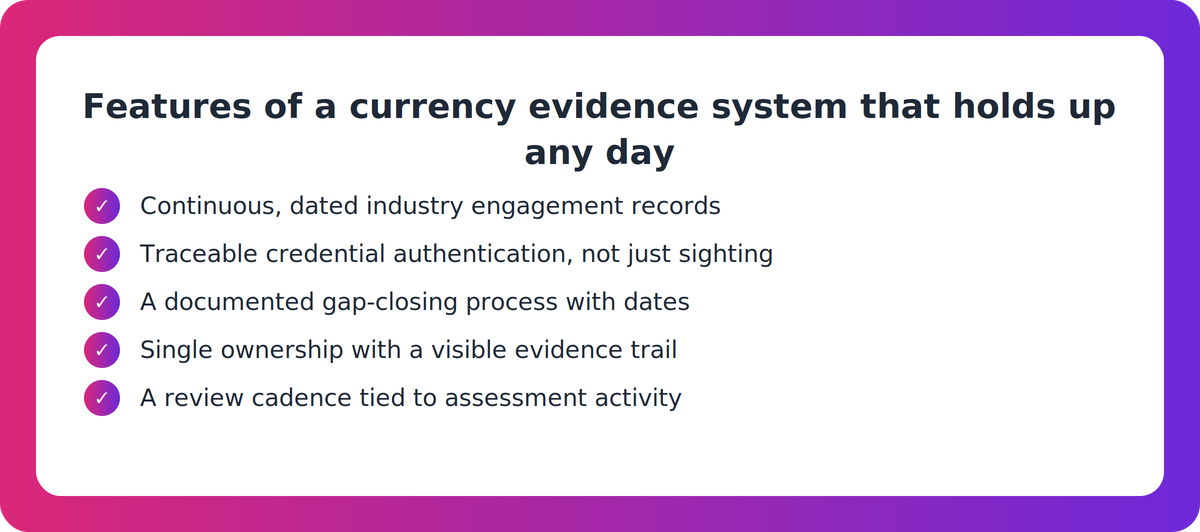
There's no ASQA-prescribed template here, which is both the risk and the opening. A system that would hold up to scrutiny on a random Tuesday, not just during a scheduled audit, tends to share a few features:
- Continuous, not annual, industry engagement records — dated entries showing what a trainer did recently in industry, not a single certificate from last year.
- Traceable credential authentication — evidence you verified the credential, not just that you were shown it.
- A documented gap-closing process — proof that when a currency gap was identified, something happened in response, and when.
- Single ownership and a visible trail — so any staff member, not just you, can show where the evidence for a given trainer currently lives.
- A cadence tied to assessment activity, not the compliance calendar — because ASQA's test is currency at the point of assessment, not at the point of filing.
None of this requires new software to design. It requires deciding, deliberately, what "meaningful industry engagement" looks like for each training package you deliver, and then holding that standard consistently rather than reconstructing it under pressure.
Key takeaways
- The Standards for RTOs 2025 moved trainer and assessor currency into Quality Area 3 and a standalone Credential Policy, with no prescribed evidence format — the design risk sits with the RTO, not ASQA.
- ASQA's currency test is "the very recent past" assessed at the point of an assessment decision, not the point a file was last updated — a stale-but-tidy file can still fail.
- ASQA names specific failure modes to watch for: no system for regular industry engagement, no credential authentication process, and unaddressed trainer skill gaps.
- Recent ASQA performance data shows a 37% non-compliance rate across assessments reviewed, with assessment practice historically the largest failure category — treat trainer currency as a high-probability trip point, not a low-risk formality.
- Trainers no longer need the exact qualification they deliver, but that shifts the compliance weight further onto ongoing, evidenced practice rather than easing the workload.
Our take
The honest read here is that ASQA has stopped grading your paperwork and started grading your judgement. That's harder to fake and harder to catch up on after the fact, but it's also a fairer test in one sense: a compliance function that genuinely tracks currency in real time will look the same whether ASQA turns up unannounced or on schedule. The providers most exposed aren't the ones with messy files — they're the ones whose tidy files were never actually tested against what's happening in industry right now. Building that discipline is slower to set up and faster to defend.
FAQ
Does ASQA specify what format trainer currency evidence must take? No. ASQA has confirmed there is no mandated format under the Standards for RTOs 2025 — the method of evidencing currency is left to the provider, which means the design and defensibility of that evidence sits with your organisation, not a prescribed template.
What does "the very recent past" actually mean for currency evidence? It's a deliberately open test from ASQA's Rules of Evidence guidance: currency must be sufficient at the time an assessment decision is made, not simply documented at some earlier point. A credential or CPD record from over a year ago may not satisfy this if it doesn't reflect current, hands-on industry practice.
Do trainers still need to hold the exact qualification they teach under the 2025 Standards? No — this requirement was relaxed under the Standards for RTOs 2025. However, this shifts more weight onto ongoing, evidenced industry practice rather than reducing the overall compliance burden.
What are the most common trainer currency failure points ASQA has flagged? ASQA's Trainer and Assessor Competencies Practice Guide names a lack of systems for regular, meaningful industry engagement; no process to authenticate trainer credentials; and failure to identify or close skills gaps as recognised compliance failures.