Trainer Currency NZQA: Proving It Without Burying Trainers
10 August 2026 · 8 min read

New Zealand's tertiary quality assurance model just flipped from a once-a-year audit to a running evidentiary record — and the bodies that set your moderation requirements are being rebuilt at the same time. If your answer to "how do we stay current" is more forms for trainers to fill in, you've already lost the year.
Why this lands on your desk
NZQA's integrated Quality Assurance Framework (iQAF) went live from 1 January 2026. It replaces external evaluation and review, and consistency reviews, with provider self-review: an annual self-review summary report, followed by a meeting with NZQA to discuss an improvement plan. From July 2026, that same continuous-evidence expectation extends to every non-university tertiary provider delivering education and training, including Industry Skills Boards running work-based training.
That report is yours to build. Not the CEO's, not compliance's — yours, because it's built from trainer currency records, assessment quality data and moderation outcomes that sit inside your delivery team. NZQA has also said it wants to extend assessment-focused monitoring as the more reliable ongoing check on quality, with scrutiny increasing wherever data, complaints or other signals suggest risk. That's a shift from "pass the review" to "keep the evidence flowing," and it changes what a good week looks like for you.
At the same time, the standard-setting architecture behind your moderation obligations is mid-rebuild. The Education and Training (Vocational Education and Training System) Amendment Act, passed in October 2025, disestablished Te Pūkenga — replaced for a two-year transition by NZIST — and split it into ten regional polytechnics. Workforce Development Councils have given way to eight Industry Skills Boards from January 2026. These are the bodies that issue Consent and Moderation Requirements and run national external moderation. You're now trying to hold currency and assessment evidence steady against a target that's itself moving.
The iQAF changes what "current" means
Under the old model, currency was something you certified: a point-in-time check, a folder of professional development records, a tidy answer for the reviewer. Under continuous self-review, currency is something you have to demonstrate is still true, on an ongoing basis, with evidence NZQA can ask to see at any point.
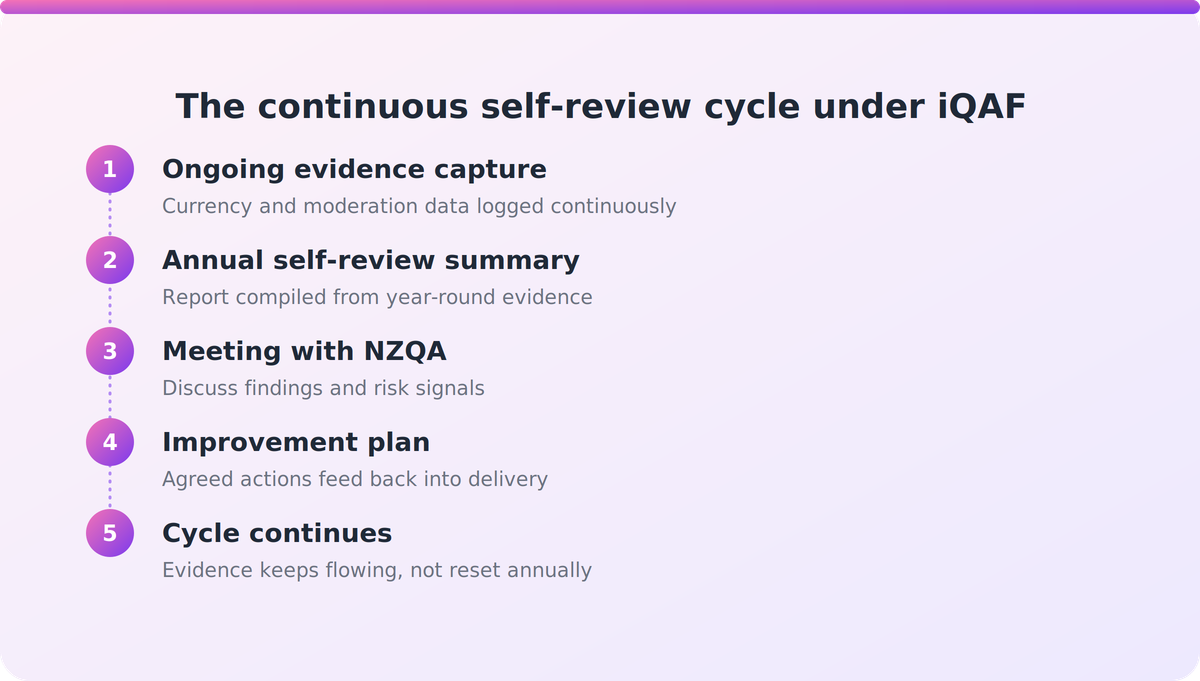
Practically, that means your annual self-review summary report is only as good as the evidence trail behind it. If trainer currency records, moderation notes and assessment consistency checks live in scattered spreadsheets and inboxes, writing that report becomes a scramble every time — and the improvement plan conversation with NZQA becomes reactive rather than a genuine account of what you've already fixed.
Sector submitters clearly saw this coming. In consultation on the draft iQAF, submitters — 59 of them — specifically flagged that compliance scheduling should be synchronised with standard-setting body requirements, precisely to avoid duplicated effort. That's a sector-recognised acknowledgement that the current design risks stacking obligations rather than streamlining them. It's worth treating that submission as a mandate: don't let your internal reporting cycle and your external moderation cycle run on separate, uncoordinated calendars.
Moderation is where inconsistency becomes visible
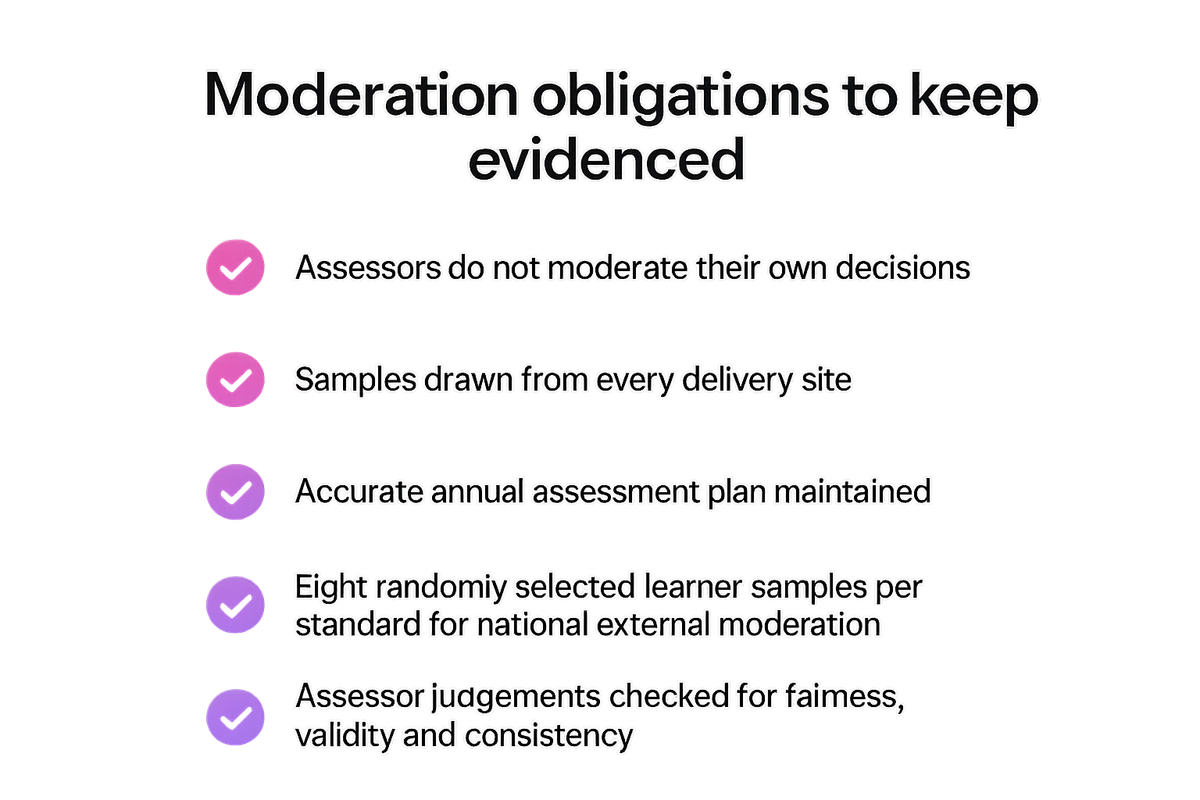
Internal moderation is where trainer shortages and assessment quality collide most directly. NZQA Rules require an effective internal moderation system: assessors cannot moderate their own assessment decisions, and where delivery happens across multiple sites, samples must be drawn from each site to check that marking is consistent across assessors.
That's straightforward to say and hard to run when you're short-staffed. If your moderation pool is thin, the same two or three people end up cross-checking everyone, which strains the very independence the rule is designed to protect. Gaps here don't stay invisible — they surface exactly where NZQA's risk-based, signal-driven monitoring is designed to look.
National external moderation adds a second layer: an accurate annual assessment plan, and evidence — via eight randomly selected learner samples per standard — that assessor judgements are fair, valid and consistent nationally. Both layers depend on trainers having time to produce clean, comparable evidence in the first place. Squeeze delivery hours to generate more paperwork, and you weaken the evidence the paperwork exists to produce.
Standard-setters in transition: don't chase a moving target blind
With Te Pūkenga disestablishing into NZIST and ten regional polytechnics, and Workforce Development Councils handing over to Industry Skills Boards, the entities issuing your Consent and Moderation Requirements are themselves being reissued. Government has acknowledged the programme-continuity risk this creates, advising learners and providers to check directly with polytechnics for any changes to courses or study programmes.
For you, that's a live version-control problem, not a hypothetical one. Unit standard interpretations, moderation guidance and assessment materials issued under the old body may be superseded without a clean handover notice landing in your inbox. Build a habit — not a one-off project — of checking which standard-setting body now owns each qualification you deliver, and confirming the moderation requirements attached to it haven't quietly shifted underneath you.
The real risk: paperwork eating the metric it's meant to protect
Here's the trap. Faced with continuous self-review, the easy move is to push more currency logging, more moderation forms, more evidence-capture tasks onto already-stretched trainers. That buys you a fatter self-review report. It also eats the delivery, coaching and early-intervention time that actually drives learner progress and completion — the numbers you're judged on.
Get the sequencing wrong and you've solved a compliance problem by creating a performance one. The providers who'll handle this well are the ones treating currency and moderation evidence as a by-product of good delivery practice — captured as trainers work, not bolted on afterwards — rather than a separate administrative layer competing with teaching time for the same hours.
Key takeaways
- The iQAF (live from 1 Jan 2026) replaces periodic external review with continuous TEO self-review — an annual summary report plus an improvement-plan meeting with NZQA, extending to all non-university providers, including Industry Skills Boards, from July 2026.
- NZQA is moving toward assessment-focused, risk-signalled monitoring rather than point-in-time audits — currency evidence needs to be continuously available, not annually assembled.
- Internal moderation obligations — assessors not moderating their own work, cross-site sampling for consistency — are hardest to run cleanly with a thin trainer pool, and gaps here are exactly what risk-based monitoring is designed to catch.
- Standard-setting bodies (Industry Skills Boards, regional polytechnics, NZIST) are mid-restructure; Consent and Moderation Requirements are being reissued, so don't assume last year's guidance still holds.
- The biggest risk isn't non-compliance — it's solving compliance by loading paperwork onto trainers, which erodes the delivery time behind your completion and progress metrics.
Our take
The sector submissions on the draft iQAF got it right: the compliance-burden risk here is real, and it's already been named publicly. Our view is that the providers who come out ahead won't be the ones who write the best self-review report — they'll be the ones who redesign how currency and moderation evidence gets captured so it's a natural output of delivery, not a parallel job trainers do after hours. That's less about writing more policy and more about deciding, deliberately, what evidence you actually need and building the lightest possible way to capture it continuously. Anything heavier just moves the burnout risk from an audit week to every week.
FAQ
What is NZQA's integrated Quality Assurance Framework (iQAF) and when does it start? The iQAF went live from 1 January 2026, replacing external evaluation and review and consistency reviews with ongoing TEO self-review. Providers submit an annual self-review summary report and meet NZQA to discuss an improvement plan. From July 2026, all non-university tertiary providers, including Industry Skills Boards delivering work-based training, must also undertake TEO self-review.
Does trainer currency evidence need to be continuous now, rather than annual? Effectively, yes. NZQA has said it wants to extend assessment-focused monitoring as a more reliable ongoing check on quality, with scrutiny increasing wherever data, complaints or other signals indicate risk — rather than relying solely on periodic point-in-time reviews.
How does the shift from Workforce Development Councils to Industry Skills Boards affect my moderation obligations? The October 2025 Amendment Act disestablished Te Pūkenga (via a two-year transitional entity, NZIST) into ten regional polytechnics, and replaced Workforce Development Councils with eight Industry Skills Boards from January 2026. These bodies issue Consent and Moderation Requirements, so it's worth confirming with each standard-setting body whether requirements you're relying on have been reissued.
What are my core internal moderation obligations under NZQA Rules? Assessors must not moderate their own assessment decisions, and where delivery spans multiple sites, samples must be drawn from each site to check consistency of marking. For national external moderation, providers need an accurate annual assessment plan and typically submit eight randomly selected learner samples per standard to show assessor judgements are fair, valid and consistent nationally.