Trainer Currency Under the Standards for RTOs 2025
23 August 2026 · 7 min read

The Standards for RTOs 2025 promised simplification. What Heads of Training actually got is a relocation: trainer and assessor credential rules now sit in a standalone Credential Policy, and validation sampling has swapped fixed quotas for judgement calls you have to justify yourself — arriving exactly when the national VET teacher shortage leaves you with fewer hands to do the work.
Why this lands on your desk in 2026
You own trainer capability, currency and workload. You own validation and moderation. You own assessment consistency across every trainer delivering the same unit of competency. Every one of those things just got a little harder to document, at a time when every one of them is also harder to staff.
That's not a coincidence you can complain your way out of. It's the operating environment for the next few years, and it's worth understanding precisely what changed and why it matters more now than it would have in 2020.
What actually changed under the 2025 Standards
The Standards for RTOs 2025 commenced on 1 July 2025 and are structured in three parts: Outcome Standards, Compliance requirements, and a separate, enforceable Credential Policy covering trainer, assessor and validator credentials (DEWR; ASQA). That third part is the one worth sitting with.
From embedded clauses to a standalone Credential Policy
Under the previous Standards, trainer and assessor credential requirements were written directly into the main clauses — familiar territory for anyone who's been through an audit before. Under the 2025 Standards, those requirements have been pulled out into their own Credential Policy that auditors now check against separately. Industry commentary has flagged this as a structural change RTOs need to actively map their evidence trails to, rather than assume old documentation habits will translate cleanly (vetadvisorygroup.com.au).
Practically, that means your currency evidence — professional development records, workplace exposure, industry engagement, involvement in industry events — needs to demonstrate an ongoing practice, not a point-in-time credential check. A TAE qualification and a current industry ticket on file is no longer the whole story auditors are reading.
Validation: from fixed quotas to risk-based judgement calls
The change with the biggest day-to-day workload impact is validation. Under the 2015-era Standards, the rule was mechanical: validate each training product at least once every five years, with at least 50% validated within the first three years. You could build a schedule, follow it, and point to it as evidence of compliance.
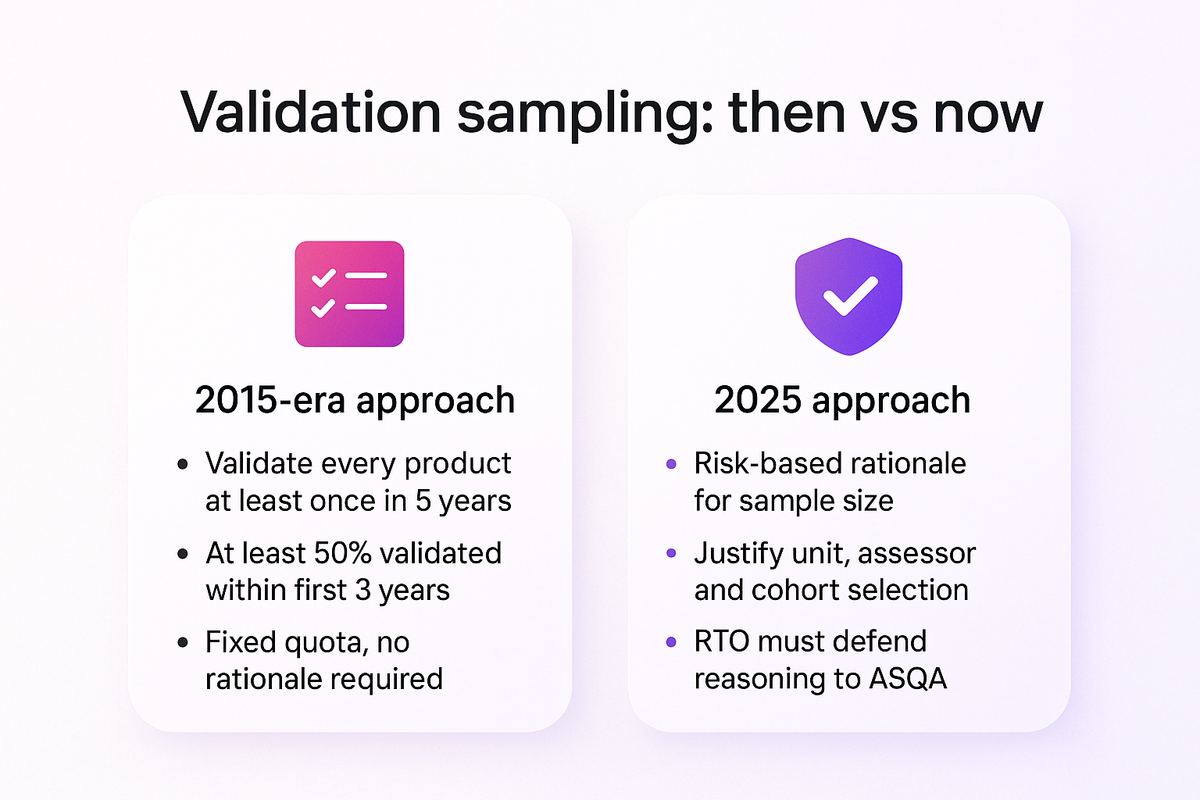
Under the 2025 approach, ASQA expects a risk-based rationale for sample size, which units get chosen, which assessors are sampled, and which cohorts are covered — not a standard quota you can lift from a template. That's a genuine improvement in principle: it should mean effort goes where the risk actually sits. In practice, it means you now have to build, defend and continually revisit a justification, on top of running the validation itself.
The workforce math working against you
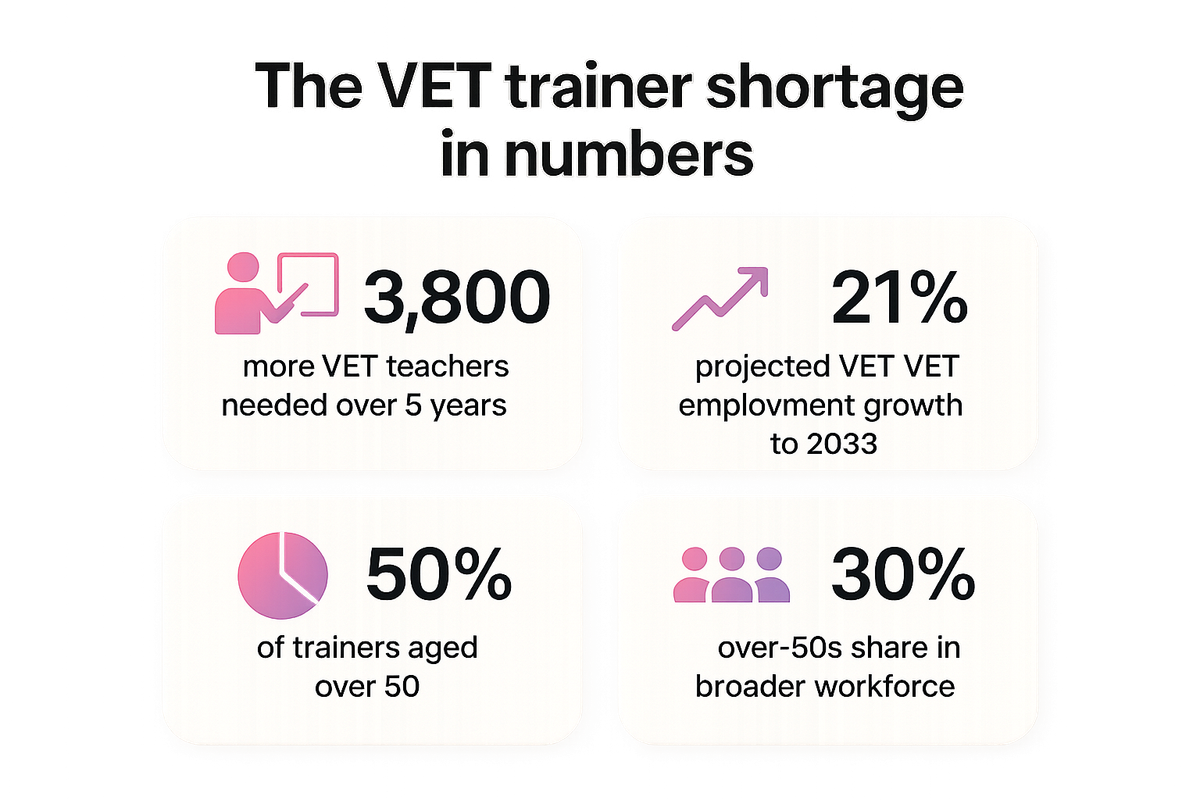
Here's the part that makes the timing sting. Jobs and Skills Australia data shows VET teachers have been in shortage nationally, and in every single state and territory, for the last two years running. The sector needs roughly 3,800 more teachers over the next five years against 21% projected employment growth to 2033. The workforce delivering against that demand is ageing — near 50% of VET trainers are aged over 50, compared with around 30% across the wider workforce — and increasingly casualised, with pay that lags other education sectors.
Recruitment isn't a quick fix either. A 2025 Skills Insight VET Workforce Project report found RTOs are losing the competition for staff to larger providers and other industries altogether, and that visa pathways such as PALM or the 482 Temporary Skill Shortage visa can take more than eight years before a worker becomes eligible for recruitment as a TAE-qualified trainer.
So the currency and validation workload just got heavier, and the people you'd lean on to absorb it are the scarcest resource on your org chart.
Where the compliance risk concentrates
Compliance-sector commentary has repeatedly pointed to assessment practice as the most frequently cited area in audit findings — this isn't a published ASQA statistic, so treat it as informed industry observation rather than official data, but it lines up with what most Heads of Training already sense from their own audit history. Inconsistent assessment quality across trainers isn't an abstract risk. It's the thing that surfaces first when a validation sample gets scrutinised, and it's the thing a risk-based rationale has to actually account for, not paper over.
The completion-rate context you can't ignore
It's not all headwind. NCVER reported in November 2025 that VET qualification completion rates have continued to improve, and South Australian government data shows completion rate growth across TAFE, private RTOs, schools, enterprise and community providers for courses started in 2020 and completed by 2024. That's a genuinely good trend, and it means the sector is proving it can lift outcomes even under pressure. But it also raises the bar: if completions are climbing, the assessment judgements behind those completions come under more scrutiny, not less.
Key takeaways
- Trainer and assessor credential requirements now sit in a standalone Credential Policy under the Standards for RTOs 2025, separate from the main clauses — map your evidence trail to it specifically.
- Validation sampling has moved from fixed quotas (5-year cycle, 50% in year three) to a risk-based rationale you must define and defend yourself.
- Jobs and Skills Australia data shows VET teacher shortages in every state and territory for two years running, an ageing workforce (near 50% over 50), and recruitment pathways that can take years to clear.
- Assessment practice remains the area most commonly flagged in audit commentary, making trainer consistency a direct line to your compliance risk, not just a delivery-quality issue.
- Completion rates are improving nationally per NCVER — a positive trend that raises the stakes on assessment judgement quality behind those numbers.
Our take
The shift to risk-based validation is defensible policy. Blanket quotas never distinguished between a stable, well-supported unit and one delivered by three casual trainers across two campuses with no shared moderation habit. Risk-based sampling should, in theory, focus your limited hours where they matter most.
But good policy design doesn't automatically translate to manageable workload, especially when it lands on a workforce that's shrinking and ageing at the same time. The honest response isn't to treat this as one more compliance box — it's to build your risk rationale around the same signals that already worry you: newer trainers, casual load, units with a history of moderation disagreement, cohorts where completion data looks shaky. If your justification for sample selection genuinely reflects where quality risk lives in your delivery, you're not just satisfying an auditor. You're running validation the way it should have worked all along.
FAQ
Does the Credential Policy under the Standards for RTOs 2025 replace TAE qualification requirements? No. The Credential Policy sits alongside existing qualification requirements but is now a separate, standalone document that auditors check against directly, rather than credential clauses embedded in the main Standards. RTOs need to ensure their evidence of ongoing currency — not just the base qualification — is mapped against this policy specifically.
How do we build a defensible risk-based rationale for validation sampling? Start from where your own risk signals already sit: units with newer or casual trainers, units with a history of moderation disagreement, cohorts with completion or progression concerns, and training products with recent content or delivery-mode changes. Document why each sample was chosen, not just what was validated — that reasoning is what a risk-based approach under the Standards for RTOs 2025 is designed to test.
What counts as evidence of trainer currency now, beyond the TAE and industry credential? Industry commentary describes ongoing currency as requiring continuing professional development, workplace exposure, industry networking, and involvement in industry events — an ongoing practice rather than a one-off credential check at induction or annual review.
Is the VET teacher shortage actually going to ease in the next few years? Jobs and Skills Australia data doesn't point that way in the near term. The sector needs roughly 3,800 more teachers over the next five years against 21% projected employment growth to 2033, and recruitment pathways for skilled overseas workers can take upward of eight years to clear — so workforce pressure is likely to remain a planning constraint rather than a temporary blip.