Trainer Knowledge Transfer: A Head of Training's NZ Guide
4 October 2026 · 6 min read
The biggest quality risk in your programme probably isn't a failed assessment. It's three trainers delivering the same unit three different ways, each defensibly, none of it written down. Under NZQA's self-review model, that quiet variation is something you now have to evidence yourself, every year, with no external reviewer to do it for you.
Why this lands on your desk
You own consistency across trainers. That has always been true. What has changed is who has to prove it.
Since 1 January 2026, NZQA's integrated Quality Assurance Framework (iQAF) has replaced external evaluation and review (EER) with annual provider self-review. NZQA is not beginning new EER processes or consistency reviews. Providers submit an annual self-review summary report and meet NZQA to discuss their improvement plan. NZQA said templates and scheduling details would follow during 2026, so check its latest guidance before you build anything around a specific format.
The assessment bar did not drop. Programme approval still requires assessment methodology that is fair, valid, consistent and appropriate, plus an effective moderation system for materials and decisions. When someone asks how you know your assessment is consistent, "our trainers are experienced" is not evidence.
What the self-review model actually asks of you
The Quality Assurance of Tertiary Education Providers Rules 2026 require an up-to-date quality management system, annual self-reviews, and reporting on those reviews to NZQA. They also cover monitoring, sub-contracting requirements and assessment records retention.
Read that last item carefully. Records of how assessment is actually done are part of the compliance picture, not just the paperwork around it. Programme approval Criterion 7 adds a requirement for processes that assess programme currency and content, and monitor the quality of outcomes for learners and other stakeholders.
None of this asks for more paper for its own sake. It asks that your quality claims can be traced to something that exists outside one person's head.
Where undocumented practice does the damage
NZQA's good-practice guidance on internal moderation is specific:
- Moderate all assessment materials before use.
- Verify assessor decisions before results are reported.
- Keep the moderator independent of the assessment designer and assessor.
- For multi-site delivery, sample learner work from each location.
Every one of those steps compares a trainer's work against a standard. If the standard is "what Hemi does, because Hemi's been here eleven years", the moderator has nothing to check against. The system runs, but it can't tell you much.
Over time
NZQA states that internal moderation helps ensure consistency of assessment within organisations, over time and between assessors. "Over time" is where undocumented practice hurts most.
When a trainer leaves or a programme changes hands, there is no record of how judgement calls were made. The next trainer re-invents them. Learners who started under one approach finish under another, and nobody can say which was right.
Across sites and employers
National external moderation now sits with Industry Skills Boards rather than Workforce Development Councils. Under the Directory of Assessment and Skill Standards (DASS) Rules 2026, the boards report annually to NZQA on the national external moderation system, including concerns about any participating institution. Moderation has to give confidence in the reliability and consistency of assessor judgements.
So your consistency is now visible from two directions: your own annual self-review and the national moderation system. A gap in one will show up in the other.
The churn problem is real
The reform is adding turnover. VET legislation passed in October 2025 disestablished Te Pūkenga and set up 10 regional polytechnics and the Industry Skills Boards from 1 January 2026. OIA documents reported by The Spinoff showed Te Pūkenga losing over $80m in funding and one in 10 staff ahead of disestablishment.
Work-based learning enrolments transfer to polytechnics, PTEs or wānanga by 1 January 2028. Many teams will absorb new trainers and new programmes in that window. Funding adds pressure: TEC's 2026 rates cut work-based VET funding by 10% and raise provider-based Trades (F2) by 5%. Nobody has spare capacity to re-learn what a departed colleague knew.
What to write down first
Don't start with a documentation project. Start with the decisions that cause the most variation.
A short list for this quarter
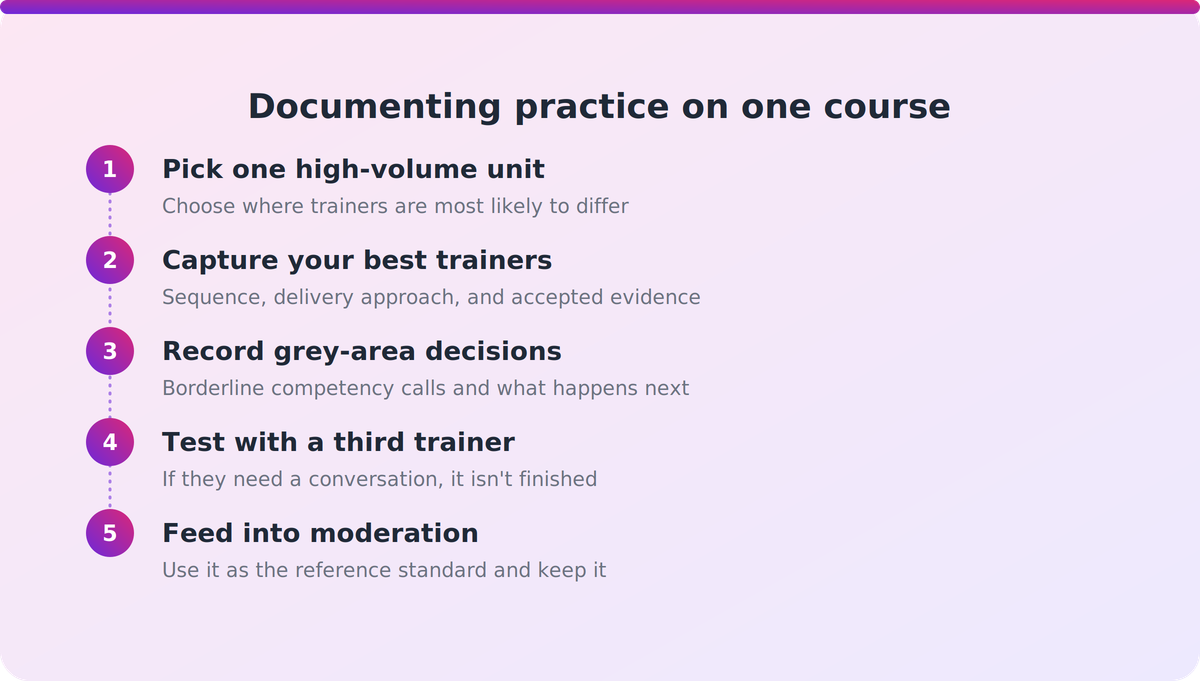
- Pick one high-volume unit or course. Choose where trainers are most likely to differ.
- Ask your two strongest trainers to describe their approach. Cover how they sequence delivery and what they accept as sufficient evidence.
- Write the grey-area decisions down. For example: what counts as "competent" when evidence is borderline, and what you do about it.
- Have a third trainer test it. If they can't follow it without a conversation, it isn't finished.
- Feed it into moderation. Use the written standard as the reference your moderator checks against, and keep it with your assessment records.
Aim for one page that someone new could pick up, not a manual. Version it, and keep one current copy.
Key takeaways
- Since 1 January 2026, NZQA's iQAF replaces EER with annual self-review, so the provider carries the burden of proof for consistent assessment.
- Assessment and moderation criteria did not loosen: assessment must still be fair, valid, consistent and appropriate, with an effective moderation system.
- NZQA's internal moderation guidance only works if there is a shared, documented standard to moderate against, including at each site.
- Reform-driven staff turnover makes undocumented know-how easier to lose before 1 January 2028.
- Start small: document the grey-area assessment decisions on one high-volume course, then test them with a trainer who wasn't involved.
Our take
Most heads of training treat documentation as a tax on delivery time. We think that's backwards. Written practice is the cheapest form of moderation insurance you can buy, and for a self-reviewing provider it's the raw material of your evidence.
The uncomfortable part is that it exposes disagreement. Two respected trainers may turn out to assess the same evidence differently. Better you find that than a national moderator, or a learner, does. Surfacing it is the job, and it's far easier to fix while both trainers are still in the building.
FAQ
Has NZQA stopped reviewing providers altogether?
No. From 1 January 2026, NZQA is not beginning new EER processes or consistency reviews. Providers submit an annual self-review summary report and meet NZQA to discuss their improvement plan. Moderation and programme approval requirements still apply.
What does NZQA expect from internal moderation?
Its good-practice guidance says to moderate all assessment materials before use and verify assessor decisions before results are reported. The moderator should be independent of the designer and assessor, and multi-site providers should sample learner work from each location.
Who runs national external moderation now?
Industry Skills Boards, rather than Workforce Development Councils. Under the DASS Rules 2026, they report annually to NZQA on the national external moderation system, including concerns about any participating institution.
Do I know the final self-review template?
Not yet from the sources we reviewed. NZQA said templates and scheduling details would follow during 2026, so confirm current requirements with NZQA directly before locking in your reporting format.
One question to sit with
If your most experienced trainer resigned on Friday, what could you show a new colleague on Monday that explains how they make their assessment decisions? Whatever the answer is, that is your starting point.