Trainer Occupational Currency in FE Just Got Harder
29 July 2026 · 8 min read

Keeping trainers occupationally current has always been hard. What's new is that two reforms are landing in the same academic year — Ofsted's renewed inspection framework and apprenticeship assessment reform — asking your training team to prove genuine competence and absorb new assessment workload at once, with fewer occupationally current trainers available than at almost any point in recent memory.
Why this hits your desk
You own trainer capability, timetabling, and the quality of training and assessment. Both reforms sit squarely inside that remit, not somewhere upstream in senior management.
Ofsted's renewed Education Inspection Framework, in force from 10 November 2025, sharpens scrutiny of whether apprenticeship and technical programmes actually build occupational competence. Common weaknesses it flags — insufficient curriculum breadth, limited development of transferable skills, thin employer involvement beyond workplace supervision — are curriculum and delivery decisions you make, not compliance paperwork someone else files.
At the same time, the DfE's apprenticeship assessment reforms, introduced from February 2025, are redistributing who does the assessing. Employers now verify apprentice behaviours in the workplace. Training providers may mark some assessment elements directly. Assessment organisations retain design and assurance, but a meaningful slice of the marking and verification load moves into delivery teams — your teams — where it didn't sit before.
Neither reform was written with the other in mind. Together, they mean you now have to demonstrate both what your trainers deliver and how consistently it's assessed, using a workforce that is smaller, more stretched, and harder to replace than the one your existing training strategy was built around.
The two reforms are not separate problems
It's tempting to file Ofsted readiness under 'curriculum' and assessment reform under 'quality assurance' and manage them as parallel workstreams. That's a mistake. Both draw on the same scarce resource: trainers who are genuinely current in their occupation and confident enough in assessment practice to mark or verify consistently.
A trainer who hasn't set foot on a live site or in a working environment for a couple of years is a curriculum risk under the renewed inspection framework. The same trainer, now handed a marking or verification role under assessment reform, is also a consistency risk. The two pressures compound rather than sit side by side.
What Ofsted is actually looking for
The renewed framework isn't asking whether your trainers hold a qualification. It's asking whether the training builds the breadth, transferable skills, and employer-connected experience that add up to genuine occupational competence — and whether that shows up in what learners can actually do, not just what's written in a scheme of work.
That's a harder bar to clear with a trainer whose last direct industry exposure was several years ago, however strong their teaching practice is. Employer involvement 'beyond workplace supervision' — the phrase Ofsted uses — is specifically about whether employers are shaping and checking competence, not just hosting placements.
Assessment reform moves marking into delivery
The practical shape of the reform is a shift from a single, heavyweight end-point assessment to assessment that can happen at any stage, governed by assessment plans that are shrinking from roughly 30–40 pages down to three or four. Revised plans are being introduced in phases from October 2025, with full transition expected by 2026–27.
That sounds like simplification. In practice, it means your team inherits parts of a job that used to be entirely outside your walls.
What changes under assessment reform
Sector commentary has already flagged the risk this creates: more provider latitude over when, how and by whom assessment is delivered is likely to increase variation, so apprentices on the same standard could be assessed differently depending on which centre — or which trainer — delivers it. That's exactly the kind of inconsistency that Centre Assessment Standard Scrutiny (CASS) expectations are designed to catch, through evidenced assessor and internal quality assurance competence, clear sampling and standardisation, consistent feedback and solid record keeping.
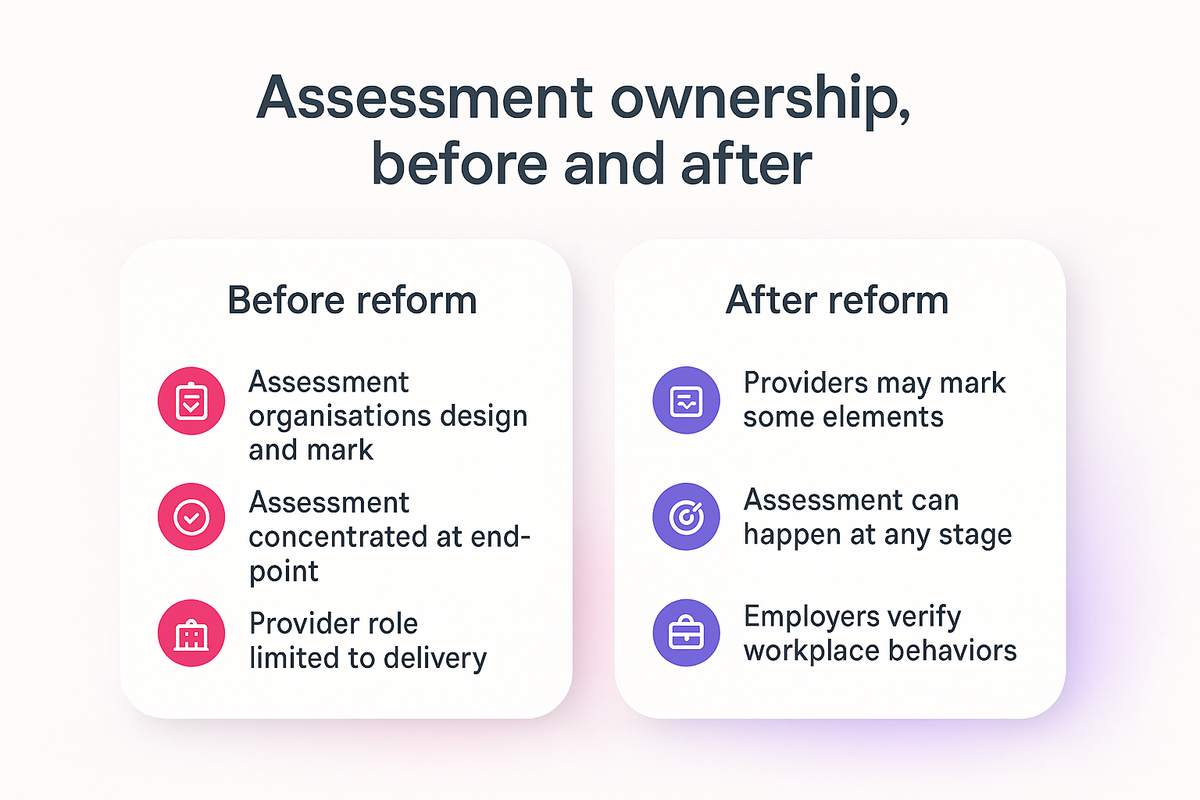
In other words: your validation and moderation function, not the assessment organisation's, is now the main line of defence against inconsistent grading across your own trainers. If your sampling and standardisation processes were built for a world where marking sat elsewhere, they need rebuilding for a world where it sits with you.
The capacity you're solving this with is shrinking
Here's the part that makes this a structural problem rather than a planning inconvenience. According to an Association of Colleges survey, further education teacher vacancy rates stood at 5.1 per 100 posts in general FE colleges, with construction teaching vacancies at 9.6% nationally — rising to 16% in the East Midlands. Around 40% of colleges reported cancelled courses because they couldn't staff them.
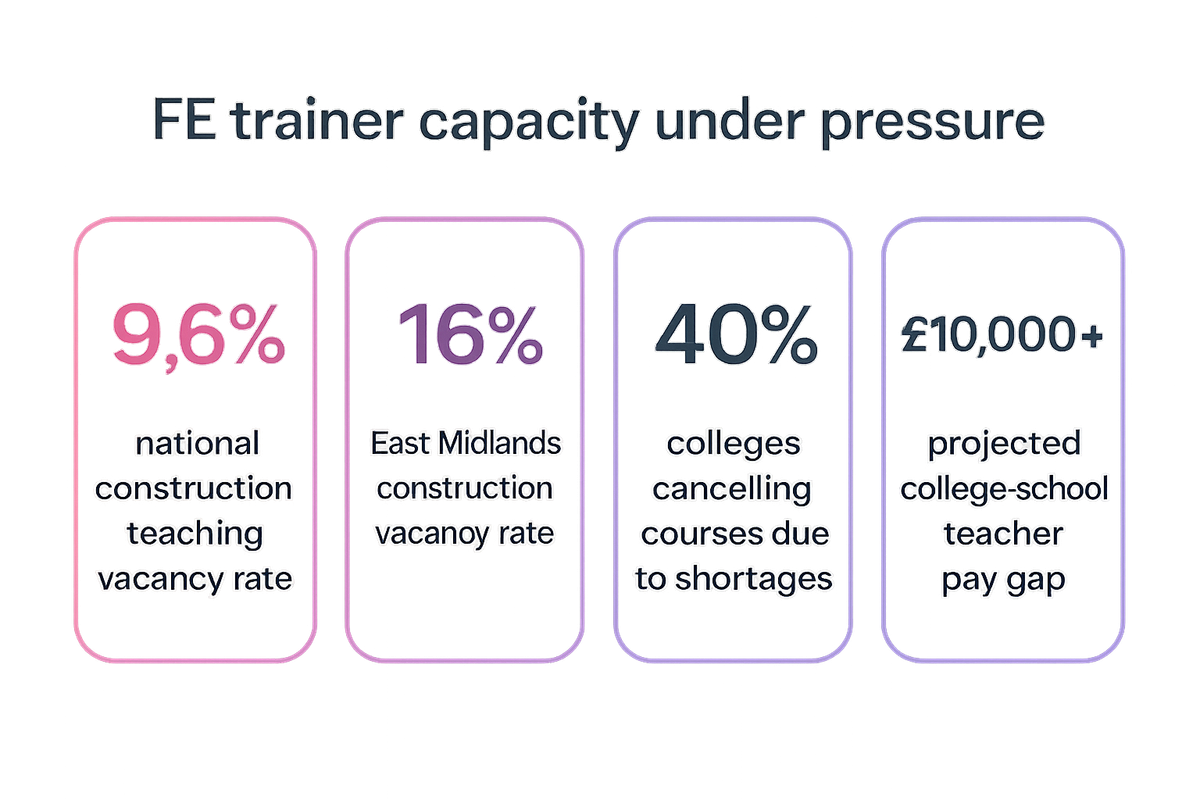
The pull away from teaching is structural, not incidental. The pay gap between college and school teaching is projected to exceed £10,000, and industry professionals are typically paid more than £8,000 above an equivalent FE teacher. Every experienced, occupationally current trainer you retain is choosing to stay despite that gap, not because of anything your training strategy controls.
Retention incentives are not the fix
The Targeted Retention Incentive — worth up to £6,000 for eligible early-career teachers in STEM and technical shortage subjects — drew 7,790 applications in 2024–25, with 5,984 approved. That's real money reaching real people. But the National Audit Office has found the scheme's overall effectiveness in resolving recruitment and retention pressures remains unclear.
Worth planning around that incentive. Don't plan as if it solves the underlying pay gap, because there's no evidence yet that it does.
Key takeaways
- Ofsted's renewed framework (from 10 November 2025) and apprenticeship assessment reform (from February 2025) are landing in the same cycle and drawing on the same scarce resource: occupationally current, assessment-capable trainers.
- Assessment reform shifts marking and verification work into delivery teams, with assessment plans shrinking to roughly three or four pages and full transition expected by 2026–27 — meaning your internal quality assurance function now carries more of the consistency burden.
- Trainer shortages are structural: 9.6% national construction teaching vacancies (16% in the East Midlands), around 40% of colleges cancelling courses, and pay gaps exceeding £10,000 versus schools and £8,000 versus industry.
- The Targeted Retention Incentive has reached thousands of eligible teachers but the National Audit Office says its overall impact on recruitment and retention pressure is still unclear — treat it as a partial measure, not a solution.
- Robust sampling, standardisation and evidenced assessor competence — the substance of emerging CASS expectations — are now the main safeguard against inconsistent assessment across your own trainers.
Our take
Most training strategies were built on an assumption that no longer holds: that occupational currency and assessment capability could be developed on separate timelines, by different people, with recruitment as the backstop when either ran short. That assumption is gone. Currency and assessment competence are now the same capability, being asked of the same shrinking group of practitioners, under two regulatory regimes that both tightened in the same academic year.
The honest response isn't a training plan that assumes you'll hire your way out of it — the vacancy and pay data suggest you largely won't. It's building validation and moderation processes robust enough to catch inconsistency early, being deliberate about which trainers you put in front of which standards, and being realistic with your board about what a smaller, more stretched pool of occupationally current staff can actually deliver against two reforms at once.
FAQ
Does Ofsted's renewed framework require a specific occupational currency policy? The framework doesn't mandate a named policy, but it does scrutinise whether curricula build genuine occupational competence, flagging insufficient breadth, weak transferable skills development, and thin employer involvement as common weaknesses — all of which point back to how current and connected to industry your trainers are.
Do all my trainers now have to mark apprenticeship assessments? Not automatically. The reforms allow providers to mark some assessment elements directly, while employers verify workplace behaviours and assessment organisations retain design and assurance — but where your team does take on marking, consistency across trainers becomes your responsibility to evidence.
Will the Targeted Retention Incentive solve our trainer shortage? It's helped several thousand early-career teachers in STEM and technical shortage subjects, but the National Audit Office has found its overall effect on recruitment and retention pressure remains unclear — plan for it as a partial support, not a structural fix for the pay gap.
What should be first on the list this planning cycle? Start with your sampling and standardisation processes. If marking responsibility is moving into your team under assessment reform, that's where inconsistency will surface first — and where CASS-style scrutiny will look first too.