Trainer Retention at Your RTO: A CEO's P&L Problem
1 October 2026 · 7 min read
When a trainer leaves your RTO, you lose more than a pair of hands. You lose delivery capacity, assessment-evidence continuity and compliance knowledge, in a labour market where a quick like-for-like replacement can't be assumed. That makes trainer retention a balance-sheet event. No public benchmark will price it for you, so you have to do it yourself.
Why this lands on your desk
You own the P&L and you answer for cost per student and operating margin. Vacancy days, casual backfill, recruitment effort and onboarding time all land there, usually spread across lines where nobody adds them up.
You also answer to the board for regulatory standing. The Standards for RTOs 2025 have been in full effect since 1 July 2025. They focus on outcomes for students and employers, and the provider carries the evidence burden. If the person who holds your assessment practice or industry currency walks out, that's a key-person risk. It's an audit risk too, and HR can't fix it alone.
What the national data says, and what it doesn't
The latest national picture is the Jobs and Skills Australia VET Workforce Study from October 2024. It's now about two years old, so treat it as the most recent national study, not a current reading. It found:
- VET teachers in shortage nationally, and in every state and territory for the previous two years.
- Many trainers leaving for better-paid roles in industry or higher education.
- A vacancy fill rate below that of universities and schools.
- A workforce that is highly casualised, with almost 50% over 50 and pay below other education sectors.
- VET teacher numbers down 11–18% over the last decade, with a projected 3,800 more needed over five years.
Industry Skills Australia's VET Workforce Project adds two cost pressures. The cost and complexity of the Certificate IV in Training and Assessment discourage new entrants. And technological change raises the time and cost of maintaining vocational currency. Both make trainers harder to replace and more expensive to keep current.
Here's the gap. We found no public sector-wide trainer turnover rate, no replacement-cost figure, and no private-RTO margin or cost-per-student benchmark. Anyone quoting you a neat "cost of losing a trainer" number is guessing.
Build your own turnover-cost view
You don't need a consultant. You need the last 24 months of your own data and one afternoon with your finance lead and your Head of Training. Price five things per departure:
- Vacancy days. How long was the seat empty, and what delivery or enrolment was delayed or declined?
- Backfill. Casual or contractor rates, plus the quality risk of someone covering a cohort they didn't start.
- Recruitment and onboarding. Advertising, interview time, and the weeks before a new trainer is fully productive.
- Lost delivery. Cohorts paused, merged or cancelled, and any learner attrition that followed.
- Compliance rework. Re-validating assessment decisions, rebuilding evidence, re-confirming currency and qualifications.
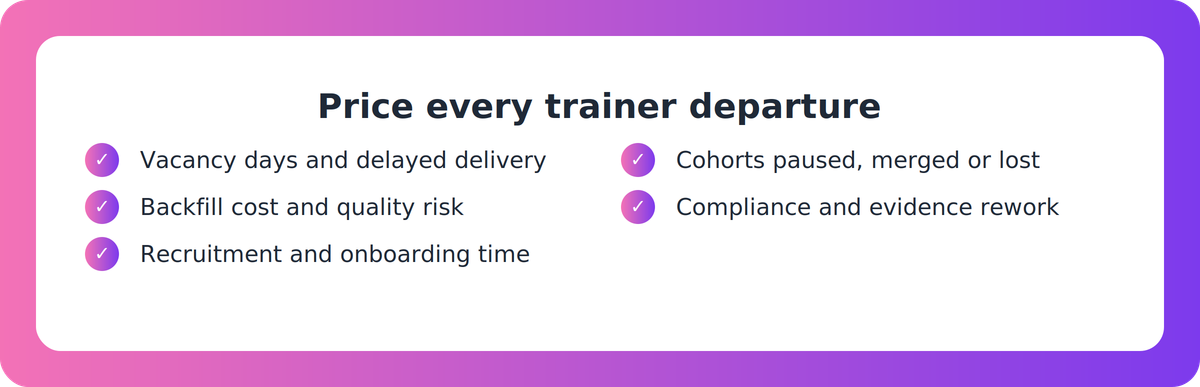
The fifth line is the one most RTOs miss. It rarely shows up in a payroll report. It shows up in someone's overtime and in the stress levels of your compliance team.
Where the compliance exposure hides
The 2025 Standards are built around the Outcome Standards, the Compliance Standards (including the Fit and Proper Person Requirements) and the Credential Policy. ASQA says it will engage more with providers and has shifted its processes to match. The practical test is simple: can you demonstrate good outcomes whoever is in the room?
If one trainer holds the real knowledge of how a unit of competency is assessed, how evidence is judged, or which industry contacts keep your content current, you can't pass that test. The knowledge lives in a head, not in the RTO.
The enforcement backdrop makes thin capacity less forgiving. ASQA told the Productivity Commission it has cancelled 13 RTOs since November 2024 for issuing qualifications without appropriate training or assessment. It has also cancelled more than 29,000 qualifications, and it is establishing independent peer validation of student assessments. Turnover didn't cause any of that. But capacity and assessment quality are clearly under scrutiny, and a stretched, constantly changing trainer pool is a poor position to be examined from.
The delivery mix is moving under you
NCVER's Total VET students and courses 2025 reports 5.1 million students. Qualification enrolments fell by 108,360, while short courses and stand-alone subjects grew. Government-funded students fell 6.6% (January to September 2025), and VET in Schools reached 276,860, up 4.1%.
That's a more varied product mix, delivered by a pool that's shrinking and casualised. A model that depends on a few long-serving trainers who carry everything in their heads won't flex across that mix. Cost pressure from regulation is also moving. ASQA has run webinars on cost recovery transition arrangements from 1 July 2026. We haven't quoted dollar impacts, so check ASQA's fees page for what applies to your RTO.
Make delivery less dependent on any one person
You can't outbid industry and universities on pay across the board. You can reduce how much a single resignation hurts. Three moves for this quarter:
- Get the tacit knowledge out of heads. Have each trainer document how they actually assess, moderate and keep currency, then check it against what your validation records say.
- Run a single-point-of-failure review. List every unit or program where one person holds the assessment judgement or the industry relationship. Those are your priorities.
- Invest in the first 90 days. If replacement is slow and expensive, a structured induction that gets a new trainer assessing consistently sooner is money you'd otherwise lose in lost delivery and rework.
On AI, stay modest. ASQA has guidance and case studies on AI in VET, and they centre on assessment integrity. We found no authoritative estimate of AI's effect on RTO costs or trainer roles. The defensible use is narrow: tools that help new or casual trainers practise, rehearse scenarios and apply your standards consistently, with human judgement still making the assessment decision. Treat it as a way to reduce dependence on individual memory, not a way to remove trainers.
Key takeaways
- Trainer turnover is a P&L and audit-readiness issue, not only an HR statistic.
- The JSA VET Workforce Study (October 2024) found national shortages, an ageing and casualised workforce, and trainers leaving for better-paid roles. It's the latest national study, but it's about two years old.
- No public benchmark exists for trainer turnover or replacement cost, so build yours from vacancy days, backfill, onboarding, lost delivery and compliance rework.
- Under the 2025 Standards you carry the evidence burden. Knowledge held by one trainer is a risk to outcomes and to your standing with ASQA.
- Reduce fragility by documenting practice, mapping single points of failure and tightening onboarding, not by assuming you can always hire your way out.
Our take
Most RTOs treat trainer departures as an HR event and a compliance event, handled by two different people on two different timelines. We think that split hides the real number. A departure is one cost with five lines, and you only see the whole thing if someone with P&L accountability adds them up.
Our position: retention isn't just about keeping people. It's also about making sure that when someone does leave, the RTO's quality and evidence don't leave with them. A provider that can do both has a genuine margin advantage in a market where nobody can hire quickly.
FAQ
What does trainer turnover really cost an RTO?
No public sector-wide figure exists, so any number you hear is an estimate. Calculate your own from five components: vacancy days, backfill, recruitment and onboarding, lost delivery, and compliance rework. Use your last two years of departures.
Is there a national shortage of VET trainers?
Yes. The Jobs and Skills Australia VET Workforce Study (October 2024) found VET teachers in shortage nationally, and in every state and territory for the previous two years. It's about two years old, so check your own local hiring experience alongside it.
How do the Standards for RTOs 2025 change the risk of losing a trainer?
The Standards focus on outcomes, and the provider carries the evidence burden. You need to show quality outcomes regardless of who is delivering. If assessment practice or industry currency sits with one person, their departure can leave an evidence and compliance gap.
Can AI solve our trainer retention problem?
Not on its own, and we found no authoritative estimate of AI's effect on RTO costs or trainer roles. ASQA's AI guidance centres on assessment integrity. Use AI modestly, to support consistent practice and reduce reliance on any one person's knowledge, with humans making assessment decisions.
Here's a first step. Pull your last three trainer departures and put a dollar figure on each across all five cost lines. Then ask what, specifically, left with them.