Trainer Retention Is a Margin Problem for RTO CEOs
29 September 2026 · 7 min read
Trainer turnover doesn't hit your P&L as a line item called "trainer turnover." It shows up as inflated cost per student, an audit that turns messy, and a delivery calendar that no longer matches what you promised your board. By the time HR raises a vacancy, the margin damage is already done.
Why this hits your desk
You own the P&L, and continuity of trainer capacity — not headcount — is what actually drives cost per student. Academic research on Australian RTO retention has found that some principals keep full-time trainers on the books through slow periods purely because losing a skilled trainer costs more than carrying idle capacity for a term; the logic, in one provider's words, is that "we'll never get them back." That's not generosity. It's a margin call.
You also answer to the board for regulatory standing, and the Standards for RTOs 2025 have tightened the line between trainer-level failure and executive accountability. Financial viability and fit-and-proper-person obligations now sit with governing persons and executives directly, so a gap in assessment validation or mapping traced back to an overstretched trainer isn't a delegated compliance issue anymore. It's yours.
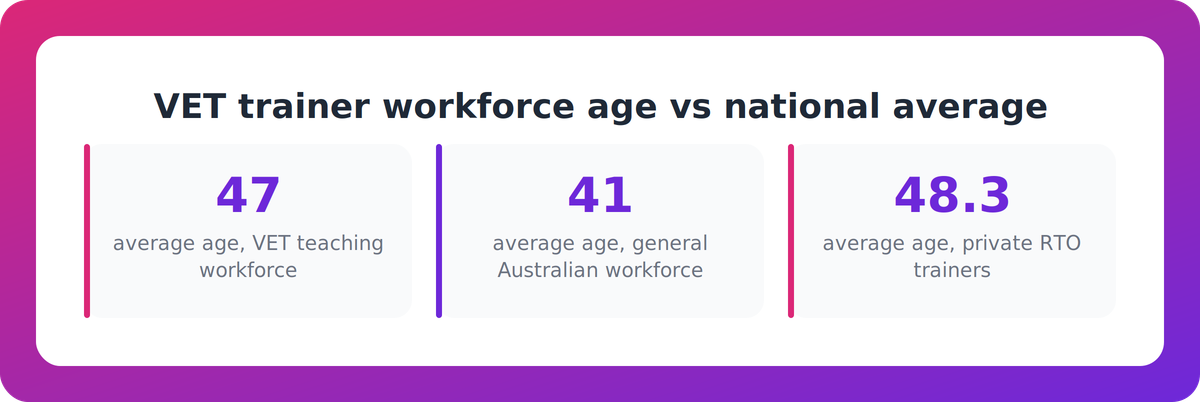
Key-person risk compounds this. Jobs and Skills Australia's VET Workforce Study (October 2024) found the VET teaching workforce averages 47 years old against 41 for the general Australian workforce — and around 48.3 for trainers at private (non-TAFE) providers — while being highly casualised. When knowledge of validation, mapping and delivery quality sits with a handful of people nearing the end of their careers, one resignation can turn into an audit-readiness problem inside a term.
And your technology strategy is now a margin decision, not an IT one. Sector commentary through 2025 and 2026 describes trainers losing disproportionate teaching time to compliance documentation, assessment design and version control — capacity you're paying for that isn't converting into delivery hours or enrolments.
The workforce you're actually staffing from
Before you can fix retention, it helps to be honest about who you're retaining. The JSA workforce study paints a sector that's older, more casualised and lower-paid than other parts of Australian education. That's not a talent-pipeline problem you solve with a better recruitment campaign — it's a structural feature of the sector, and every RTO is competing for the same shrinking pool of qualified trainers.
Retention strategies alone won't fix this
A 2025 workforce study from Skills Insight looked directly at whether attraction, retention and succession planning could solve VET workforce shortages on their own. Its finding: no. The study pointed instead to structural barriers — chief among them, excessive administrative burden created by compliance and regulatory requirements, plus the higher cost of delivery in regional and remote locations. You can run the best retention programme in the sector and still lose trainers to admin fatigue if the underlying workload doesn't change.
Compliance load is climbing while delivery capacity shrinks
The Standards for RTOs 2025, in force from 1 July 2025, restructured obligations into Outcome Standards, Compliance Requirements and a Credential Policy — and added new pre-enrolment obligations, including assessing a learner's existing skills, digital literacy and LLN proficiency before they even start. That's more administrative work loaded onto the front end of delivery, on top of everything trainers already carry.
Sector commentary has started calling this an administrative crisis: trainers spending disproportionate time on compliance, assessment mapping, documentation and version control instead of teaching. Every hour a trainer spends re-mapping evidence to a unit of competency is an hour not spent on delivery you're already charging for.
Tellingly, the regulatory framework has already acknowledged part of the problem. An earlier amendment, effective 1 March 2024, removed the requirement for trainers to hold current industry experience — specifically to address the shortage of qualified trainers. That's the regulator conceding trainer supply is a systemic constraint, not just something an individual RTO can recruit its way out of.
The one retention lever with actual evidence behind it
Academic research published in the Journal of Vocational Education & Training (2024) looked specifically at what keeps trainers at private providers. The answer wasn't pay alone — it was continuity of work. Providers that kept trainers employed full-time through fluctuating course demand, rather than standing them down between contracts, retained skilled staff for longer. It's a simple trade-off: the cost of some idle capacity against the cost of rebuilding trainer knowledge, relationships and compliance familiarity from zero.
This is a governance question now, not just an HR one
Industry commentary describes a "compliance avalanche" following the 2025 Standards — rising compliance costs squeezing provider margins across the board. Some private consultancy analysis has reported a steep decline in enterprise RTO numbers in recent years; treat that as an industry estimate rather than verified ASQA or NCVER data, but the direction it points to — fewer providers absorbing rising compliance cost per unit of delivery — is consistent with what the Standards themselves now demand.
Put those threads together and trainer attrition stops looking like a staffing gap. It's the visible symptom of a margin and governance problem: an ageing, casualised workforce, growing administrative load under the current Standards, and financial-viability obligations that now reach your desk directly when something slips.
Key takeaways
- Trainer continuity, not headcount, is what actually drives cost per student — some providers retain full-time trainers through slow periods because rebuilding lost expertise costs more than carrying idle capacity.
- The VET workforce is structurally older and more casualised than the general workforce (47 vs 41 years average, per JSA's 2024 study), concentrating compliance and delivery knowledge in fewer, older hands.
- Retention programmes alone won't fix attrition — Skills Insight's 2025 research points to administrative burden and regional delivery costs as the deeper structural barriers.
- The Standards for RTOs 2025 extend fit-and-proper and financial viability obligations to governing persons directly, so trainer-driven compliance gaps are now a board-level exposure.
- The regulator's own 2024 removal of the current industry experience requirement for trainers is an admission that trainer supply is a systemic, sector-wide constraint.
Our take
Most retention conversations in this sector are still framed as an HR exercise: better pay, better culture, succession plans. None of that is wrong, but the evidence — from Skills Insight's 2025 workforce study to the academic research on continuity of employment — points somewhere less comfortable for a CEO: the biggest lever you control is how much non-teaching load you're putting on the trainers you already have. If assessment mapping, documentation and version control are quietly eating the hours you're paying for as delivery, that's a margin decision sitting inside a workforce problem, and it's one only you can see across the whole P&L.
FAQ
Is trainer retention really a compliance risk, or just a staffing issue? Both, and increasingly the compliance side carries more weight. Under the Standards for RTOs 2025, financial viability and fit-and-proper-person obligations sit with governing persons and executives. A trainer resignation that leaves assessment mapping or validation incomplete becomes a governance exposure, not just a rostering headache.
What changed under the Standards for RTOs 2025 that affects trainer workload? The Standards restructured obligations into Outcome Standards, Compliance Requirements and a Credential Policy, and added new pre-enrolment obligations — including assessing a learner's existing skills, digital literacy and LLN proficiency before enrolment. That adds administrative work ahead of delivery, on top of existing trainer duties.
Why did the regulator remove the current industry experience requirement for trainers in 2024? The amendment, effective 1 March 2024, was made specifically to address the shortage of qualified trainers — an acknowledgement from within the regulatory framework itself that trainer supply is a sector-wide constraint, not something any single RTO can resolve through recruitment alone.
What actually works to retain trainers, based on the evidence? Continuity of work. Academic research on private RTO retention (Journal of Vocational Education & Training, 2024) found some providers retain full-time trainers through fluctuating demand specifically to avoid losing skilled staff permanently — treating the cost of occasional idle capacity as cheaper than rebuilding trainer expertise from scratch.