Trainer Retention Is Now a CEO-Level Risk in NZ VET
22 September 2026 · 8 min read
Trainer burnout used to be a line in your HR report. From January 2026 it's a line in your funding risk register too. TEC now weighs pass rates and financial performance when it decides who gets funded, and NZQA's new registration rules pile fresh reporting onto the same stretched compliance and delivery staff whose fatigue is what drives those numbers down in the first place.
Why this lands on your desk, not HR's
You don't get judged on staff sentiment surveys. You get judged on pass rates, financial performance, audit outcomes and whether the enrolment pipeline holds. The problem is that trainer and assessor workload now sits directly upstream of all four.
TEC has said for three years running, 2025 through 2027, that government funding won't cover forecast tertiary enrolment demand. Its 2026 funding guidance goes further: decisions will factor in pass rates, financial performance and a provider's contribution to the wider network of provision, and some providers are explicitly at risk of reduced or lost funding. If your trainers are stretched thin and pass rates slip, that's not an abstract quality issue — it's a direct input into whether your next funding round shrinks.
At the same time, NZQA's Private Training Establishment Registration Rules 2026, in force from 19 January 2026, add obligations that land on the same small compliance and academic team: an explicit requirement for adequate internal financial controls, sub-contracting rules relocated and updated under the Quality Assurance of Tertiary Education Providers Rules 2026, and a standing requirement to report completed qualifications within two months. None of this is optional, and none of it comes with extra headcount attached.
The maths TEC now runs on your provider
Budget 2025 lifted tuition subsidies — 3% for priority provision, 1.75% for Levels 7 to 10 — but TEC's own figures suggest that still only funds around 99% of forecast enrolments in 2025 and 2026. Read that carefully: even a well-run, well-performing provider is likely to face a shortfall through no fault of its own.
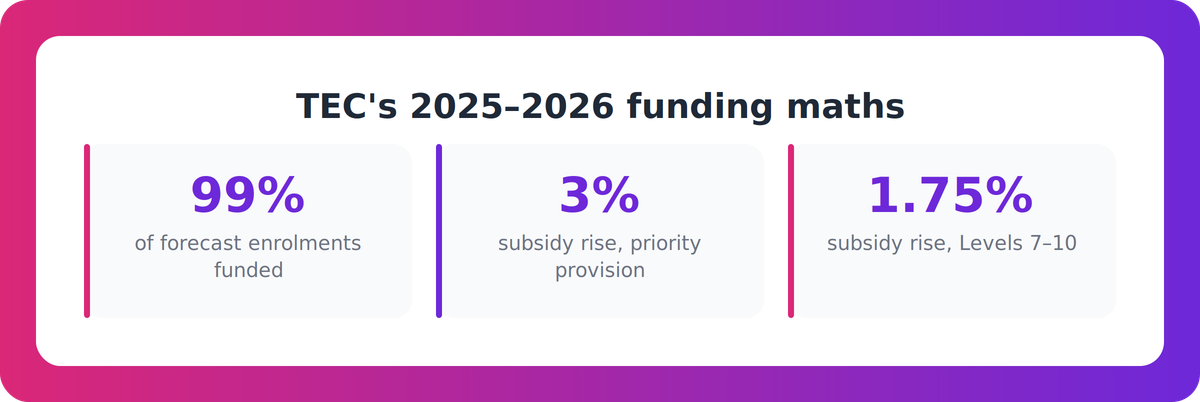
Layer pass-rate-linked funding on top of a shortfall and the incentive structure gets sharper. Providers can't grow their way out of the gap by enrolling more students if delivery quality — and therefore completions — dips because the people doing the delivering are stretched. Margin pressure and workforce pressure become the same problem viewed from two angles.
Three new obligations landing on the same desks
The risk isn't any single NZQA deadline. It's that the obligations run concurrently and draw on the same finance, compliance and delivery staff who are already carrying assessment loads, moderation and reporting.
- Internal financial controls now have to be demonstrably adequate, not just present on paper.
- Sub-contracting arrangements sit under relocated, updated rules that someone has to re-map and re-document.
- Completed qualifications must be reported within two months, on a standing basis, not as a periodic catch-up.
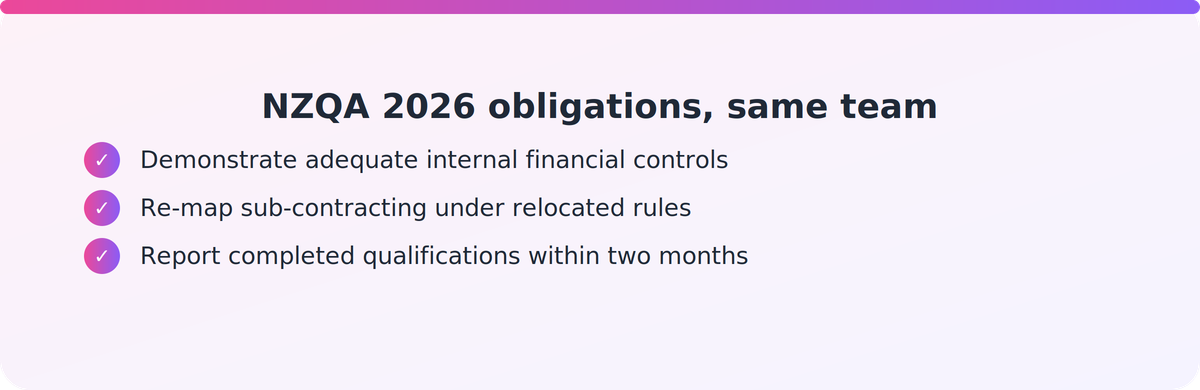
If your provider relies on one or two people who understand both the compliance framework and the delivery side, that's key-person risk sitting inside your audit exposure. A resignation in the wrong month doesn't just cost you a hire — it can cost you a deadline.
A tighter market for the people you need to keep
The vocational education and training legislation passed in October 2025 disestablished Te Pūkenga and established ten regional polytechnics and Industry Skills Boards from 1 January 2026. That's a genuine reshaping of the provider landscape, and it means a wider field of employers competing for the same pool of skilled trainers and assessors at exactly the moment workload is rising for everyone.
If you've assumed your trainers have nowhere else to go, that assumption is weaker than it was twelve months ago. A stretched, under-supported team in a market with more employer options is a retention problem waiting to surface at the worst time — mid-audit, mid-cohort, or mid-funding review.
What actually keeps trainers in the sector
Peer-reviewed VET retention research from 2024 is fairly consistent on what keeps educators in the sector: employment conditions, workload and lifestyle balance, support for professional development, and a genuinely supportive culture. These aren't soft extras — they're the levers.
A 2025 study on vocational teacher burnout points the same direction from the other side: work pressure and workload intensity are the most significant drivers of burnout, made worse by insufficient resources and support. New Zealand doesn't yet have its own published burnout statistics for the sector, but the mechanism described in that research — rising demands without matching resourcing — maps closely onto what NZQA's 2026 rules and TEC's funding conditions are doing to compliance and delivery teams right now.
The visibility gap you're expected to manage anyway
Here's the uncomfortable part: no NZ regulator currently publishes trainer burnout or turnover data for the sector. You have no benchmark to know whether your resignation rate, your sick leave pattern, or your assessor turnover is normal or a warning sign. NZQA will still expect you to demonstrate financial control and reporting discipline, and TEC will still weigh your pass rates, regardless of whether you had the data to see the problem coming.
That gap is worth closing internally even if no one externally is measuring it. Track assessor and trainer turnover, moderation turnaround times, and time spent on compliance reporting the same way you track enrolment and revenue. If those numbers are moving in the wrong direction, they're an earlier warning than a dip in pass rates will ever be.
Some providers are also looking at where instructional design time actually goes — building role plays, practice scenarios and assessment content is often the slowest, most resource-hungry part of a trainer's week, and OECD and Manukau Institute of Technology research on AI-assisted assessment design suggests there's real scope to compress that cycle without cutting corners on quality. That's a resourcing lever worth understanding, whatever you decide to do with it.
Key takeaways
- TEC's 2026 and 2027 funding decisions factor in pass rates and financial performance, meaning trainer burnout now has a measurable line to funding outcomes.
- NZQA's Private Training Establishment Registration Rules 2026 add internal financial control requirements, relocated sub-contracting rules, and two-month completion reporting — all landing on the same stretched staff.
- The disestablishment of Te Pūkenga and the launch of ten regional polytechnics and Industry Skills Boards from January 2026 has widened the market competing for skilled trainers and assessors.
- VET retention research consistently points to workload, employment conditions and professional development support as the levers that keep trainers in the sector.
- No NZ regulator publishes trainer burnout or turnover benchmarks, so CEOs need to track their own workload and turnover indicators rather than wait for a sector signal.
Our take
Boards tend to treat staff wellbeing as a lagging, soft metric — something HR reports on after the fact. The regulatory settings for 2026 and 2027 don't allow that anymore. When funding is explicitly tied to pass rates and financial performance, and compliance obligations are stacking on the same small team, workforce strain becomes a leading indicator you can actually watch, months before it shows up in a funding letter or an audit finding. Treat trainer workload and turnover as seriously as you treat enrolment and cash flow, because in this funding environment, they're feeding the same outcome.
What would it take for your provider to spot a retention problem three months before it hits a pass rate?
FAQ
Does TEC funding really depend on trainer retention? Not directly — but TEC's 2026 funding guidance ties decisions to pass rates and financial performance, and both are heavily influenced by whether trainers and assessors are stretched thin or well-supported. Burnout is an upstream driver of the outcomes TEC is now measuring.
What do the NZQA 2026 rules actually add for PTEs? The Private Training Establishment Registration Rules 2026, in force from 19 January 2026, introduce an explicit requirement for adequate internal financial controls, relocate and update sub-contracting rules under the Quality Assurance of Tertiary Education Providers Rules 2026, and add a standing requirement to report completed qualifications within two months.
How does the disestablishment of Te Pūkenga affect my ability to retain trainers? The October 2025 legislation disestablished Te Pūkenga and created ten regional polytechnics and Industry Skills Boards from 1 January 2026, widening the field of employers competing for the same pool of skilled trainers and assessors during a period of sector transition.
Is there a benchmark I can use to know if my burnout risk is normal? No NZ regulator currently publishes trainer or assessor burnout or turnover data, so there's no official benchmark. The practical approach is to track your own turnover, moderation turnaround and compliance reporting time as leading indicators, since 2025 burnout research identifies workload intensity as the most significant driver of the problem.