Trainer Retention in NZ Vocational Training: A CEO's View
6 October 2026 · 7 min read
Trainers rarely leave a PTE for money alone. More often the unseen work has become a second job: keeping the quality system current, evidencing assessment practice, rewriting materials after hours. That is an operating-model problem, and it belongs to the CEO or GM, not to HR or the annual pay review.
One caveat first. We found no authoritative NZ data on why vocational trainers leave, so none is quoted here. What follows is a hypothesis for you to test in your own organisation, built on what has changed in the regulatory load.
Why this lands on your desk
You own the P&L and the people risk. Losing a strong trainer or a compliance lead is a margin issue, a delivery issue and a regulatory-standing issue all at once.
It's also a structural moment. Te Pūkenga was disestablished by legislation passed in October 2025. From 1 January 2026 there are 10 regional polytechnics and 8 Industry Skills Boards, and the ISBs temporarily manage work-based training through to the end of 2027. The TEC has said it will transition more work-based learning providers into PTEs or polytechnics.
That is a lot of uncertainty for staff to carry. It is also a strategic question for you about delivery mode and growth. Add a heavier compliance rhythm and you have the conditions for quiet burnout in the people you can least afford to lose.
The quality load just became annual
NZQA's integrated Quality Assurance Framework went live on 15 January 2026. It replaces EER with an annual self-review. From 1 January 2026 NZQA is not starting new EER processes or consistency reviews, though those already underway will be completed.
Providers now submit an annual self-review summary report and meet NZQA to discuss the improvement plan. The Quality Assurance of Tertiary Education Providers Rules 2026 replace the 2022 rules and require an up-to-date quality management system.
The updated NZQA rules came into force on 19 January 2026. The PTE Rules 2026 replace the PTE Registration Rules 2025 and the PTE Enrolment and Academic Records Rules 2022, and remove the annual fee.
The point for you is the rhythm. Quality used to peak around a review. Now it is a yearly operating duty, and someone in your PTE has to keep the system alive between reports.
Who is quietly absorbing it?
That "someone" is the question. In many PTEs it is not a role in the org chart. It is one or two people who care enough to keep things tidy: the trainer who also owns moderation, the programme lead who knows where every version of every assessment lives.
This work is hard to see. It happens in evenings, in shared drives, in someone's head. It doesn't show up in a utilisation report, so it doesn't show up in a pay review either.
The risk compounds the better the person is. Your most capable trainers get handed the tasks that need judgement, so they carry the most invisible load and become the people the business can't afford to lose. Neither NZQA nor the TEC has said anything on key-person risk, so no outside body will flag this for you. You have to look for it yourself.
Assessment practice is under a brighter light
Two further pressures land on the same people.
First, NZQA has reportedly proposed three quality descriptors (Highly Effective, Effective, Not Effective) across four areas, with assessment practice one of them. That comes from a secondary report, and we did not retrieve NZQA's own consultation document, so treat it as proposed and unconfirmed. But the direction is clear: assessment practice is likely to be looked at more closely.
Second, NZQA encourages providers to support staff to understand how generative AI can be used in teaching, learning and assessment, and to review academic integrity policies regularly. Its guidelines recommend four elements: uphold, prevent, detect and respond.
Every one of those elements lands on trainers and assessors. The leadership question is whether they are given time and support to do it, or simply expected to absorb it on top of delivery.
A test you can run this month
You don't need a consultant to check your exposure. You need a few uncomfortable questions and honest answers.
- Who maintains the quality management system today, and what happens if they are away for six weeks?
- Who wrote the last annual self-review, and how many hours did it take outside paid time?
- Which two or three people do others go to for the answer on assessment and moderation?
- Who is working out what generative AI means for your assessments, and is that written into anyone's workload?
- Would your delivery calendar survive one of those people resigning in March?
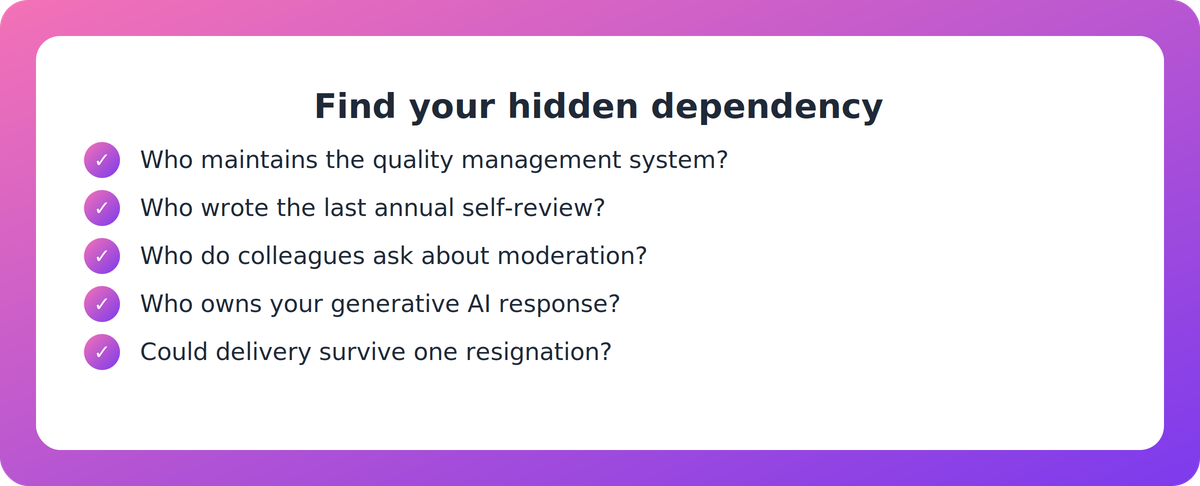
If the same two names keep coming up, you have found the dependency. A salary rise won't remove it. It might just make the resignation more expensive to replace.
What to do with the answer
Move from "who is willing" to "who is resourced". That means three practical steps.
- Name the owner and the deputy. Put quality management system upkeep and the annual self-review in a position description, with allocated hours.
- Make the hidden hours visible. Ask trainers to log non-delivery work for a month. The gap between paid and actual time is your retention risk, in hours.
- Decide what stays manual. Some of the work needs human judgement. Much of it is version control, mapping and formatting. Be deliberate about which is which, and fix the repetitive part by whatever means suits your size.
Key takeaways
- Trainer retention is an operating-model decision about where compliance and assessment work sits, not only a pay question.
- NZQA's Quality Assurance Framework, live 15 January 2026, makes self-review and a current quality management system an annual duty.
- The people absorbing that duty are often your best trainers, and the work is rarely visible in workload models.
- Assessment practice is proposed as one of four quality areas (unconfirmed), and NZQA expects providers to address generative AI and academic integrity.
- No NZ data on trainer turnover was found. Test the hypothesis internally before acting.
Our take
Most retention conversations start with the pay band and end with a counter-offer. We think that's the wrong place to begin. Pay is the visible lever, so it gets pulled, but a trainer who is quietly running your quality system at 9pm is not asking for a rise. They're asking for the work to be seen.
The 2026 changes don't create this problem. They make it harder to ignore, because quality is now a yearly rhythm that needs an owner. If that owner is whoever cared enough to volunteer, you are running a regulatory obligation on goodwill.
The first step costs nothing. Before your next board meeting, write down who would have to be replaced to keep your quality management system current, then ask yourself whether they know how much you rely on them.
FAQ
What changed in NZQA quality assurance in 2026?
NZQA's integrated Quality Assurance Framework went live on 15 January 2026, replacing EER. Providers now complete an annual self-review, submit a summary report, maintain an up-to-date quality management system, and meet NZQA to discuss their improvement plan.
Is there data on why NZ vocational trainers leave?
We found no authoritative NZ data on vocational trainer turnover or reasons for leaving. The link between compliance workload and retention here is a leadership hypothesis, so test it with your own people and workload records.
How do I spot key-person risk in compliance?
Ask who maintains the quality management system, who writes the annual self-review and who answers assessment and moderation questions. If the answers point to one or two people with no deputy and no allocated hours, you have key-person risk.
Are the proposed NZQA quality descriptors confirmed?
No. A secondary source reports proposed descriptors of Highly Effective, Effective and Not Effective across four areas, including assessment practice. NZQA's consultation document was not retrieved, so treat the proposal as unconfirmed until NZQA publishes final settings.