Skill Mix Over Headcount: Trainer Rostering for NZ VET
22 September 2026 · 8 min read
Timetabling by headcount is about to become a compliance liability, not just an inefficiency. As NZQA replaces external consistency reviews with provider-led self-review, and standard-setting reorganises around new Industry Skills Boards, the only real check on assessment consistency is whether your trainer roster was built around skill currency and site coverage — not who happened to be free.
Why this lands on your desk
Under the Programme Approval, Recognition, and Accreditation Rules 2026, in force from 19 January 2026, NZQA discontinued consistency reviews from 1 January 2026 and removed references to external evaluation and review in favour of self-review and monitoring. That's not a paperwork change. It moves the burden of proving assessment consistency across sites and assessors onto you, with no external review sitting behind it to catch what internal moderation misses.
At the same time, the bodies you'd normally call to confirm a standard's currency are mid-reorganisation. October 2025 legislation disestablished Te Pūkenga, established ten regional polytechnics from 1 January 2026, and handed standard-setting, qualification development and temporary management of work-based training to eight new Industry Skills Boards during a two-year transition. The former Te Pūkenga continues as NZIST, a transitional entity supporting programme handover, with four polytechnics — NorthTec, WITT, Whitireia/WelTec and Tai Poutini — still inside NZIST pending viability decisions expected in the first half of 2026. If your training spans multiple regions, the contact you'd ring to check whether a trainer is current on a standard may not be the one you rang last year.
And you're doing all this on a tighter budget. In June 2025, TEC confirmed it would remove extra funding for Māori and Pasifika vocational enrolments and cut workplace training funding by around 8% of its budget, while holding funding steady for disabled learners and those with low prior achievement. Fewer dollars for workplace training means fewer trainer hours to allocate carefully — right as the margin for allocating them badly has shrunk.
The self-review shift changes what "good" looks like
Under the old regime, an external consistency review was a backstop. If your internal moderation had a gap — an assessor moderating their own decisions, a site never sampled — there was a reasonable chance someone from outside would eventually notice. That backstop is gone for consistency reviews specifically. NZQA's own moderation guidance already assumes providers will carry this risk: assessment materials moderated before use, assessor decisions checked before results are reported, moderators independent of the assessor or designer where possible, and learner samples drawn from every site delivering a standard to check consistency of marking across assessors.
Notice that the last two requirements are rostering problems dressed up as quality-assurance problems. Role separation only works if your timetable doesn't put the same person designing, assessing and moderating the same standard. Cross-site sampling only works if you know, site by site, which trainer delivered which standard to which cohort — information that lives in the roster, not in a moderation policy document.
Standard-setting is in flux — so is trainer currency
Providers with consent to assess must participate in national external moderation, supplying NZQA with an accurate assessment plan and evidence that assessor judgements are fair, valid and consistent nationally. The core principle is that judgements hold up "regardless of who does the assessing or when the assessment occurs." That principle is harder to guarantee when the Industry Skills Board responsible for a given standard is newly formed, still building its moderation contacts, and possibly reviewing the standard itself as part of the transition. A trainer who was current six months ago against a standard now sitting with a different board is a currency question you can't outsource — you need to know, and you need to roster around the answer.
A tighter budget, a wider quality net
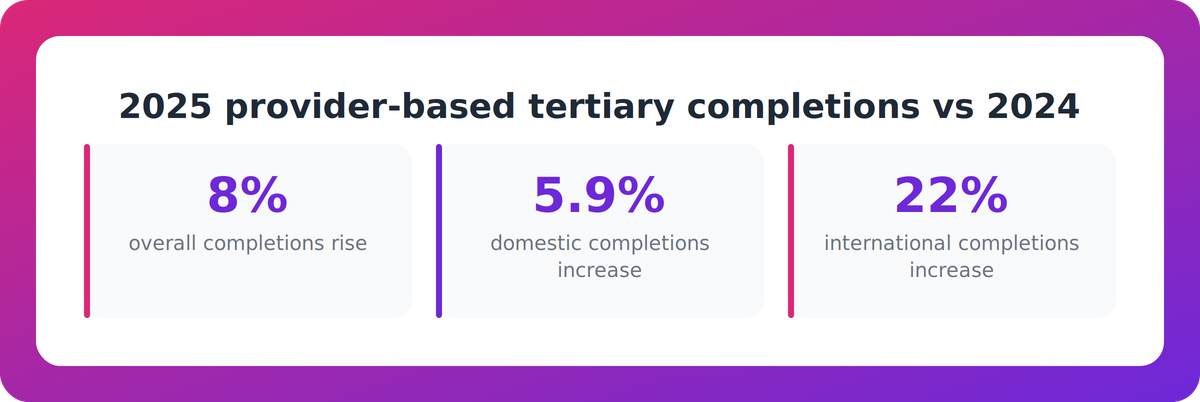
The temptation under budget pressure is to timetable for coverage first and quality second — put someone qualified-adjacent in the room rather than leave a gap. Educational Performance Indicators, which TEC uses to track progression, retention and completion including outcomes for Māori and Pacific learners, make that trade-off visible eventually. Ministry of Education data shows provider-based tertiary completions rose 8% in 2025 against 2024, with domestic completions up 5.9% to 123,200 and international completions up 22% to 21,230. That's a genuinely good national trend. But New Zealand still records one of the lowest higher education completion rates in the OECD, which means EPI performance stays a live measure of whether individual rostering decisions are actually landing for learners — not just whether classes ran.
A rostering checklist grounded in NZQA moderation rules
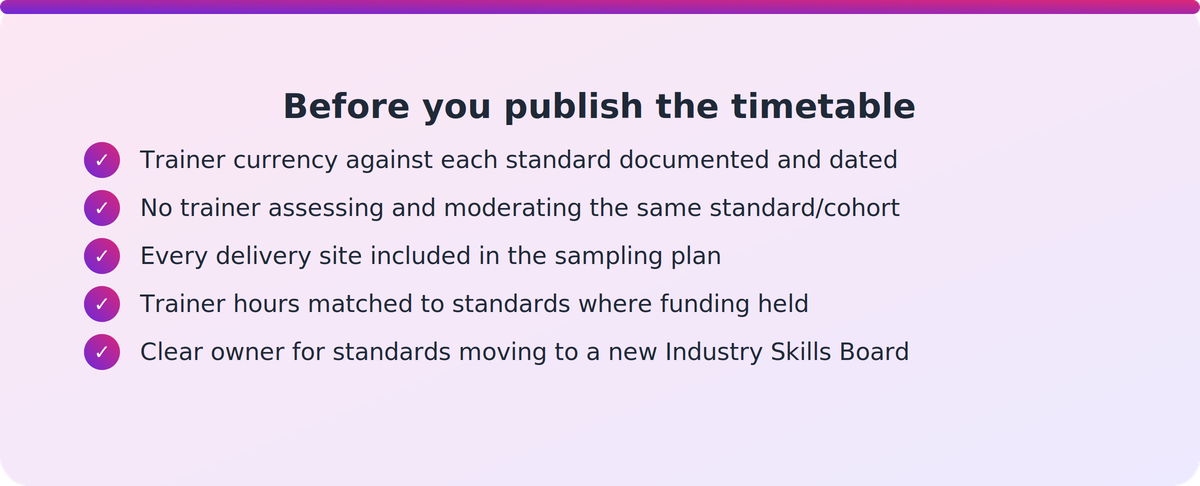
A timetable built as a quality-assurance instrument, not just a scheduling grid, needs to answer a handful of questions before it's published, every term:
- Is every trainer's currency against the specific standard they're teaching documented and dated, not assumed from last year?
- Does any trainer assess and moderate the same standard for the same cohort?
- Has every site delivering a shared standard been included in the sampling plan for that moderation cycle?
- Are trainer hours matched to the standards where funding has actually held, rather than spread evenly across a shrinking pool?
- Who owns the check when a standard moves to a new Industry Skills Board mid-cycle?
None of this needs new software to start. It needs the roster treated as a live compliance record, reviewed with the same seriousness as a moderation plan, because under the 2026 rules it functionally is one.
Key takeaways
- NZQA's Programme Approval, Recognition, and Accreditation Rules 2026 discontinued consistency reviews from 1 January 2026, shifting ongoing quality assurance onto provider self-review.
- Standard-setting has moved to eight new Industry Skills Boards during a two-year transition from 1 January 2026, so trainer currency checks may need new contacts and confirmation.
- TEC's mid-2025 funding decisions cut workplace training funding by roughly 8% and removed extra funding for Māori and Pasifika vocational enrolments, tightening the hours available to roster carefully.
- NZQA moderation guidance requires role separation between assessor and moderator, and cross-site sampling for any standard delivered across multiple locations — both are rostering decisions before they're quality decisions.
- National completions rose 8% in 2025, but New Zealand's completion rate remains low by OECD standards, keeping EPI performance a real test of whether rostering choices translate into learner outcomes.
Our take
The uncomfortable part of this transition isn't the extra documentation — it's that inconsistent assessment quality will now surface through learner outcomes and internal moderation records before anyone external tells you it's a problem. That's a harder signal to catch, and a slower one. The providers that come through this in good shape will be the ones who stopped treating the roster as an operations artefact and started treating it as evidence: proof, built into the schedule itself, that the right person was in the right room against the right version of the standard. That's a cultural shift for a training team as much as a process one, and it's worth starting before the next moderation cycle forces the question.
FAQ
Does provider self-review under the 2026 rules mean less NZQA oversight overall? No — it means the type of oversight has changed. External consistency reviews were discontinued from 1 January 2026, but providers with consent to assess must still participate in national external moderation and supply accurate assessment plans and evidence of fair, valid, nationally consistent assessor judgements.
Who do I contact now to confirm a standard's currency if my previous contact was through Te Pūkenga? Standard-setting and qualification development have moved to eight new Industry Skills Boards as part of a two-year transition from 1 January 2026, alongside NZIST continuing as a transitional entity supporting programme handover for some polytechnics. Confirm the current owning body for each standard you deliver rather than assuming continuity from 2025 contacts.
How does the TEC funding change affect trainer resourcing specifically? TEC's June 2025 decision reduced workplace training funding by around 8% of its budget and removed extra funding for Māori and Pasifika vocational enrolments, while maintaining funding for disabled learners and those with low prior achievement. That directly narrows the hours available for trainer allocation, making deliberate rostering more important, not less.
What does NZQA's moderation guidance actually require of a timetable? It requires assessment materials to be moderated before use, assessor decisions checked before results are reported, moderators independent of the assessor or designer where possible, and learner samples drawn from every site delivering a standard to check consistency across assessors — all of which depend on how trainers are rostered across standards and sites.