Trainer Utilisation in RTOs: The Metric You're Getting Wrong
3 September 2026 · 7 min read

Trainer utilisation, as most RTOs calculate it, measures the wrong constraint. It counts contact hours delivered against hours paid, when the real capacity question is how much of a trainer's week goes into the evidence, mapping and validation work that now determines whether your organisation passes an audit at all.
That gap matters because you can't fix it by hiring. Jobs and Skills Australia has confirmed a VET teacher shortage in every state and territory for the past two years, with roughly 3,800 more VET teachers needed over the next five years just to keep pace with projected 21% employment growth by 2033. If your utilisation metric is telling you to add headcount, it's giving you advice you can't act on.
Why this hits your desk
You own the rostering model. You're the one who has to decide whether a trainer's non-contact time is overhead to be squeezed or core delivery capacity to be protected — and the 2025 Standards for RTOs, which took effect on 1 July 2025, just made that decision harder to get wrong. The revised standards shifted ASQA's compliance emphasis from written policy to demonstrated evidence of practice. That means the hours a trainer spends validating assessments, mapping coverage against a unit of competency, or building assessor-guide documentation aren't administrative drag anymore — they're the evidence an auditor will actually ask to see.
Most utilisation dashboards still treat that time as unbillable. If yours does, you're optimising trainers toward the metric and away from the compliance work the Standards for RTOs 2025 now requires.
What the 2025 Standards changed about trainer time
Under the previous approach, a well-written policy on assessment validation could carry you through an audit. Under the current standards, ASQA wants to see the practice: validated mapping, moderated judgements, documentation that shows the system operates the way it says it does, not just the way it's described on paper.
That's a meaningful shift in what 'productive' trainer time looks like. Coverage mapping against training package requirements, pre-delivery validation, and assessor-guide preparation are now part of the evidence trail — not preparation that happens somewhere off the utilisation ledger. If your reporting still separates 'delivery hours' from 'compliance hours' as though they're competing for the same trainer's attention, you're measuring against a standard that no longer exists.
Two enrolment cohorts, one utilisation target
Government-funded enrolments fell 6.6% nationally across January–September 2025 compared with the same period in 2024, with qualification enrolments dropping even faster, at 8.7%. Fee-for-service enrolments grew over the same window, but the pattern isn't uniform — NSW enrolments declined while South Australia and Western Australia grew.
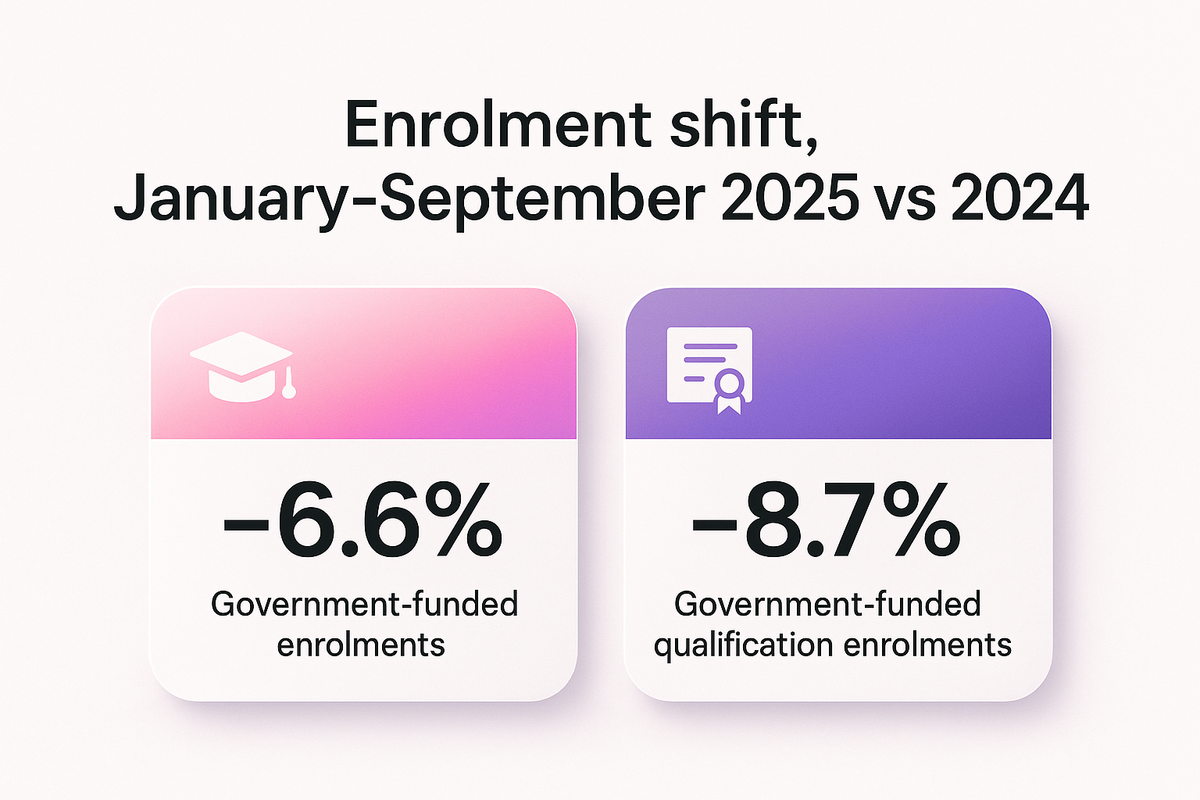
That divergence breaks the logic of a single utilisation benchmark applied across a multi-site provider. A funded cohort shrinking in one state and a fee-for-service cohort expanding in another don't need the same trainer capacity model, the same rostering assumptions, or the same definition of a 'full' timetable. Applying one number to both is how COOs end up either overstaffed against declining funded demand or under-resourced against growing commercial demand — often in the same organisation, in the same quarter.
The reporting overlap nobody budgeted for
AVETMISS reporting deadlines remain in force through this transition — 2025 submissions are due 28 February 2026, and RTOs with zero activity still have to lodge a Nil Return. At the same time, the sector is moving toward the new VET Information Standard, with the amended Data Provision Requirements taking effect 1 October 2026.
That's a dual-reporting period sitting on top of the same trainer and admin capacity your utilisation metric is meant to protect. If the metric doesn't account for reporting load explicitly, you'll find out the hard way — when a reporting deadline collides with a delivery peak and something gives.
Redefining what the number should count
A utilisation figure that only tracks contact hours hides the work that keeps you compliant and audit-ready. A more honest version accounts for:
- Contact hours delivered against timetabled hours
- Assessment validation and moderation time
- Coverage mapping against units of competency
- Evidence-of-practice documentation and assessor-guide preparation
- Reporting load tied to AVETMISS and the incoming VET Information Standard
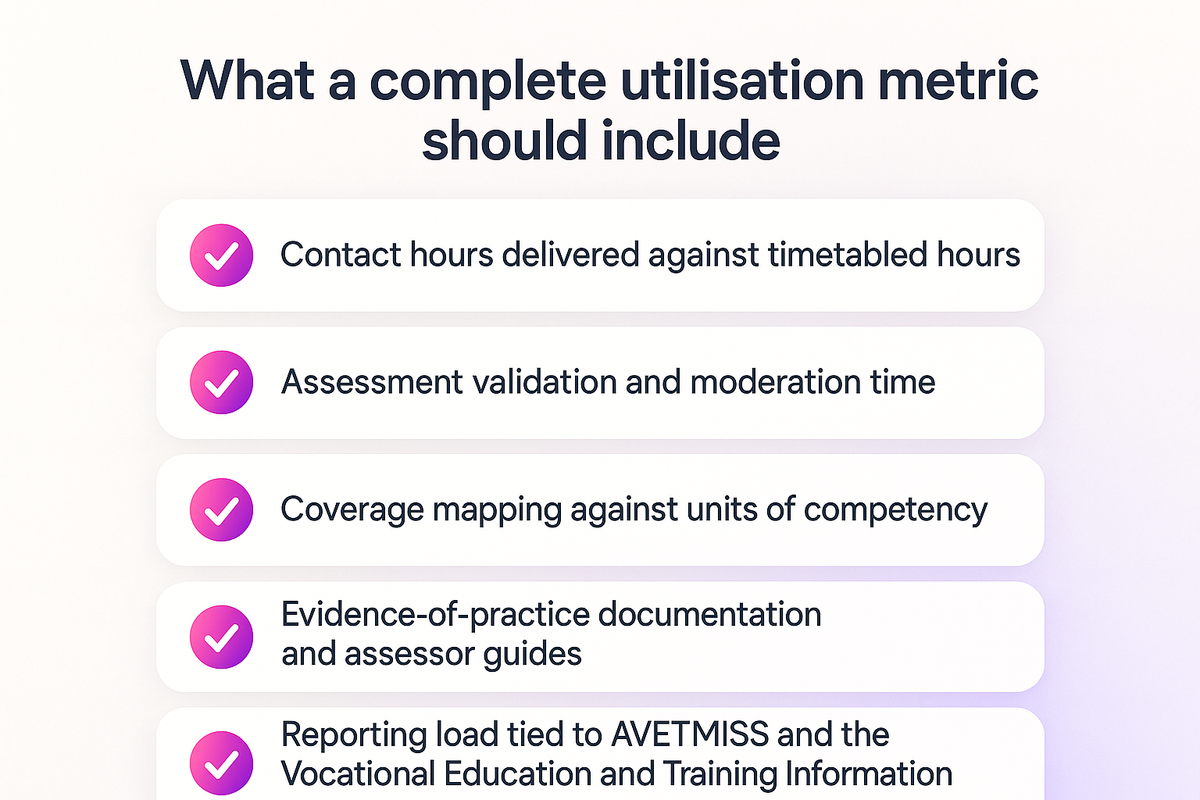
None of that needs to be tracked to the minute. But if it isn't visible in your utilisation reporting at all, you're managing capacity on incomplete information — and so is your board.
Key takeaways
- Trainer utilisation calculated as contact hours over paid hours no longer reflects what the 2025 Standards for RTOs require — evidence-of-practice work is now compliance-critical, not overhead.
- With a confirmed national trainer shortage and roughly 3,800 more VET teachers needed over the next five years, hiring can't be your default response to a capacity gap.
- Government-funded enrolments fell 6.6% (and qualification enrolments 8.7%) from January to September 2025, while fee-for-service demand grew unevenly by jurisdiction — one utilisation target can't serve both cohorts.
- The overlapping AVETMISS and VET Information Standard reporting requirements through 2026 add a parallel workload on the same trainer and admin capacity your metric is supposed to be protecting.
- Redefine utilisation to include validation, mapping and reporting time, or you're managing your workforce on a number that hides most of the real work.
Our take
Utilisation metrics tend to survive long after the operating environment that justified them has changed, because they're easy to report and everyone already understands them. That's exactly why this one is worth challenging now. A COO who redefines trainer utilisation to include evidence-of-practice work isn't adding bureaucracy — they're making the metric tell the truth about where capacity actually goes, which is the only way to plan for a workforce you can't simply scale up. If your dashboard still shows trainers at 85% utilisation while your compliance team is quietly absorbing validation and mapping work unaccounted for anywhere, the 85% is the wrong number to be proud of.
FAQ
Does the 2025 Standards for RTOs specify how to measure trainer utilisation? No. The standards, effective 1 July 2025, don't prescribe a utilisation formula — they require demonstrated evidence of practice across training and assessment systems. That shift in emphasis is what makes validation, mapping and moderation time compliance-relevant, even though ASQA doesn't dictate how you track trainer capacity internally.
Can we solve trainer capacity constraints simply by hiring more trainers? Jobs and Skills Australia's VET Workforce Study found a shortage of VET teachers in every state and territory for the past two years, with about 3,800 additional VET teachers needed over the next five years. Regional and rural RTOs face the sharpest shortages. Hiring remains part of the answer, but it's not a reliable single lever given the structural constraint.
How does the shift from AVETMISS to the VET Information Standard affect our reporting workload? AVETMISS obligations remain in force in the interim — 2025 submissions are due 28 February 2026, including Nil Returns for providers with no activity — while the amended Data Provision Requirements under the new VET Information Standard take effect 1 October 2026. RTOs are effectively managing both frameworks through this transition period, which adds reporting load on top of existing utilisation pressures.
Should we apply the same utilisation benchmark across a multi-site or multi-sector RTO? Probably not. Government-funded enrolments and fee-for-service enrolments are moving in different directions and at different rates by jurisdiction, with NSW declining while South Australia and Western Australia grew across January–September 2025. A single utilisation target applied uniformly risks over- or under-resourcing one cohort while managing to the other.