Trainer Workload Management in NZ Vocational Training
31 August 2026 · 7 min read

Ask any Head of Training how many hours a trainer spends in front of learners each week and you'll get a precise number, usually to the half-hour. Ask how many hours they spend marking, mapping evidence to standards, and preparing for moderation, and the number goes vague — because nobody timetables for it, and that untimetabled load is what's actually deciding whether your assessment quality holds through the current reform.
Why this lands on your desk
You own trainer capability and workload. You're accountable for validation and moderation quality. And right now both of those things are under pressure from two directions at once: a base workload that New Zealand research already shows is heavier than the timetable suggests, and a regulatory handover happening mid-cycle, whether you asked for it or not.
Workforce Development Councils (WDCs), which managed national external moderation of industry unit standards, ceased operations on 19 December 2025. Industry Skills Boards (ISBs) became operational from 1 January 2026. New NZQA rules — the Directory of Assessment and Skill Standards Listing and Operational Rules 2026 and the Programme Approval, Recognition, and Accreditation Rules 2026 — take effect 19 January 2026, updating terminology to reflect the Education and Training (Vocational Education and Training System) Amendment Act 2025 and removing the previous five-year maximum period for programme reviews. None of that is workload in the sense of a class to cover. All of it lands as re-orientation hours for you and your team, on top of a base that was already stretched.
What NZ research says trainers actually do with their time
This isn't a hunch. New Zealand research into vocational education and training reform found that vocational educators' day-to-day practice is consistently more teacher-centred than the practice they say they'd ideally deliver — and that the gap is driven by workload dominated by marking and administration, ahead of things like building learner rapport. In other words: the hours that don't show up on a timetable are the hours crowding out the teaching your trainers actually want to do.
The same research points to a structural problem worth sitting with: vocational educators often work without a strong, formally supported sense of their educational position or function. There's little formal guidance for the complexities of the role. If you're onboarding trainers into a sector currently changing its regulator relationships, its rules, and in some cases its employer, that identity gap is exactly where confidence and consistency go missing first.
The moderation sample size just changed — and the body running it just changed too
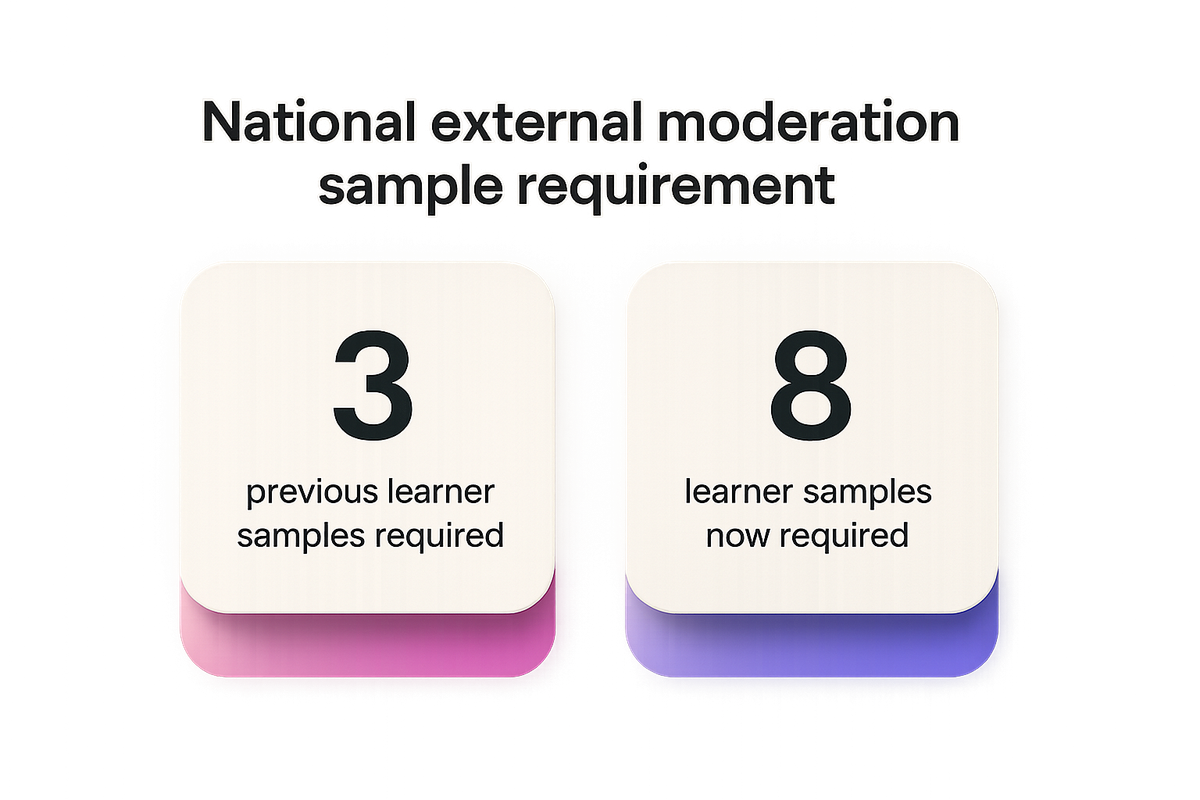
National external moderation now requires providers to submit eight randomly selected learner samples, up from three. Learners are entitled to only one resubmission and one further assessment opportunity. That's not a rounding change — it's close to a threefold increase in the evidence a subject-specialist trainer has to prepare, check and submit per moderation round, at the same time as the body coordinating that moderation for industry standards has changed from WDCs to ISBs.
Internal moderation (verification) still has to happen first, and it still has to be done by someone with standard-specific subject knowledge, before results go anywhere near NZQA. That's a skilled task, not an admin task — and it's exactly the kind of work that gets squeezed when trainer headcount is tight and nobody has flagged it as a distinct workload line.
The consistency bar you're accountable for
NZQA's national external moderation principles are direct on this point: assessor judgements must be reliable and accurate across all learners, "regardless of who does the assessing or when the assessment occurs." That's the formal standard behind every informal worry you've had about one trainer marking tighter than another, or a newer trainer interpreting a unit standard differently under time pressure.
Holding that bar gets harder, not easier, when moderation prep time is the first thing that gets absorbed into delivery hours because nobody costed it separately. If your TAS documentation and assessor guides aren't consistent across your trainer team before a sample goes to national moderation, the eight-sample requirement will find that out for you.
Capacity planning in a shrinking, shifting workforce
This is playing out against a sector that's already lost people. At least 154 roles, one campus and multiple courses have been cut across ten institutes of technology and polytechnics ahead of Te Pūkenga's disestablishment. Four polytechnics remain in a transitional holding pattern under NZIST, with viability decisions expected in the first half of 2026. If you're planning trainer capacity for the next two quarters, you're doing it without a settled picture of who else is in the system, or what support structures around moderation and standards will look like once the ISB handover beds in.
That makes the case for treating moderation prep, internal verification and TAS re-orientation as a named, protected block of trainer time — not a task that gets fitted around timetabled delivery when there's a gap. It won't appear in any reform announcement, but it's the workload that determines whether your next moderation round goes smoothly or turns into a scramble.
Key takeaways
- NZ research on vocational educators shows workload dominated by marking and administration, not classroom time — the timetable undercounts the real job.
- National external moderation now requires eight learner samples per round, up from three, with only one resubmission and one further assessment chance for learners.
- WDCs ceased operations 19 December 2025; ISBs took over from 1 January 2026 — a body handover sitting inside live moderation cycles.
- New NZQA rules from 19 January 2026 update TAS and programme-approval terminology and remove the five-year review cap — both touch documentation your trainers maintain.
- Sector job and course cuts, plus four polytechnics still in a holding pattern under NZIST, mean trainer capacity planning has to happen without a settled workforce picture.
Our take
The reform documents talk about structures — councils, boards, rules. They don't talk about the trainer who now has to prepare evidence for eight learners instead of three, on a unit standard whose moderating body just changed, using a TAS template that's about to be reworded. That gap between structural change and operational reality is where quality risk actually lives.
Our view: protect non-contact time for moderation prep and internal verification as its own line item, not a leftover. Treat the identity-and-guidance gap in the research as a real onboarding risk, especially for newer trainers joining mid-reform. And don't assume the ISB handover means continuity by default — confirm, standard by standard, that moderation requirements and contacts have actually transferred before your next submission is due.
FAQ
Do the new NZQA rules taking effect 19 January 2026 change what my trainers need in their TAS documentation right now? Yes — the Directory of Assessment and Skill Standards Listing and Operational Rules 2026 and the Programme Approval, Recognition, and Accreditation Rules 2026 update terminology to align with the Education and Training (Vocational Education and Training System) Amendment Act 2025 and remove the previous five-year maximum review period, both of which touch TAS and review documentation.
Does the move from Workforce Development Councils to Industry Skills Boards affect moderation I've already got underway? WDCs ceased operations 19 December 2025 and ISBs became operational from 1 January 2026, so any national external moderation cycle spanning that date sits inside the handover. It's worth confirming directly with NZQA or the relevant ISB that continuity has been maintained for the specific standards you're moderating.
Why did the national external moderation sample size increase from three to eight learners? The brief doesn't specify NZQA's stated rationale, but the practical effect is a substantial increase in the evidence trainers must prepare and check per moderation round, with learners limited to one resubmission and one further assessment opportunity.
Who is allowed to carry out internal moderation before results go to NZQA? NZQA requires internal moderation (verification) to be undertaken by a subject specialist with standard-specific knowledge, before results are reported nationally — it's a skilled task, not general administration.