Head of Training: Trainer Workload and the Practice Gap
14 October 2026 · 7 min read
Timetables record hours. They rarely record how many times a learner actually rehearsed the task they are about to be assessed on. That gap is a capacity problem disguised as a quality problem, and under the Standards for RTOs 2025 it is yours to explain.
Why this lands on your desk
You own the delivery model and the training and assessment strategy (TAS). You also answer for trainer capability, currency and workload. When a learner is assessed on a skill they have barely rehearsed, no one blames the timetable. They look at the Head of Training.
ASQA's Assessment Practice Guide, written for Standard 1.3, expects the assessment system to be fit for purpose and consistent with the training product. It also expects an RTO to show how the integrity of assessment judgements is maintained when training duration varies. Practice time sits right inside that question.
There is a completions angle too. NCVER reported 845,165 qualification completions in 2025, down 4.8% on 2024. NCVER also notes that not every learner aims to complete a full qualification, so read that figure with care. Even so, anything that gets more learners to assessment genuinely ready is worth your attention.
What the Standards for RTOs 2025 change
The 2025 Standards replaced the 2015 Standards on 1 July 2025. They are built around Outcome Standards, Compliance Requirements and a Credential Policy. ASQA says its approach has shifted to match that outcomes focus. Providers get more flexibility in how they show they meet the Standards, alongside more regulatory engagement.
That flexibility cuts both ways. You can design how learners build competence. You also need evidence that the design works. "We ran the scheduled hours" is a weak answer to "how do you know these learners were ready?"
Consultancy commentary (not ASQA) lists two common 2026 risk areas: delivery models that are poorly documented or not matched to the training product and cohort, and assessment practices that don't sufficiently demonstrate competency. Both are delivery-design questions, and both are yours.
The workforce maths behind the bottleneck
Trainer-led practice is the gold standard, and it is also the hardest thing to scale right now. Jobs and Skills Australia (JSA) reported in its October 2024 VET Workforce Study that VET teacher shortages have existed nationally, and in every state and territory, for the last two years. It projects around 3,800 more VET teachers are needed over five years, which is 21% employment growth by 2033.
The workforce profile adds pressure. Almost 50% of VET workers are over 50, against 30% of the wider workforce. The workforce is highly casualised and paid less than other education teachers. JSA also notes that VET workforce data collection still needs to be more comprehensive and consistent. NCVER's 2019 survey counted 71,379 trainers and assessors and says that is likely an under-estimate.
One caution. We found no authoritative public dataset on trainer burnout, so we won't claim one. You can see your own workload pressure in your own rosters, though. If your best trainers are already running at capacity, extra practice sessions can't come from the same hours.
Practice you can't see is practice you can't manage
Here is the uncomfortable part. We found no public data on how many practice repetitions learners get before assessment. That is an unmeasured gap, not a proven one. It may be fine in your RTO. You can't currently show that it is.
Sector-level figures won't answer it either. They don't show provider-level practice gaps, and nothing public tells you early which of your learners are under-practised. You have to build that picture yourself.
A practice audit you can run this quarter
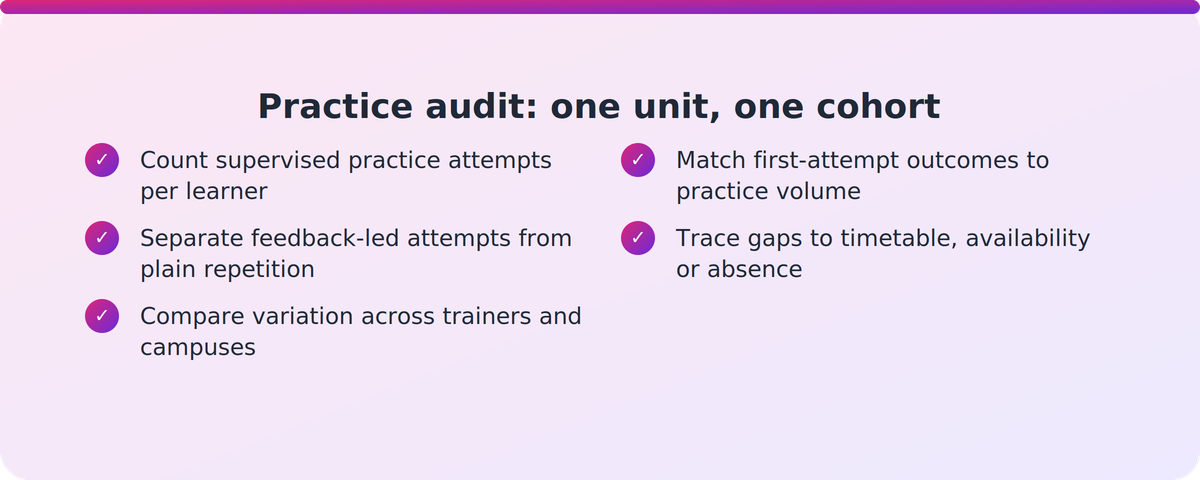
Pick one high-risk unit of competency and one recent cohort. Then ask:
- How many supervised practice attempts did each learner log before assessment?
- Did the attempts include feedback, or only repetition?
- How much did that number vary between trainers, campuses or delivery modes?
- How did first-attempt assessment outcomes line up with practice volume?
- Where did the variation come from: timetable, trainer availability or learner absence?
Expect rough numbers at first. Even rough numbers will show you whether practice is a design decision or an accident of who happened to be rostered.
Expanding reps without adding trainer hours
Once practice volume is visible, the question becomes where more reps can come from. Trainer hours are the one input you can't easily grow. Several options are worth testing:
- Structured peer practice. Learners run scenarios for each other against an observation checklist, with the trainer sampling rather than attending every rep.
- Workplace practice with defined expectations. Supervisors know what to observe and what to log.
- Simulation and role-play outside scheduled contact time. This includes recorded or tool-supported practice that gives feedback before the formal assessment.
- Targeted trainer time. Free trainers from paperwork and repeat demonstrations so their hours go to feedback, where they matter most.
Two constraints apply. Practice design must respect the training product's own requirements, and some products can't be delivered online. Also, assessment decisions stay with the qualified trainer or assessor. Notes from a March 2026 ASQA sector workshop, published by Skills Education, make that point, but they are a secondary source and worth checking against ASQA guidance before you rely on them.
There is a timing issue as well. The same notes suggest around 60 new training products are expected around mid-2026 as Jobs and Skills Councils ramp up (verify with the relevant JSC). Every refreshed unit means rework for practice scenarios, TAS and materials. Whatever you build, make it cheap to update.
Key takeaways
- Practice volume before assessment is largely unmeasured, publicly and probably inside many RTOs. Treat it as an unknown to audit, not a problem to assume.
- ASQA's Assessment Practice Guide (Standard 1.3) expects you to show how assessment judgement integrity holds when training duration varies.
- JSA reports VET teacher shortages in every state and territory for two years, with a projected 3,800 more teachers needed over five years, so extra trainer hours are not a realistic fix.
- Expand practice through design (peer practice, workplace observation, simulation, better use of trainer time), not through hours alone.
- Build practice scenarios so they can be refreshed quickly as training packages and units of competency change.
Our take
The sector tends to treat inadequate practice as a trainer problem. Trainers are the people closest to it, but it is a delivery-design problem, and the Head of Training is the person who owns the design. Our view is that practice reps should be a number you can state, not a belief you hold.
The 2025 Standards reward providers who can show their model works. A cohort where you can say "learners averaged this many supervised attempts with feedback, and here is how they performed" is a stronger position than any amount of hours-based assurance. It is also a better position for your trainers, who stop being the only buffer between a thin delivery model and an assessment outcome.
Your first step is small. Pick one unit, one cohort and one week, and count the reps.
FAQ
Does ASQA set a minimum number of practice repetitions before assessment?
Not in anything we found in the supplied sources. ASQA's Assessment Practice Guide (Standard 1.3) expects RTOs to show how the integrity of assessment judgements is maintained when training duration varies. The RTO decides how to demonstrate that, and the evidence needs to hold up.
Is there data showing learners are under-practised before assessment?
No public source we found measures practice repetitions before assessment. The gap is unmeasured, not proven. An internal audit of one unit and one cohort is the practical way to find out whether it exists in your RTO.
How bad is the trainer shortage, really?
JSA's October 2024 VET Workforce Study reports VET teacher shortages nationally and in every state and territory for the last two years. It projects 3,800 more teachers are needed over five years. Nearly 50% of the workforce is over 50, and the workforce is highly casualised.
Can we add practice online to ease trainer workload?
Sometimes. Notes from an ASQA sector workshop, published by Skills Education, report that some training products can't be delivered online. Check the requirements of each training product before changing how practice is delivered, and keep assessment decisions with qualified trainers and assessors.