Training and Assessment Strategy Version Control: Your Risk
1 October 2026 · 7 min read
Version control isn't a named requirement in the 2025 Standards for RTOs, and that's why it's easy to miss. You can't show that assessment tools were reviewed before use, or that validation covered what learners actually sat, unless you know which version was in play. That makes it a delivery-quality risk, not an admin tidy-up.
Why this lands on your desk
You own assessment quality across every trainer. Under the 2025 Standards, which have been in effect since 1 July 2025, that quality has to be demonstrable, not just documented.
ASQA says its approach has shifted with the outcomes-focused Standards: more regulatory engagement, and more flexibility in how providers show they meet them. Flexibility in method doesn't remove the need for evidence. You still have to be able to show what was used, when, and why.
So the question isn't "do we have a training and assessment strategy?" It's "are all our trainers working from the one we validated?"
What the Standards require, and what they don't say
Here is what we can say with confidence. The 2025 Standards comprise the Outcome Standards, the Compliance Standards and the Credential Policy. The Outcome Standards cover training and assessment, VET student support, VET workforce and governance.
ASQA's 2025 Standards FAQs (Version 3) say providers must ensure assessment is consistent with the requirements of the training product, and must review assessment tools before use. A revised tool is a tool that needs review before it reaches learners.
Here is what we couldn't find. We found no ASQA statement that specifically names "version control" under the 2025 Standards. We also found no national data on how often version-control failures are cited in audits, so we won't claim an audit trend.
The case rests on logic. Two requirements, tool review and validation, both assume you can identify the exact tool. Version control is the practical way to do that.
Legacy 2015-era ASQA guidance, which is no longer the current framework, said that if tools are changed, providers should complete quality checks and review the revised tool before implementing it for future students. The principle hasn't aged badly.
The three-way match
Think of it as three things that must be the same document:
- the tool the trainer delivered and assessed from
- the tool that was validated
- the tool the learner was judged against
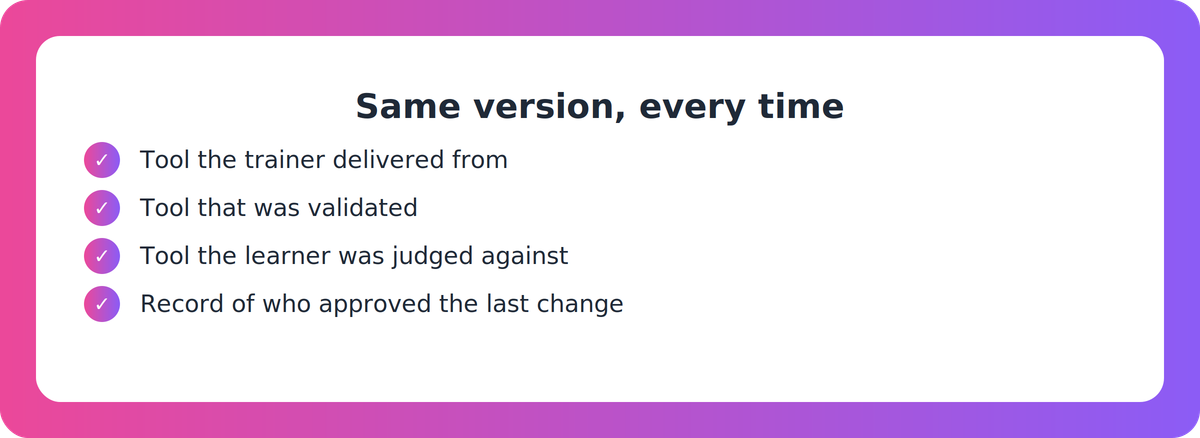
When those diverge, you can't say your validation covers your assessment judgements. It's rarely dramatic. A trainer saves a local copy. A mapping gets fixed in one campus folder. A revised tool goes out by email to some trainers and not others.
Validation raises the stakes. ASQA's FAQs say the outcome can't be determined solely by someone who designed or delivered the training and assessment. Validators must collectively have relevant industry skills, a practical understanding of current industry practice and a validation credential from the Credential Policy. For TAE qualifications or skill sets that enable assessment judgements, at least one validator must be independent.
That's a lot of qualified people applying scrutiny. It's wasted if they were handed a version that isn't the one in use.
A version-control test you can run this quarter
You don't need a new system to find out where you stand. Pick one high-enrolment unit of competency and do this:
- Ask three trainers, separately, to send you the assessment tool they're using right now.
- Compare the files. Are they identical, and do they match the master?
- Find the validation record. Does it identify the version that was validated?
- Pull a recent learner's marked evidence. Can you tell which version they were assessed against?
- Trace the last change to the tool. Who approved it, was it reviewed before it reached learners, and who was told?
If any step takes more than a few minutes, that's your finding. Treat it as useful information, not a failure.
Where this meets trainer workload
We didn't find authoritative national data on trainer burnout or assessment paperwork time, so we won't put a figure on it. There are signals, though. Industry Skills Australia's VET Workforce Study, which covered Transport and Supply Chain only, found that digital and technological change increases the time and cost for trainers to maintain vocational currency. An AUSMASA bulletin argues that new or underprepared trainers are more likely to leave early.
Neither source is about version control. But the implication holds. Trainers who have to guess which material is current spend effort on something that should be settled before they walk into the room.
There's also a timing problem. NCVER allows four years before reporting observed completion rates. If inconsistent or outdated materials depress outcomes, the published numbers will tell you long after the fact. You have to catch it internally, and a clear record of what was used and when is how you do it.
Don't treat a guide as a checklist
Practice Guides are supplementary. ASQA's position, relayed by a consultancy, is that they carry no legal or compliance obligations, and DEWR notes the policy documents don't impose legal obligations. So don't build your document control around any guide's wording. The test is whether you can evidence compliance with the Standards themselves.
On validation frequency, the excerpt we reviewed didn't state a required schedule. The old rule to validate 50% of products in the first three years of a five-year cycle has been removed, and providers must now demonstrate validation of assessment practices and judgements. Read the FAQ itself for the detail.
Key takeaways
- The 2025 Standards don't name version control, but tool review before use and validation of assessment practices and judgements both depend on knowing which version was used.
- You need to show that the tool delivered, the tool validated and the tool applied to the learner are the same.
- The 50% validation rule is gone. Check ASQA's FAQs (Version 3) for what is now expected rather than assuming a frequency.
- Test it this quarter: ask three trainers for their current tool and compare it with the validated master.
- Don't wait for completion data. NCVER's four-year lag means you'll hear about it late.
Our take
Most RTOs treat version control as housekeeping and give it to whoever has the least time. We think that's backwards. In an outcomes-focused regime, the quiet mechanics of assessment are the evidence. A strong validation panel and a sound training and assessment strategy count for less if you can't connect them to what happened in the room.
We also think it's worth being honest about the limits. No one has shown that version-control failures drive audit findings, and we won't pretend otherwise. But you don't need a trend to justify a five-step check. If you can't answer "which version?" in minutes, a regulator or a validator will notice before you do.
FAQ
Does ASQA require version control under the 2025 Standards?
We found no ASQA statement that names version control. The Standards do require assessment tools to be reviewed before use and validation of assessment practices and judgements. Version control is a practical way to evidence both, not a named obligation.
Does a revised assessment tool need review before it's used?
ASQA's 2025 Standards FAQs (Version 3) say providers must review assessment tools before use. A revised tool is a tool that needs review before it reaches learners. Legacy 2015-era guidance said the same about completing quality checks before implementing changes.
Who can validate our assessment tools and judgements?
Validators must collectively have relevant industry skills, a practical understanding of current industry practice and a validation credential from the Credential Policy. The outcome can't be determined solely by someone who designed or delivered the training and assessment. For TAE qualifications or skill sets enabling assessment judgements, at least one validator must be independent.
Can I use an ASQA Practice Guide as my document control checklist?
No. Practice Guides are supplementary and carry no legal or compliance obligations. The test is whether you can evidence compliance with the Standards themselves.
Run the three-trainer test on one unit this week. What you find will tell you more than any policy folder.