Training Delivery Capacity Planning NZ: A COO's Guide
11 October 2026 · 7 min read
Theory scales almost for free. Coached practice doesn't: every extra learner still needs assessor, facilitator or workplace-partner time. For a PTE COO in 2026, the practical-skills bottleneck is a capacity-planning problem before it is a teaching problem, and the new quality rules make it one you now have to evidence.
One caveat first. We found no authoritative New Zealand source that directly tests the claim that coached practice scales worse than theory. What follows is an operational argument built on the regulatory and funding context, not a researched finding. Test it against your own timetables.
Why this lands on your desk
You own capacity and utilisation. When intake grows, the lecture or online component absorbs it with little extra effort. The practical, coached component is usually where headcount still tracks enrolments, and that growth lands directly on assessor and facilitator time.
Three things make 2026 different from a normal growth year:
- Evidence. NZQA's integrated Quality Assurance Framework (iQAF) went live in 2026. Providers now submit an annual self-review summary report and meet NZQA to discuss their improvement plan.
- Scope. Industry Skills Boards (ISBs) cannot enrol, manage or assess learners after 31 December 2027. Apprenticeships and traineeships will then be offered by industry-led private providers, polytechnics and wānanga, so PTEs may inherit practice-heavy delivery.
- Price. Funding rates are diverging, and practical delivery is not on the favourable side of every example.
Where the hours actually go
Most PTEs can tell you cost per learner for theory. Few can tell you what an hour of coached practice costs once you include scheduling, travel, preparation, feedback, assessment write-up and rework.
Split practice time into three buckets:
- Contact time: the coached practice itself.
- Coordination time: rostering, workplace-partner liaison, rebooking when someone doesn't turn up.
- Evidence time: recording what happened, judging it and filing it so it can be found later.
In our experience, contact time gets the attention and coordination and evidence time quietly eat the margin. That is also where process knowledge hides. If one senior assessor knows which workplace partner needs a week's notice, that knowledge is a single point of failure, not a process.
Four questions to ask of every practice hour
- Who is the only person who can deliver it?
- Is it done the same way by every assessor or facilitator?
- Does the record of it exist anywhere except someone's notes?
- If intake rose 20%, would this hour need another person?
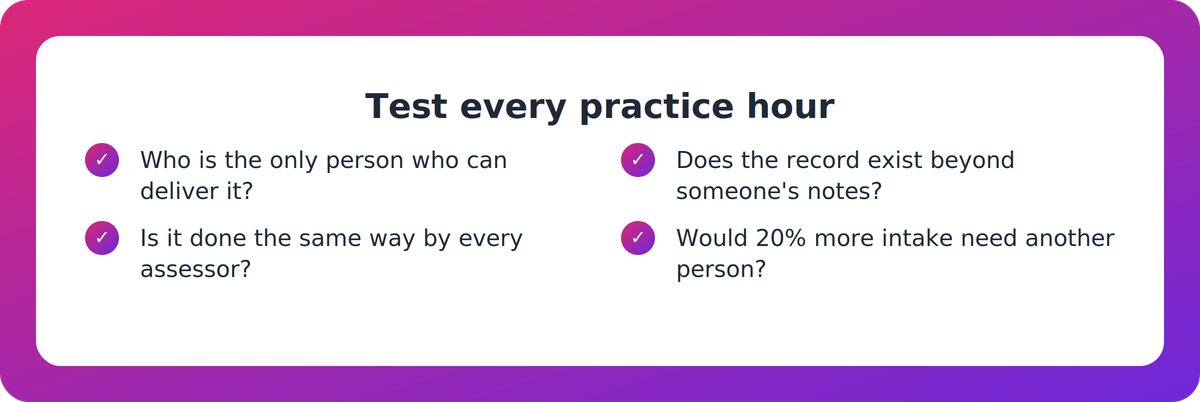
The answers show you where marginal cost sits. Those are the hours to model first in any training delivery capacity planning NZ exercise.
What the 2026 rules change about evidence
The quality regime has shifted from periodic external review to continuous self-review. NZQA says new external evaluation and review (EER) and assuring consistency reviews have stopped, and the EER category rating system will cease. In their place, the Quality Assurance of Tertiary Education Providers Rules 2026 require an up-to-date quality management system and annual self-reviews.
So the question "is practice delivered consistently?" now gets asked every year, and you answer it. That answer has to come from systems and processes, not from individuals' memories.
Two further points matter for operations:
- The Private Training Establishment Rules 2026 came into force on 19 January 2026. They replace the PTE Registration Rules 2025 and the PTE Enrolment and Academic Records Rules 2022, so enrolment and academic-records requirements now sit inside them. Check your record-keeping against the new text rather than assuming the old practice still fits.
- NZQA describes a risk-informed approach to monitoring that draws on sector-wide intelligence and data. Its December 2025 eQuate also refers to learner-level quality assurance, such as ensuring each learner's NSN is correctly matched. Learner-level data quality matters alongside programme-level evidence.
For TEC-funded providers there is a reporting dimension too. Data goes through the Single Data Return on TEC's Data Exchange Platform, and TEC lists SDR 2026 v3.1 data specifications and an API portal for integrating with the platform. If practice records are re-keyed into the SDR by hand, every extra learner adds to that duplicate entry. Check the submission calendar on TEC's site rather than relying on memory.
The cost lines moving underneath you
The funding signals are mixed, and rates vary by subject, so check your own fields. In one TEC worked example, provider-based delivery shows a net 5% increase while work-based delivery shows a net 7% decrease. TEC's targeted-areas overview shows a 2% increase for VET and -10% for all work-based delivery. Budget 2025 provided $111.4 million over four years to fund 99% of forecast tertiary enrolments in 2025 and 2026.
There is also a new cost line. Since 1 January 2026, eight ISBs develop and maintain industry qualifications and unit standards and handle national external moderation, consent-to-assess endorsement and micro-credential approval. TEC's consultation document says ISBs can charge providers such as PTEs for moderation. Budget for it, and expect moderation to look harder at practical assessment where consistency is hardest to show.
Put those together and work-based learning looks like a growth opportunity that arrives with falling rates and the most labour-intensive delivery model. That can still be a sound decision. It should be a modelled one.
Key takeaways
- Theory adds learners at low marginal cost. Coached practice still draws on scarce assessor, facilitator and workplace-partner time.
- The thesis is an operational argument, not a tested NZ finding. Validate it with your own time data.
- iQAF and the Quality Assurance of Tertiary Education Providers Rules 2026 mean you need annual, system-based evidence of consistent practice delivery.
- The PTE Rules 2026 now contain enrolment and academic-records requirements. Check your record-keeping against them.
- Model where marginal cost sits before taking on work-based learning, given ISB moderation charges and the funding rate signals.
Our take
Most PTEs treat practice quality as a teaching matter and practice capacity as a staffing matter. We think that split is the problem. A practice hour that only one person can run well is a capacity risk, a consistency risk and an evidence risk at once.
The practical move this quarter is to pick one practice-heavy programme and trace a single learner through it, counting every touchpoint and who owned it. Write down what is repeatable and what lives in someone's head. Then decide, deliberately, which parts should stay human-led and which can be standardised, documented or captured in data. Growth should stop meaning a matching rise in headcount.
FAQ
Why doesn't coached practice scale like theory?
Theory can be delivered to more learners at little extra cost. Coached practice depends on an assessor, facilitator or workplace partner for each learner or small group, so time rises with enrolments. This is an operational argument. We found no NZ source that tests it directly.
What does iQAF require of a PTE in 2026?
NZQA's iQAF went live in 2026. Providers submit an annual self-review summary report and meet NZQA to discuss the improvement plan. The Quality Assurance of Tertiary Education Providers Rules 2026 also require an up-to-date quality management system and annual self-reviews.
How should a COO plan capacity for work-based learning?
Start from the dates and the rates. ISBs cannot enrol, manage or assess learners after 31 December 2027, and one TEC worked example shows a net 7% decrease for work-based delivery. Model assessor and coordination time per learner, then test whether the programme holds up at current rates.
Which new costs should operations budget for?
TEC's consultation document says ISBs can charge providers such as PTEs for moderation. Check your own subject rates as well, since they vary, and review reporting effort against the Single Data Return specifications on TEC's site.