Training Material and Assessment Alignment for RTOs
4 August 2026 · 6 min read

Training Material and Assessment Alignment for RTOs
A training package might specify that a unit be assessed through applied demonstration, but the assessment generated for it tests recall instead — or the reverse. Nobody flags it at the time. Trainers spend hours rewriting content by hand, assessors judge inconsistently across cohorts, and learners are left studying materials that don't match how they'll actually be assessed. That mismatch rarely shows up until an audit — or a confused learner — surfaces it.
Where the Mismatch Actually Comes From
Most RTOs assume assessment problems look like missing evidence or an outdated template. The subtler risk is structural: the assessment method doesn't fit the mode a unit of competency was designed for.
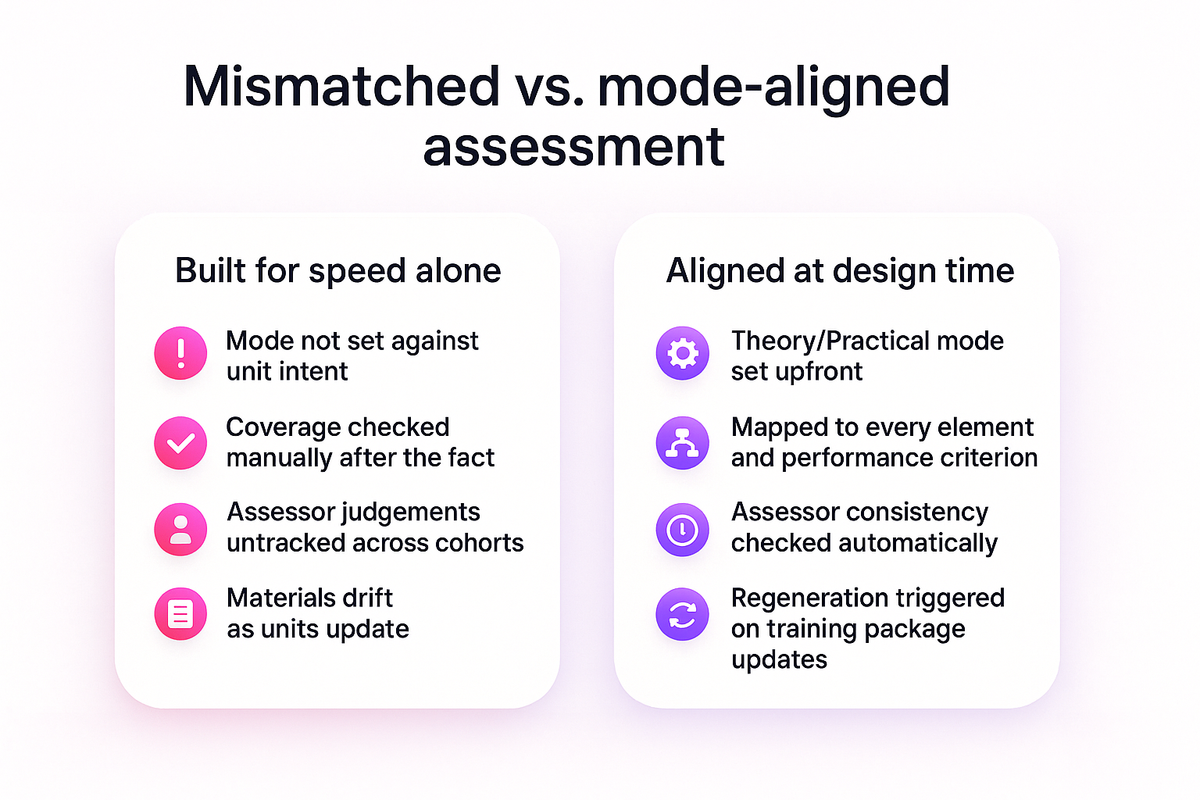
It happens easily. A unit built around demonstrated workplace performance gets a knowledge-based assessment. Or a unit meant to test conceptual understanding gets handed a hands-on task that measures the wrong thing entirely. Content generated at speed can miss this distinction because speed and mode-accuracy are two different problems — solving one doesn't automatically solve the other.
When it happens, the burden lands on training managers and assessors:
- They manually rewrite the assessment to fit the intended mode.
- They cross-check performance criteria by hand to confirm coverage.
- They try to reconcile training material that was written to support one mode against an assessment built for another.
That's not a one-off fix. It's rework that repeats across every unit, every qualification, and every training package version an RTO holds — quietly eating the time savings the process was meant to deliver.
Why This Rarely Shows Up on an Audit Checklist
A mismatched assessment mode doesn't trip an obvious compliance flag. There's no missing document, no blank field. What it produces instead is inconsistency: a learner studying practical scenarios then sitting a theory-heavy assessment, or an assessor applying judgement criteria that don't quite fit what the material actually taught.
Under the Standards for RTOs 2025, ASQA audit reviews look directly at this territory — assessment alignment to units of competency, including performance criteria and performance evidence, plus the quality assurance processes applied before and after assessment delivery. Recent targeted reviews have covered workplace assessments in qualifications including Individual Support, Carpentry, and Early Childhood Education and Care. The mismatch is exactly the kind of gap those reviews are built to catch.
How VETos Closes the Gap
VETos addresses this at the point where the problem originates: assessment design.
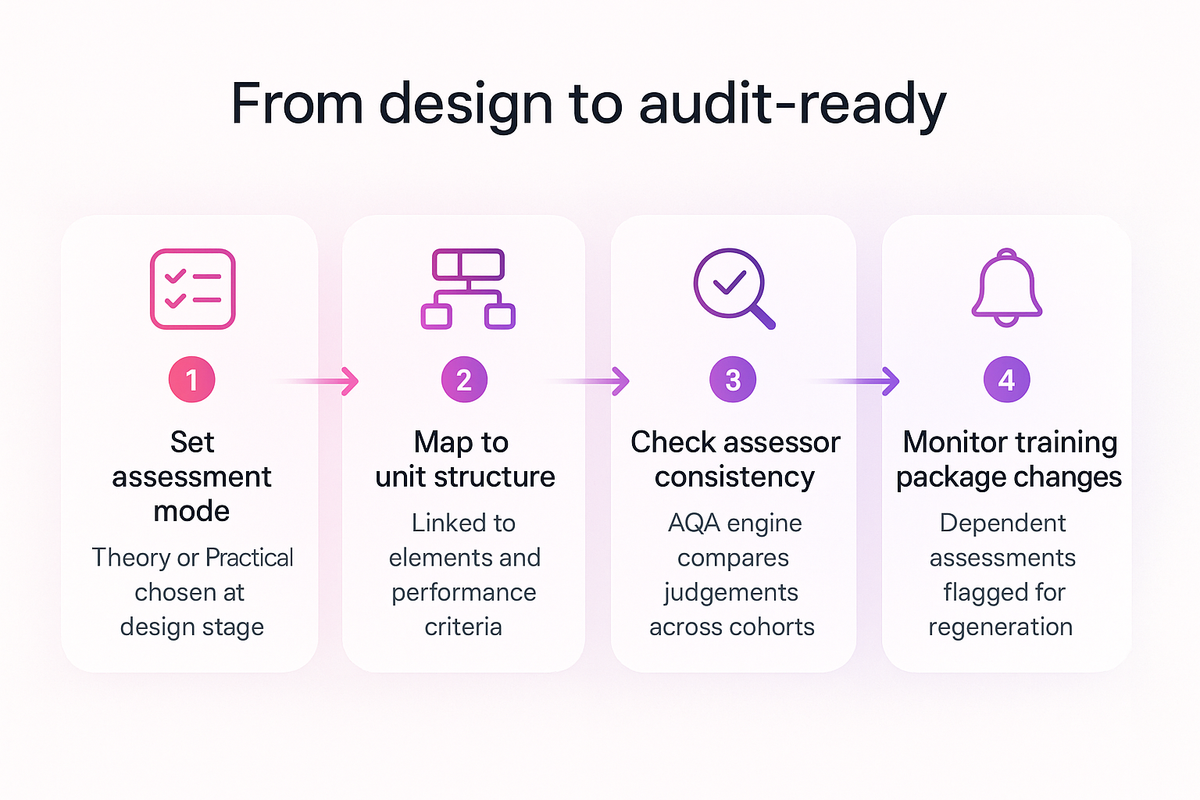
Instructional designers and trainers set the intended assessment mode — Theory or Practical — right in the existing assessment criteria workflow. There's no extra setup step; the selector sits inside the process trainers already use, so getting the mode right doesn't cost any additional time.
From there, every generated assessment is mapped automatically to the relevant elements and performance criteria within the training package. VETos models a provider's full scope — training package, qualifications, units, elements and performance criteria — as one connected structure, so every assessment stays mapped, covered, and defensible against an audit request.
The assessor side of the problem gets its own answer. The Assessor Quality Assurance engine compares assessor judgements for consistency across different cohorts, flags discrepancies against what ASQA audit reviews expect to see, and generates moderation-ready validation reports. It's ongoing calibration feedback, not a one-time check — the kind of quality assurance process the Standards for RTOs 2025 specifically look for.
VETos also monitors ASQA training package revisions automatically. When a unit changes, dependent assessments and resources can be flagged or regenerated, so materials don't quietly drift out of step with the version an RTO is actually delivering against.
What Changes for Trainers and Learners
Set the mode correctly at the design stage and the downstream work changes shape:
- Assessors spend less time manually rewriting tasks that were generated for the wrong mode.
- Training material and assessment criteria reinforce the same expectations, instead of pulling learners in two directions.
- Validation cycles have a moderation-ready record to work from, rather than starting from scratch each time.
- Training package updates trigger a review of dependent assessments, instead of relying on someone noticing a gap later.
Key takeaways
- Assessment mode mismatch — practical content for a theory-based unit, or vice versa — is a structural design problem, not a formatting slip, and it compounds across every qualification an RTO holds.
- Left unaddressed, it creates rework for trainers and assessors and inconsistent experiences for learners, whose training material and assessment stop reinforcing the same standard.
- ASQA audit reviews under the Standards for RTOs 2025 specifically examine assessment alignment to units of competency and the quality assurance processes around it.
- VETos sets the intended Theory or Practical mode at the point of assessment design, maps every assessment back to its elements and performance criteria, and runs an Assessor Quality Assurance engine that flags inconsistent judgements and produces moderation-ready reports.
- Automated monitoring of ASQA training package revisions helps keep assessments and training materials from drifting apart as units change.
Our take
Most compliance conversations focus on what's missing — a document, a signature, an evidence log. The mode mismatch problem is different: everything looks present, and it's still wrong. That's precisely why it survives so long inside an RTO's assessment library without being noticed. Building the mode decision into the design step, rather than treating it as a manual review task, is the right place to intervene — it stops the error before it multiplies across a portfolio, rather than trying to catch it after the fact during validation.
FAQ
What is assessment mode mismatch in RTO assessment design? It's when the method used to assess a unit of competency — practical demonstration versus theoretical/knowledge-based testing — doesn't match the mode the unit was actually designed to be assessed under. The result is an assessment that doesn't measure what it's meant to.
Why doesn't this kind of mismatch show up on a standard compliance checklist? Because nothing is technically missing. The document exists, the mapping fields are filled in, but the assessment method itself doesn't fit the unit's intended approach. It surfaces through learner confusion or inconsistent assessor judgement rather than an obvious gap.
How does the Standards for RTOs 2025 treat assessment alignment? ASQA audit reviews under the Standards for RTOs 2025 specifically examine how well assessments align to units of competency — including performance criteria and performance evidence — along with the quality assurance processes applied before and after assessment delivery.
How does VETos help RTOs keep training materials and assessments aligned? VETos lets trainers set the intended Theory or Practical mode directly in the assessment design workflow, maps every assessment automatically to its elements and performance criteria, and runs an Assessor Quality Assurance engine that flags inconsistent judgements across cohorts and produces moderation-ready validation reports.
Does fixing assessment mode at the design stage actually reduce rework? Setting the mode correctly upfront means assessors and training managers spend less time manually rewriting content after the fact — the rework that typically happens when a mismatch is only discovered during delivery or validation.