Training Material Generator Software for RTOs
4 August 2026 · 9 min read

Training material generator software for RTOs works best when it ties generated content directly back to unit-of-competency elements, performance criteria and assessment tasks — producing an explicit mapping document, not just a standalone workbook. Under the Standards for RTOs 2025, any AI-assisted output still needs a qualified, accountable assessor to review and validate it before use.
That's the honest answer to the question most buyers are actually asking. The harder part is working out which platform in this crowded category genuinely does the mapping, keeps pace with training package changes, and leaves your validation process intact rather than working around it.
What "linked to assessments" actually means
A lot of tools will happily generate a learner workbook, a slide deck or a facilitator guide. Far fewer will show you, in writing, exactly which unit elements and performance criteria that content addresses — and whether the linked assessment tasks actually gather sufficient, valid evidence against them.
This matters because ASQA's audit guidance repeatedly flags missing or weak mapping as a common non-compliance finding. A training material generator that can't produce a clear mapping artefact — training material, assessment task, unit element, performance criterion, evidence requirement — is giving you content, not compliance infrastructure.
When you're evaluating a platform, ask to see the mapping output itself, not a marketing screenshot of a workbook. If it can't show you the trail from unit of competency to assessment tool to training resource, you'll be rebuilding that trail manually anyway.
The three types of platforms in this category
Most tools buyers find under this search term fall into one of three groups, and they solve different problems:
- AI-native authoring and LMS platforms, such as Coursebox, which generate assessor guides, learner workbooks, mapping spreadsheets and presentations per unit of competency.
- Human-developed resource libraries, such as Compliant Learning Resources, where content is written by instructional designers and AI plays a supporting role rather than doing the primary drafting.
- Compliance and mapping-focused platforms, such as Cloud Assess, which centre the workflow on evidence, mapping and validation rather than content generation itself.
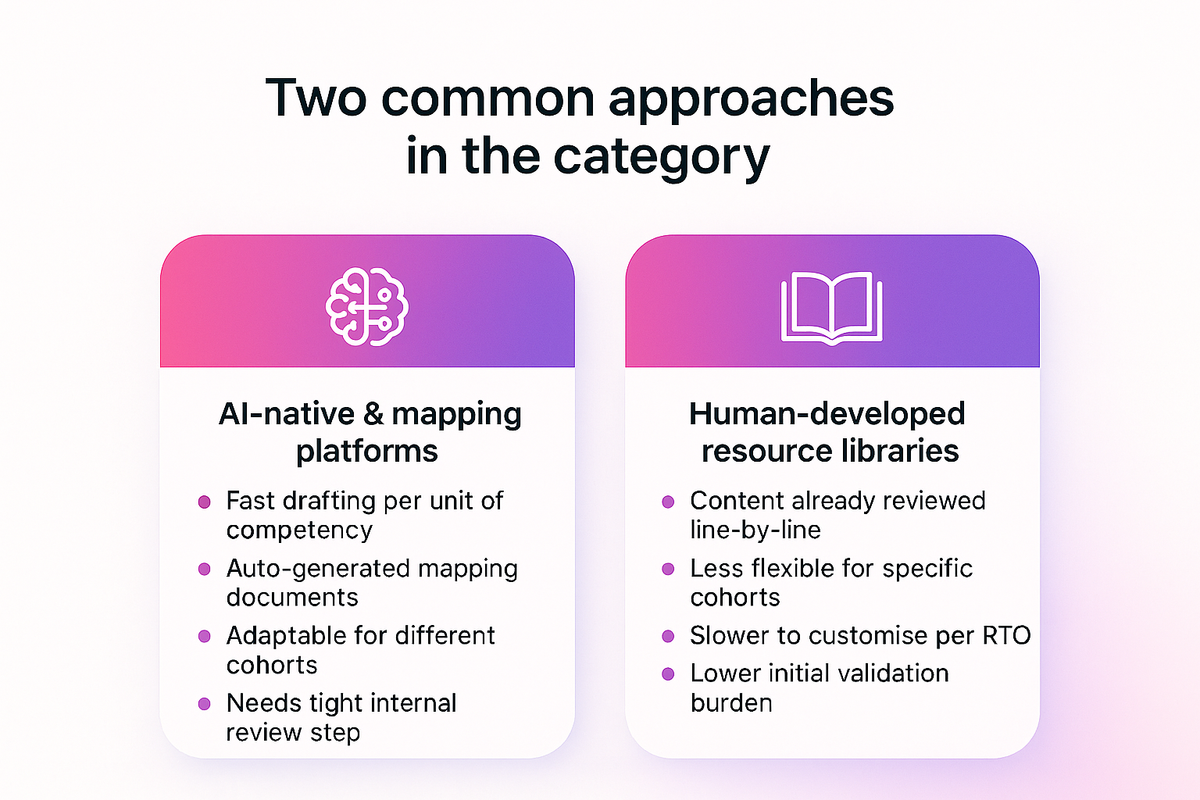
None of these is objectively "best" — they trade off speed, control and cost differently. A resource library gives you materials someone has already reviewed line-by-line, at the cost of flexibility for your specific cohort. An AI-native platform gives you speed and customisation, at the cost of needing a tighter internal review step before anything goes live.
Does AI-generated content still need human validation?
Yes — and this isn't optional or a matter of vendor preference. ASQA's Principles for the Responsible Use of AI in VET don't create new rules, but they're explicit that human oversight and accountability for AI-assisted activity sits with the provider. Decisions that affect students remain the RTO's responsibility, full stop.
Practically, that means whatever a generator produces still has to be checked against the principles of assessment and rules of evidence — validity, reliability, flexibility and fairness on one side, validity, sufficiency, authenticity and currency on the other. Sector commentary is blunt about this: AI output can read confidently while quietly missing a performance criterion or making a wrong assumption about a learner cohort. Fast isn't the same as compliant.
It's also worth remembering that assessment-only roles have been subject to trainer and assessor credentialing requirements since March 2024. Whoever signs off on generated assessment materials needs to actually hold that authority — the software doesn't hold it for them.
Can these tools handle ESOL, LLN and mixed delivery without duplicate resource sets?
This is where the category splits further. Static resource libraries typically require you to hold separate versions for classroom, workplace and distance delivery, and often a separate set again for learners with LLN or ESOL support needs. That's a maintenance burden that compounds every time a unit changes.
AI-native platforms are generally better placed to adapt tone, reading level and context (workplace scenario vs classroom exercise) from a single mapped source, though the quality of that adaptation varies a lot between vendors — this is a feature worth testing on your own cohort's material, not taking on faith from a demo.
Staying current as training packages change
Training packages get revised, units get superseded, and formats change — most recently with the Training Package Organising Framework's Application of Skills and Knowledge (ASK) unit format rolling into effect under TPOF 2025. A generator that produces beautiful materials against a superseded unit format is a liability, not a time-saver.
Before you buy, get specific answers on:
- Does the vendor draft to the current unit format, including the newer ASK structure, or an older template?
- When a training package updates, is regeneration of affected materials automatic, flagged for review, or entirely manual on your side?
- Is that update coverage included in your subscription, or billed as separate work? Some vendors explicitly exclude training package revisions from standard update inclusions — get this in writing.
A short evaluation checklist
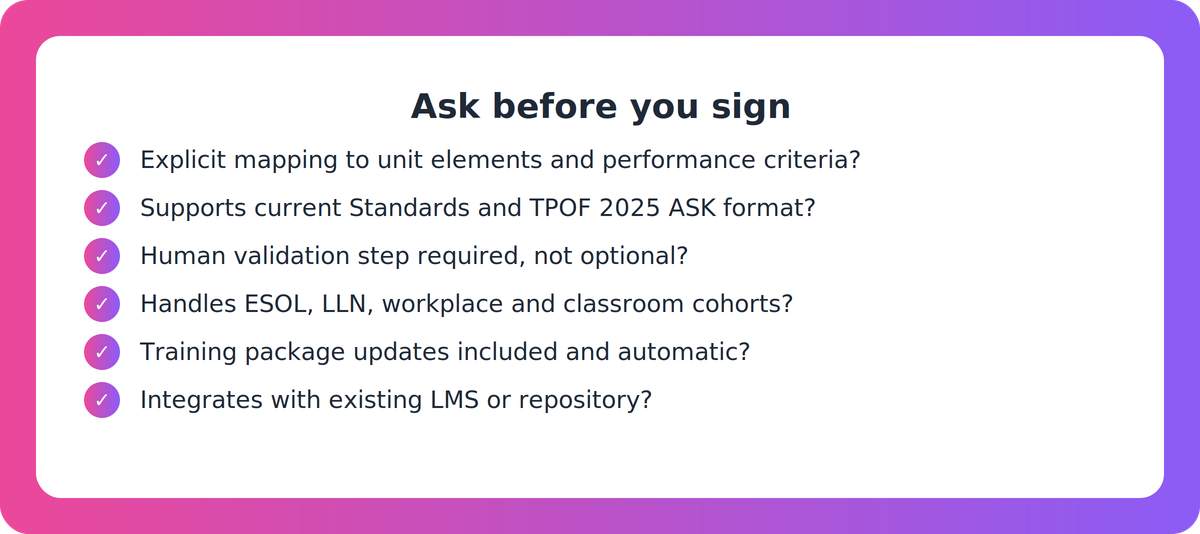
Whatever platform you're weighing, these are the questions worth asking before you sign anything:
- Does it generate an explicit mapping document — not just narrative content — tying materials and assessment tasks to unit elements, performance criteria and evidence requirements?
- Does the vendor reference the current 2025 Standards for RTOs and support the TPOF 2025 ASK unit format?
- Is human review a required workflow step, with your qualified assessors retaining final accountability?
- Can it adapt for ESOL, LLN, workplace and classroom cohorts without you maintaining parallel resource sets by hand?
- What exactly happens — and what's included — when a training package or unit is updated?
- Does it integrate with your existing LMS or document repository, or create a separate workflow you now have to manage?
- Does it produce anything useful for your own validation and moderation process, rather than assuming it replaces it?
Key takeaways
- Generic content generation isn't the point — mapping generated materials and assessments back to unit-of-competency elements and performance criteria is what makes a tool useful for compliance, not just drafting.
- Under the Standards for RTOs 2025 and ASQA's AI use principles, human validation and sign-off by a qualified assessor is required regardless of how fast or polished the AI output looks.
- The category splits into AI-native authoring platforms, human-developed resource libraries and compliance/mapping-focused tools — each trades speed against built-in review differently.
- Ask vendors precisely what "updated for training package changes" includes; some exclude unit revisions from standard subscriptions.
- Support for ESOL, LLN and mixed delivery modes from a single mapped source, rather than parallel resource sets, is a genuine time-saver worth testing directly.
Our take
The honest state of this category is that speed and compliance rigour don't automatically come together — you're usually trading one off against the other, and the vendors who claim otherwise are worth a second look. We'd weight the mapping artefact and the currency-update terms more heavily than the polish of the sample output, because a workbook that reads well but doesn't trace back to the unit is expensive rework waiting to happen at your next validation cycle. Platforms like VETos, which we build, take the approach of mapping the training package structure first and generating study materials and assessments against it, with an educator review step built into the workflow rather than assumed away — but that's one approach among several, and it should be judged against your own validation requirements, not taken on description alone.
FAQ
What software can generate training materials that are properly linked and mapped to units of competency and assessment tools, rather than generic content? Look for platforms that produce an explicit mapping document connecting materials and assessment tasks to specific unit elements, performance criteria and evidence requirements — this spans AI-native authoring tools like Coursebox, mapping-focused platforms like Cloud Assess, and vendors such as VETos that map the training package structure before generating linked content.
Does AI-generated training material still need human validation under the Standards for RTOs 2025? Yes. ASQA's Principles for the Responsible Use of AI in VET require RTOs to maintain human oversight and accountability for all AI-assisted activity — a qualified, accountable assessor must still review and sign off on outputs before they're used with students.
Can training material generators handle ESOL, LLN and mixed delivery modes without separate resource sets? Some AI-native platforms can adapt a single mapped source for different cohorts and delivery contexts, but quality varies significantly between vendors — this is worth testing against your own learner group's material rather than assuming it from a demo.
How do vendors keep training materials current as training packages change, including the new TPOF 2025 ASK unit format? Approaches differ. Some vendors monitor training package revisions and trigger regeneration workflows automatically; others require manual review or bill unit updates separately. Confirm in writing whether the current ASK unit format is supported and what update coverage is actually included.
Is a fast AI-generated assessment automatically ASQA-compliant? No. Generated assessment tools still need to meet the principles of assessment (validity, reliability, flexibility, fairness) and the rules of evidence (validity, sufficiency, authenticity, currency) regardless of how they were produced — speed of generation doesn't establish compliance on its own.
If you're currently comparing options, the most useful next step is asking each shortlisted vendor to show you their actual mapping output against one of your own units of competency — not a demo unit, yours — and to put their training package update terms in writing before you sign.