Training Material Version Control NZ for Heads of Training
30 September 2026 · 6 min read
Version-control chaos isn't an admin annoyance. Under NZQA's 2026 rules it's an accountability gap. Your organisation is responsible for every assessment and every resource trainers use, including bought-in and edited material. If you can't show which version each cohort received, and that it was pre-moderated, you can't show the assessment was fair.
Why this lands on your desk
You answer for assessment quality and consistency across trainers. NZQA describes consistent judgements as reliable and accurate "regardless of who does the assessing or when the assessment occurs". That is hard to claim when one trainer teaches from last year's workbook, another from a tweaked copy on their laptop, and a third assesses against a task that has since been rewritten.
The Quality Assurance of Tertiary Education Providers Rules 2026 came into force on 19 January 2026. They replace the 2022 QA (including EER) Rules and require an up-to-date quality management system, annual self-review reported to NZQA, monitoring, and retention of assessment records. You are the person who has to supply the evidence for those.
A good week means a trainer can say which version they used, and you can back it up. A bad week is discovering that nobody can.
What the rules put on the table
The moderation obligations are where version control bites. NZQA expects internal moderation to be embedded in every tertiary education organisation's quality management system. That covers pre-assessment moderation of materials and post-assessment moderation of learner work.
NZQA's guidance on good internal moderation is specific about what needs pre-assessment moderation:
- newly self-developed assessment material
- changed assessment material
- material that is commercially produced or sourced elsewhere
The last point matters most for bought-in content. The assessing organisation stays responsible for fitness for purpose, even if a third party says the material has already been moderated.
Read that with a version-control lens. Every edit a trainer makes to a task, a marking guide or a resource can trigger a moderation obligation. An untracked edit isn't a small shortcut. It's a change that was never moderated, sitting in front of learners.
Where drift starts
Drift rarely comes from carelessness. It comes from sensible people under pressure. A trainer adjusts an example for a workplace cohort. Someone fixes a typo in a learner guide but not in the assessment that refers to it. A shared drive collects files named "final", "final v2" and "final USE THIS".
The result is two documents that used to match and no longer do. The learner studies one thing and is assessed on another. That is a fairness problem before it is a compliance one.
NZQA also says an effective moderation system feeds back to assessors, assessment writers and programme developers on the quality and effectiveness of assessment materials. That loop only works if everyone is looking at the same, current version. Otherwise the feedback improves a document half your trainers aren't using.
A version register that answers NZQA's question
You don't need an elaborate system to start. You need to be able to answer one question for any cohort: what exactly did these learners receive, and had it been moderated against the current standard?
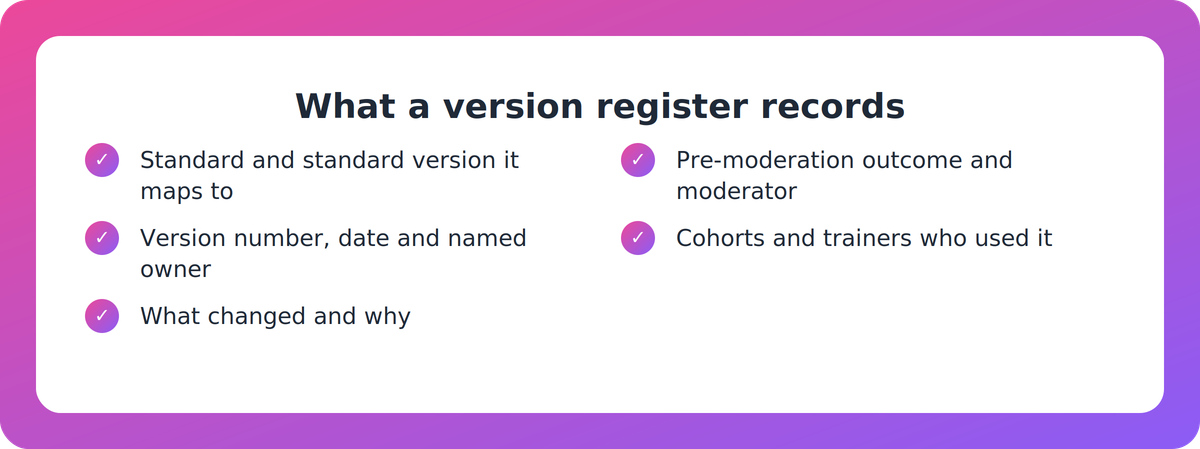
A workable register records, for each resource and assessment:
- the standard or qualification it maps to, and the version of that standard
- the version number, date and named owner
- what changed and why
- the pre-moderation outcome and who did it
- which cohorts and trainers used it, and when it was retired
Two habits make this stick. First, training material and assessment are versioned together, so a change to one prompts a check of the other. Second, there is one place trainers go to get current material, and local copies are treated as uncontrolled.
Standards that may move on a less predictable clock
The ground under your materials is shifting too. Vocational education legislation passed in October 2025 disestablished Te Pūkenga, which continues as NZIST, a transitional entity. Eight Industry Skills Boards (ISBs) were set up from 1 January 2026. ISBs lead standard-setting and qualification development, and according to the TEC consultation document a programme will not be funded without ISB endorsement.
The DASS Rules 2026 also remove the five-year maximum period for reviews. What follows is our inference, not an NZQA statement. Standards may now change on a less predictable schedule, so the mapping between your materials and the standard may need checking more often than a five-year rhythm allowed.
One caution. NZQA's external moderation page still refers to Workforce Development Councils. Confirm who moderates which standards after the move to ISBs rather than assuming.
Key takeaways
- NZQA's Quality Assurance of Tertiary Education Providers Rules 2026 (in force 19 January 2026) put your quality management system and assessment records at the centre of the regulatory relationship.
- Changed, self-developed and bought-in assessment material all need pre-assessment moderation. The provider stays responsible for fitness for purpose.
- Untracked edits are unmoderated changes. That makes version control a compliance and learner-fairness issue.
- Version training material and assessments together, with named owners, moderation status and cohort use.
- Expect standards to change less predictably under ISBs and the DASS Rules 2026, and verify who moderates what.
Our take
Most training organisations treat version control as a tidy-up task for a quiet month. We think that's backwards. The more you rely on self-review and an annual conversation with NZQA, the more your credibility rests on being able to show your working without a scramble.
The uncomfortable part is that trainers are rarely the problem. If five capable people each hold a slightly different document, the system has failed them, not the reverse. Fixing it frees delivery time, because nobody has to reconstruct history when a moderator asks a question.
A first step for this quarter: pick one high-volume unit standard and trace the current learner guide, assessment and marking guide back to the standard version. Then ask three trainers which copy they used last term. The gap between those answers is your real risk.
FAQ
Who is responsible for moderating bought-in assessment material?
You are. NZQA guidance says commercially produced or externally sourced material should be pre-assessment moderated. The assessing organisation remains responsible for fitness for purpose, even if the supplier says it has been moderated.
Does a small edit to an assessment need pre-moderation?
NZQA's guidance says to pre-assessment moderate newly self-developed or changed assessment material. So changes should be tracked and moderated, not quietly absorbed. Your internal policy should define how you judge and record the scale of a change.
What evidence will I need under the 2026 QA Rules?
The rules require an up-to-date quality management system, annual self-review reported to NZQA, monitoring, and assessment records retention. A version register linking materials to standards and moderation outcomes supports all of these.
Will ISBs change how often standards are reviewed?
ISBs now lead standard-setting, and the DASS Rules 2026 remove the five-year maximum review period. NZQA hasn't said reviews will become less predictable. That is our inference, so check for updates and confirm moderation responsibilities directly.