Training Material Version Control for RTO Heads of Training
6 October 2026 · 7 min read
Version drift looks like an admin problem until a validator reviews one version of an assessment tool and a trainer assesses with another. At that point it is a question of assessment integrity and currency. ASQA doesn't regulate it by name, but the nearest requirements land squarely on the Head of Training.
Why this lands on your desk
You answer for assessment quality across every trainer, site and delivery mode. Under the 2025 Standards for RTOs, which took effect on 1 July 2025, that accountability is judged on outcomes. ASQA says the Standards focus on the quality of outcomes for students and employers, and give providers more flexibility and room to innovate in delivery.
Flexibility has a cost. If you can structure delivery your own way, you also have to show how you keep it consistent. "We have a shared drive" is not much of an answer when three trainers are using three copies of the same tool.
Whichever copy a trainer is actually using is the one that counts. That is the copy a learner is assessed against, and the one an auditor could end up looking at.
What the Standards say, and what they don't
Be precise here, because overclaiming will cost you credibility with your own compliance team. The research behind this piece found no ASQA statement that addresses training-material version control directly. This is a case built from adjacent requirements, not a rule you can cite.
The adjacent requirements are solid:
- Standard 1.3. ASQA's Assessment Practice Guide says assessment tools are reviewed before use, to confirm that assessment can follow the principles of assessment and the rules of evidence. Review outcomes should inform any necessary changes to the tools. A tool edited informally mid-delivery can sit outside that loop.
- Currency. ASQA's guide (August 2025) lists demonstrating currency of assessment, in line with the training product and current industry practice, as an example activity. Showing currency means showing what is in use and when it last changed.
- Validation. According to ASQA's 2025 Standards FAQs (version 3), validation can't rest solely with the person who designed or delivered the training or assessment. Validators need to collectively hold relevant industry competencies and understand current industry practice. One consultancy summary (RTO Coach) adds a Credential Policy requirement. Check the ASQA text before you rely on that detail.
- Pacing and the TAS. ASQA won't provide a training and assessment strategy template. Providers decide how to compile and present theirs. Standard 1.1 still expects training to be structured and paced to allow time for instruction, practice, feedback and assessment. Your TAS has to match what trainers deliver, and drifting materials quietly break that match.
How drift actually happens
It rarely looks like negligence. A trainer fixes a confusing question before Tuesday's class. A site coordinator saves a local copy to the desktop. A casual trainer inherits last term's folder because it was the one they were sent.
NCVER's 2021 release on the VET workforce is old, so treat it as background only. It pointed to an ageing workforce, high casualisation, the need to maintain industry currency and the need to build trainer capacity. That supports a cautious inference: trainers who are casual or spread across sites are more likely to work from local copies. The research doesn't quantify it, so test it against your own roster.
The pattern is that every individual edit is sensible. The accumulated result is an assessment tool nobody reviewed.
Why your validators are only as good as the version they get
Validation is meant to be a check independent of the people who designed or delivered the assessment. That independence is wasted if the validator reviews the master copy while delivery runs on edited ones.
The validation report may be clean and still say nothing about what learners sat. So the question for validation isn't only "Is this tool good?" It is also "Is this the tool in use?"
What the completion data can and can't tell you
NCVER's four-year completion rate for 2020 commencers was 49.0%, up from 47.5% for 2019 starters. Qualification completions in 2025 were 845,165, down 4.8%. Among part-completers, 38.4% cited training-related changes such as better support, flexibility and workload.
None of that shows version drift causes non-completion. No source measures it. It is plausible that inconsistent or confusing materials add to learner frustration, but treat that as a hypothesis. Look at your own cohorts: do the units with the most mid-delivery edits, or the most trainers, also show the most withdrawals?
The regulatory climate adds weight. ASQA's 2025–26 risk priorities name inadequate assessment practices. Its Corporate Plan says it will adopt a more robust risk-focused strategy and differentiate supervision by risk profile. Assessment integrity is where that scrutiny points.
A version audit you can run this month
You don't need new systems to find out how bad it is. You need one unit and one afternoon.
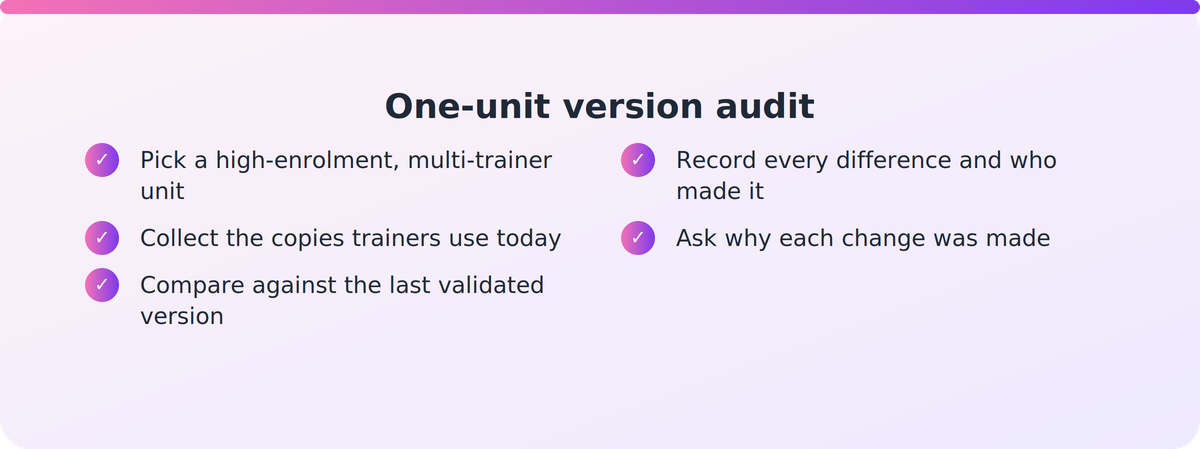
- Pick a high-enrolment unit delivered by more than one trainer.
- Ask each trainer to send the assessment tool and learner resource they are using today, not the one they should be using.
- Compare them against the version your last validation reviewed.
- Record every difference and who made it.
- Ask the trainer why. The reasons tell you whether the master version is failing them.
If the copies match, you have evidence of control. If they don't, you have a finding you can fix before anyone external finds it for you.
Key takeaways
- Version drift is an assessment-integrity and currency risk, not a filing issue.
- No ASQA statement addresses training-material version control directly. The argument rests on Standard 1.3, currency expectations, validation independence and Standard 1.1 pacing.
- Flexibility under the 2025 Standards puts the burden on your own systems to show consistency.
- Validation only helps if validators review the version trainers actually use.
- NCVER data doesn't link drift to non-completion. Test that in your own cohort data.
Our take
Most RTOs treat version control as housekeeping and assessment validation as quality. We think that split is wrong. A validated tool that nobody delivers is a document, not a control.
The fix is rarely a bigger policy. It is making the reviewed version the easiest one for a trainer to reach, and making informal changes visible so they can feed back into review instead of around it. Trainers edit because the master isn't working for them, and that is useful information.
The question to sit with: if ASQA asked you today which version of your busiest unit was delivered last term, could you answer with evidence, or with confidence?
FAQ
Does ASQA require version control of training materials?
The research found no ASQA statement addressing training-material version control directly. The nearest hooks are Standard 1.3 (assessment tools reviewed before use), ASQA's currency expectations and the requirement for independent validation. Treat version control as the practical way to evidence those, not as a standalone rule.
How does version drift affect validation?
Validation must not rest solely with the person who designed or delivered the assessment. If validators review a different version from the one trainers use, the outcome says little about actual assessment practice, and review findings may never reach the tool in use.
Does version drift cause lower completion rates?
No source shows that. NCVER reports a 49.0% four-year completion rate for 2020 commencers, and 38.4% of part-completers cited training-related changes. Those figures give context only. Compare units with frequent informal edits against completion in your own data.
Who should own version control: training or compliance?
The sources don't prescribe an owner. The Head of Training answers for assessment quality across trainers, so they should own whether delivery matches the reviewed version. Compliance can own the review and validation process that feeds it.