Why Training Package Currency Never Gets Cheaper
28 July 2026 · 7 min read

Every time a training package updates, you rebuild content you already built properly. That's not backlog — it's how the system runs. The Standards for RTOs 2025 raised the compliance bar on design itself, and national qualification reform just put a use-by date on anything built around today's unit wording. The real question for 2026 isn't how to keep up. It's why the build model hasn't changed while everything under it keeps moving.
Why this lands on your desk
You're no longer just mapping content to unit-of-competency wording and handing it to a trainer. Standard 2.5 of the Standards for RTOs 2025 requires every RTO — regardless of whether First Nations learners are currently enrolled — to foster a culturally safe learning environment, and that obligation now runs through your case studies, scenarios and role plays, not just a trainer's classroom conduct. Outcome Standard 3.1 goes further: it extends mandatory professional development and currency access to all staff involved in VET delivery, explicitly bringing instructional and learning designers into scope for the first time, where the 2015 Standards focused on trainers and assessors.
On top of that, ASQA's audit approach under the 2025 Standards assesses evidence of practice, not paperwork. That means when your RTO is audited, the question isn't whether a cultural safety policy exists — it's whether your materials actually operate safely and effectively for real learners in real delivery contexts. Design work has become auditable in its own right.
The compliance bar moved from policy to proof
The 2025 Standards for RTOs took effect on 1 July 2025, replacing the 2015 Standards, and the shift is deliberate: less emphasis on written policy, more on demonstrated evidence in delivery and assessment. For an instructional designer, that changes what "done" looks like. A module that technically maps to a unit of competency but hasn't been checked for cultural safety, trauma-awareness or genuine currency isn't compliant anymore — it's a finding waiting to happen.
Cultural safety is now a design brief, not a delivery afterthought
Standard 2.5 doesn't wait for enrolment data. It applies universally, which means the practical work — revising learning materials and activities to be culturally safe and trauma-aware, and involving First Nations staff or industry experts in review — sits with whoever builds the content. That's design work, done before delivery, not something a trainer can retrofit in the room.
The redesign clock is already running
Skills Ministers agreed in December 2024 to move VET qualification design to a purpose-based model. New templates became available from 1 July 2025, with reformed qualifications expected from 2026. DEWR's Training Package Assurance function, operating since January 2023, exists specifically to drive continuous improvement in training products — a signal that this pace of change is a permanent policy setting, not a one-off disruption.
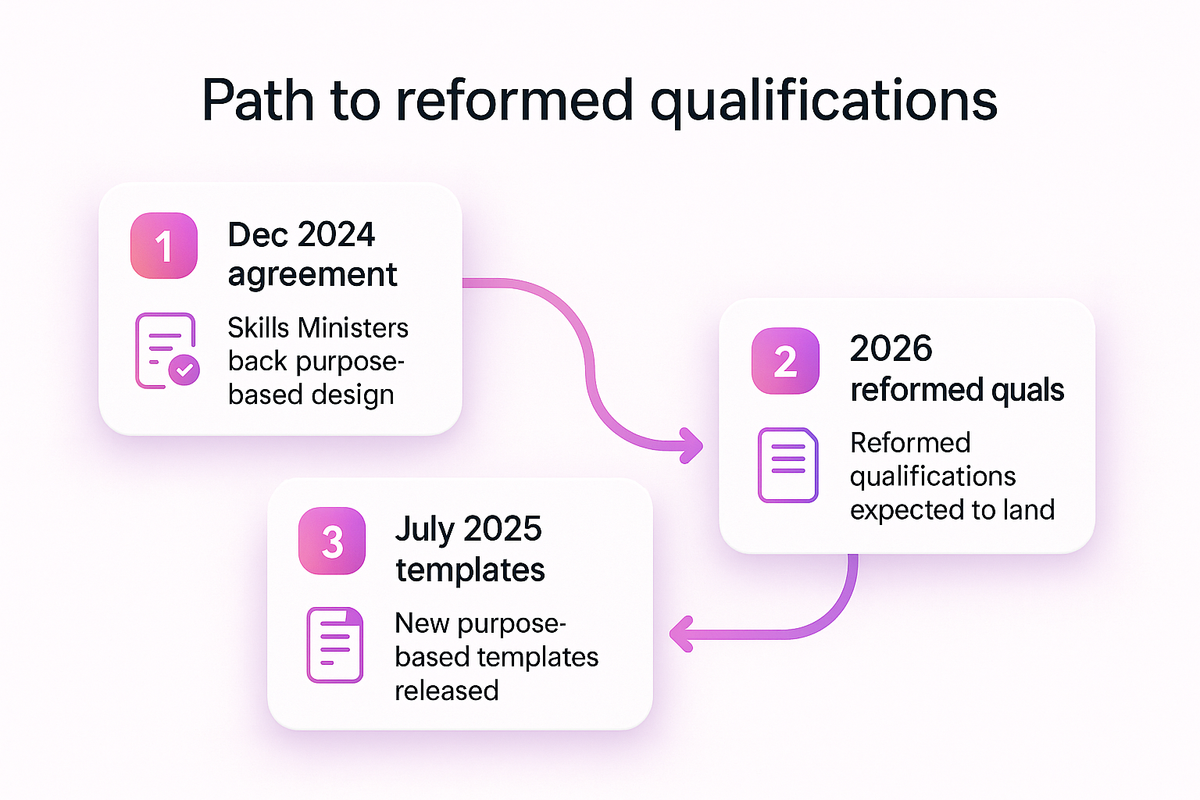
For design work built tightly around current unit-of-competency wording, that's a near-term obsolescence risk. Effort spent perfecting language and structure that maps precisely to today's units is effort that may need reworking once reformed qualifications land.
The 54-package problem
There are 54 training packages currently listed on training.gov.au, and RTOs must transition to the newest version whenever one updates. There's no ceiling on that obligation — it doesn't pause because your team is stretched or your budget is set for the year. This is the structural source of what most instructional designers already feel in their gut: the work never actually finishes, it just gets deferred.
The maths that doesn't move
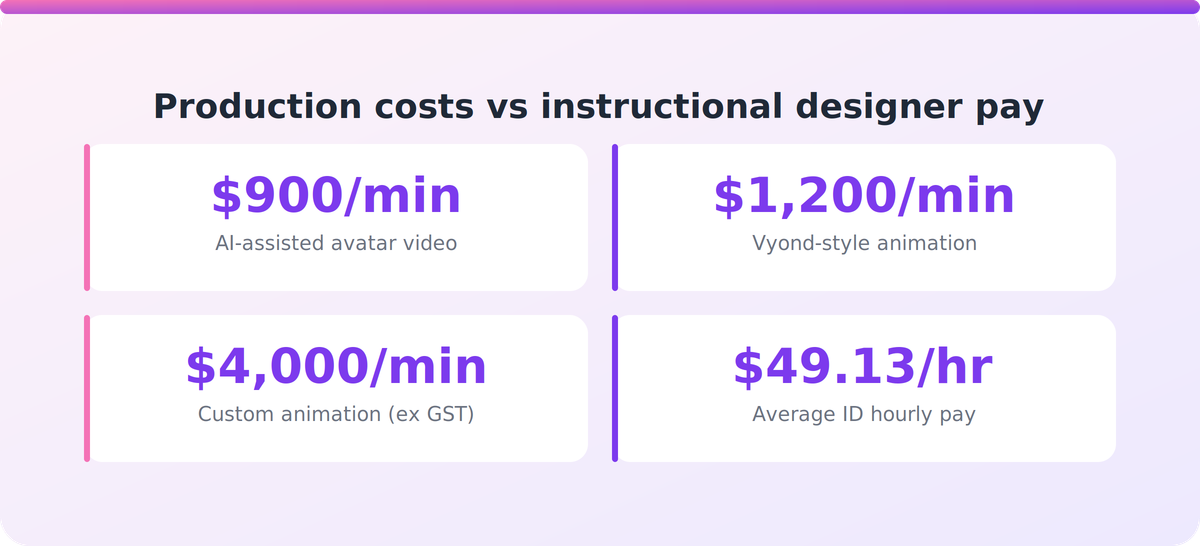
Australian production benchmarks make the cost of that treadmill concrete. AI-assisted avatar video runs from around $900 a minute, Vyond-style animation from about $1,200 a minute, and custom animation from roughly $4,000 a minute (ex GST) — costs that recur every time the underlying package changes. Set against average instructional designer pay of AU$49.13 an hour (ranging roughly AU$39–90), it's clear why constant rebuilds are a genuine budget pressure, not just a workload complaint.
Sector workforce research from Jobs and Skills Australia and Skills Insight backs this up, identifying rising compliance demands and constant training package change as factors stretching VET workforce capacity — with recruitment now harder than retention in a sector already short on design capability.
Key takeaways
- Standard 2.5 and Outcome Standard 3.1 bring instructional and learning design directly into ASQA's audit scope — cultural safety and CPD currency are now design obligations, not just delivery ones.
- ASQA's 2025 Standards assess evidence of practice, so materials need to demonstrably work safely and effectively, not just reference a policy.
- Purpose-based qualification reform (new templates from July 2025, reformed qualifications from 2026) puts near-term rework risk on anything built tightly to current unit wording.
- With 54 training packages on training.gov.au and no cap on transition obligations, currency work is structurally continuous — not a temporary spike to survive.
- Production costs ($900–$4,000 per minute depending on format) against average ID pay of $49.13/hour mean every rebuild is a real, recurring line item, not a rounding error.
Our take
The instinct when compliance tightens is to work harder on the same build model — map more carefully, validate more thoroughly, commission more content. That's necessary, but it doesn't address the actual problem, which is structural: the thing you're building against keeps changing, permanently, by design of national reform.
The more useful question is how much of what you build has to be rebuilt versus swapped. A cultural safety review, an assessment validation process, a coached-practice scenario structure — these can be built once as durable scaffolding. What changes with each training package version is often narrower than the whole asset: specific terminology, particular unit references, updated performance criteria. Treating the whole module as disposable every time a package updates is expensive by choice, not by necessity.
That distinction — reusable design logic versus package-specific content — is worth mapping explicitly for your highest-volume qualifications before the 2026 reformed qualifications start landing. It won't make the treadmill disappear. It will change how much each lap costs.
FAQ
What exactly changed in the Standards for RTOs 2025 for instructional design work? The 2025 Standards, effective 1 July 2025, replaced the 2015 Standards and shifted ASQA's audit focus to evidence of practice rather than written policy. Standard 2.5 extends cultural safety obligations to all RTOs regardless of current First Nations enrolments, and Outcome Standard 3.1 brings all staff — including instructional and learning designers — into scope for mandatory CPD and currency, where the 2015 Standards were largely focused on trainers and assessors.
Does Standard 2.5 apply if we don't currently have First Nations learners enrolled? Yes. Standard 2.5 applies to every RTO regardless of current enrolment status, with practical implications including revising learning materials and activities to be culturally safe and trauma-aware, and involving First Nations staff or industry experts in the review process.
What happens to content built around current unit-of-competency wording once purpose-based redesign lands? Skills Ministers agreed in December 2024 to a purpose-based approach to qualification design, with new templates available from 1 July 2025 and reformed qualifications expected from 2026. Content mapped tightly to current unit wording carries near-term redevelopment risk once those reformed qualifications are released.
How many training packages does this affect, and is the obligation ever going to ease off? There are 54 training packages currently on training.gov.au, and RTOs must transition to the newest version whenever a package updates, with no cap on that obligation. DEWR's Training Package Assurance function, running since January 2023, indicates this pace of change is an ongoing policy setting rather than a temporary phase.
The treadmill isn't slowing down in 2026 — it's picking up pace. The RTOs that come out ahead won't be the ones who rebuild fastest under pressure. They'll be the ones who worked out, before the next version drops, exactly which parts of their content actually needed to change.