Training Package Currency: The Operations Tax on RTO COOs
23 August 2026 · 7 min read

Training package currency looks like a curriculum problem until you're the one reconciling training.gov.au release dates against your LMS, your student management system and your marketing collateral on a Friday afternoon. For RTO operations leaders, it isn't an occasional curriculum refresh — it's a recurring tax on staff time, systems and reporting accuracy that scales with regulatory churn, not with enrolments.
Why this lands on your desk
Someone has to own the tracking task every time a qualification is superseded: checking the new release date, the teach-out timeline, the unit mapping, then pushing those changes through the LMS, the student management system, assessment tools and marketing collateral before students enrol in a version that's about to expire. There's no natural owner for that work unless operations builds the process — it isn't a training-team task, and it isn't a one-off project either.
Reporting sits on you too. AVETMISS submissions have no extensions and no exemptions. RTOs delivering fee-for-service training in 2025 must have that data with NCVER by 28 February 2026, full stop. Layer on a second, evolving data regime arriving on top of it, and the reporting calendar stops being an annual event and starts looking like a standing operational commitment.
And under the 2025 Standards for RTOs, the auditor isn't just checking that a policy document exists. They want to see evidence that the process actually worked — which turns an undocumented, individually-held method for managing training package transitions into a compliance exposure that sits with you, not with whoever happened to run the last transition.
The structural cost: why training packages keep moving
Jobs and Skills Councils took over from the former Skills Service Organisations and are responsible for the ongoing maintenance of training packages — reviewing units, updating them, and superseding them as industries change. That's a structural, permanent function, not a periodic clean-up. Training package currency isn't a project you finish; it's a maintenance cost you carry indefinitely.
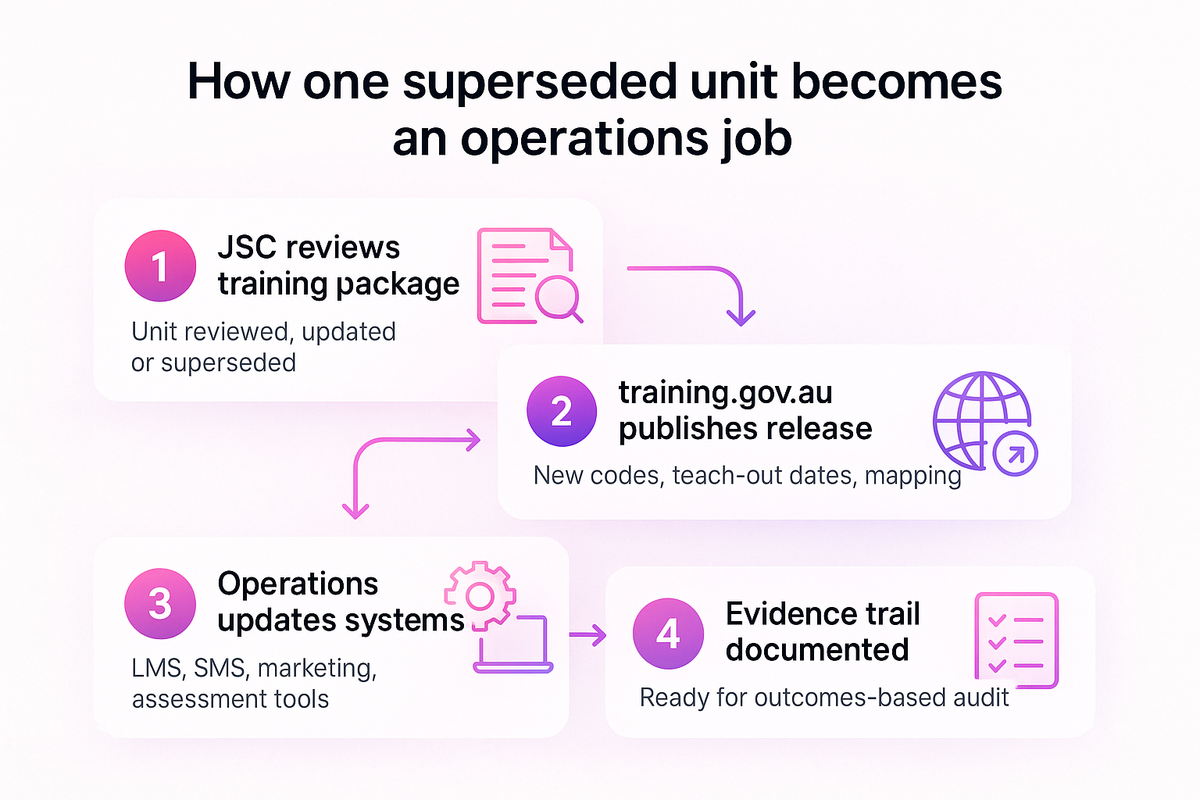
training.gov.au publishes the official release dates, teach-out timelines and unit mapping RTOs need to track this. Miss the window and the cost isn't abstract: students needing the updated version for licensing or job readiness can't enrol in the old one, and enrolments are lost while your systems catch up to the register.
Two reporting regimes, one deadline that never moves
AVETMISS reporting keeps running on fixed dates regardless of what else is happening in your compliance calendar. Industry commentary already describes the annual submission as demanding enough to warrant a dedicated person or team — and that's before a second regime lands on top of it.
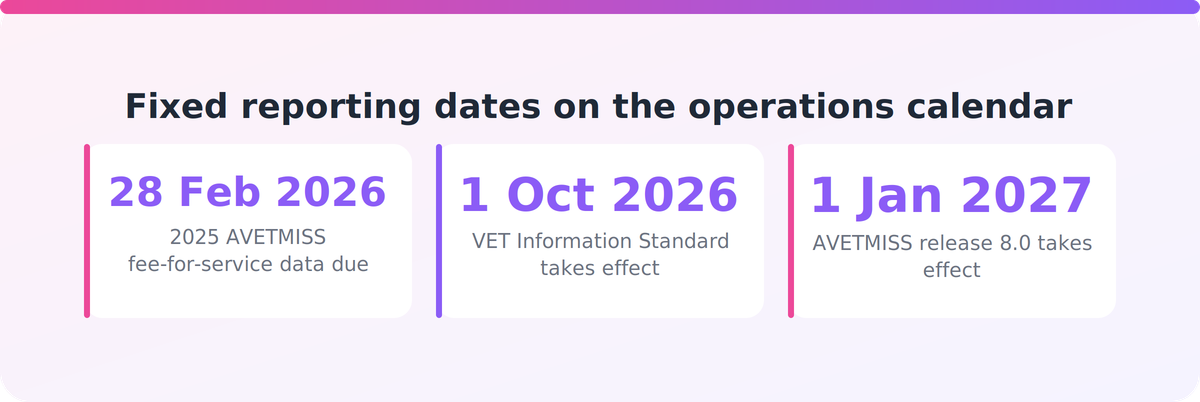
The VET Data Streamlining Program is introducing a new VET Information Standard intended to eventually replace AVETMISS, with the relevant data instrument taking effect from 1 October 2026. Separately, AVETMISS release 8.0 — including a shift from ANZSCO to the new Occupation Standard Classification for Australia, plus a new funding identifier for Free TAFE — takes effect from 1 January 2027. For close to eighteen months, your team will be operating two evolving reporting regimes in parallel, not switching cleanly from one to the other.
From paperwork to evidence: what the 2025 Standards actually changed
The 2025 Standards for RTOs commenced on 1 July 2025, moving compliance from a document-based model to one built on outcomes and evidence of practice. ASQA made this shift after sector feedback that the 2015 Standards drove an undue focus on prescriptive compliance rather than good organisational practice.
That's a genuine change in what gets audited. A policy stating how you manage superseded units is no longer enough on its own — you need to show it worked, with evidence that maps to a real transition your organisation went through. If that knowledge lives only in one coordinator's inbox, you don't have a compliant process; you have a single point of failure that happens to be compliant most of the time.
The capacity trap: headcount, churn and cost-per-student
Re-mapping units, updating assessment tools, and evidencing trainer industry currency all consume staff hours. Those hours track the pace of training package churn, not the number of students you enrol — which quietly breaks any cost-per-student model you're trying to hold flat.
Sector commentary on the 2025 transition already points to manual data entry and disjointed systems as the leading compliance risk facing providers right now. And market analysis of the Australian RTO sector notes that rising compliance load, alongside regulatory scrutiny and funding uncertainty, is a contributing factor in the wave of strategic exits and consolidation currently reshaping the market. Operations capacity isn't just a delivery issue — it's becoming a factor in which providers stay independent.
Building an operating rhythm, not a fire drill
Commentary on 2026 compliance strategy makes a specific argument worth sitting with: risk management, quality assurance and validation can't keep running as separate, occasionally-reviewed activities. They need to operate as one integrated governance framework if you want to be audit-ready on demand rather than audit-ready in a scramble.
For operations, that means a live register — not a folder — that tracks which units are current, which are in teach-out, which systems need updating for each change, and who owns each step. Built once, it turns every future JSC release into a known workflow instead of a fresh emergency.
Key takeaways
- Training package currency is a continuous maintenance cost driven by Jobs and Skills Council activity, not a one-off curriculum project.
- training.gov.au release dates and teach-out timelines need a single tracked owner across LMS, student management system, assessment tools and marketing.
- AVETMISS has no extensions: 2025 fee-for-service data is due to NCVER by 28 February 2026, with a new VET Information Standard from 1 October 2026 and AVETMISS release 8.0 from 1 January 2027 running in parallel for a period.
- The 2025 Standards for RTOs judge demonstrated outcomes and evidence, not policy documents alone — undocumented, individually-held processes are now a direct audit risk.
- Staff hours spent on unit remapping and currency evidencing scale with regulatory churn, not enrolments, which quietly erodes cost-per-student targets.
Our take
Most RTOs still treat training package updates as an interruption to be absorbed by whoever's free, which is exactly why they keep feeling like emergencies. They're not interruptions — they're a predictable, recurring line of operational work with known triggers (JSC releases) and known deadlines (teach-out dates, AVETMISS cut-offs). Once you build a standing process around that predictability, the work doesn't get smaller, but it stops competing with delivery for your best people's attention every time it happens.
FAQ
Who is actually responsible for tracking training package currency inside an RTO? There's no single mandated owner, which is the problem. Training teams manage content updates, but reconciling training.gov.au release dates and teach-out timelines across the LMS, student management system and reporting tools is an operational tracking task that needs a named owner in operations, not an assumption that someone else is watching it.
What happens if we miss a teach-out deadline for a superseded qualification? training.gov.au publishes the official phase-out timelines for superseded qualifications and units. Acting late risks enrolling students into a version that's about to expire, which can mean lost enrolments where students need the current version for licensing or job readiness.
Is there any flexibility on AVETMISS reporting deadlines? No. AVETMISS reporting has no extensions or exemptions. RTOs delivering fee-for-service training in 2025 must have that data submitted to NCVER by 28 February 2026, regardless of what else is competing for operations' time that quarter.
How does the 2025 Standards for RTOs change what we need to show at audit? The Standards, in force since 1 July 2025, shifted ASQA's focus from document-based compliance to outcomes and evidence of practice. That means having a policy for managing training package transitions is no longer sufficient — you need evidence that the process was actually followed during a real transition.