Training Package Currency: Why RTO Content Goes Stale
24 August 2026 · 6 min read

Training Package Currency: Why RTO Content Goes Stale
Since 1 July 2025, training package currency has stopped being a tidy-up task and become a direct audit-failure risk under the Standards for RTOs 2025. ASQA's 2026 audit cycle checks the actual version of a unit of competency against what's reflected in a provider's Training and Assessment Strategy and delivery resources — and most RTOs still find out about changes through a trainer's comment or a newsletter, well after the fact.
What changed on 1 July 2025
The Standards for RTOs 2025 are now the live compliance benchmark, not a future-dated policy to plan around. Two shifts matter for anyone managing content:
- The 2026 Annual Declaration on Compliance requires providers to declare alignment against the 2025 Standards specifically, not legacy frameworks.
- ASQA audits are checking the actual unit-of-competency version delivered against what's documented in Training and Assessment Strategies and assessment tools.
That second point is the sting. A superseded unit still in active use isn't a minor housekeeping lag anymore — it's a checkable, provable breach the moment an auditor pulls the file.
Where the pace problem comes from: Jobs and Skills Councils
Training package updates aren't issued by ASQA. They come from Jobs and Skills Councils (JSCs) — bodies such as AUSMASA, BuildSkills Australia and Future Skills Organisation — which were established in 2023 specifically to make vocational education more responsive to industry need.
That responsiveness is the point, and it cuts both ways. JSCs run multiple revision projects at once, often across overlapping units and qualifications, which means:
- Changes arrive from several parallel streams rather than one predictable release schedule.
- A single training package can have units revised by different JSC projects at different times.
- There's no single central alert that tells an RTO "this affects you" — the reform was built to increase the frequency of change, not to make tracking it easier.
The Jobs and Skills Council revision pipeline
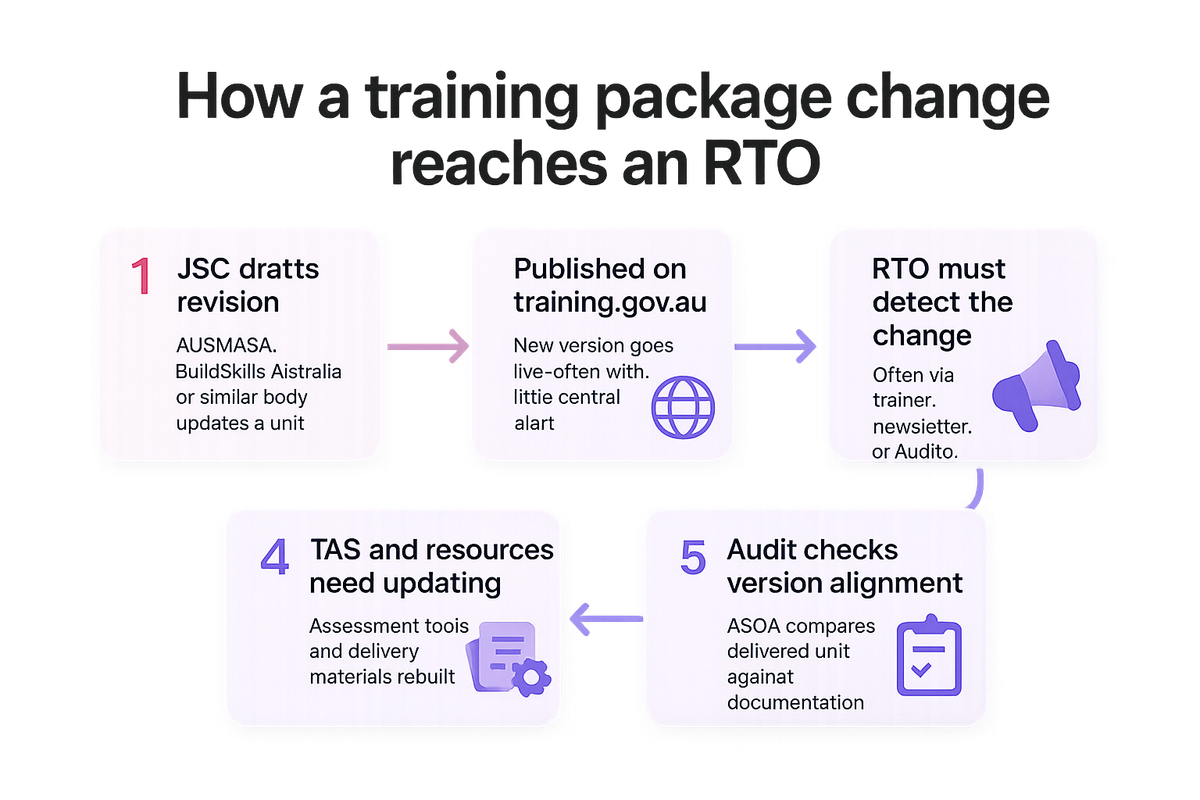
How most RTOs actually find out about a change
Research into provider practice shows the dominant detection method for training package changes is informal: a trainer mentions something, a peak body newsletter flags an update, or — worst case — an ASQA auditor raises it during a visit.
This creates a structural mismatch. JSCs are, by design, increasing the pace of revision. Most RTOs are still running manual, periodic content reviews built for a slower era. By the time a change is noticed through informal channels, delivery has often already been running against a superseded unit for weeks or months.
What ASQA is checking now that used to be looser
Two things have tightened together, and providers need to treat them as one problem, not two:
- Version alignment as a compliance breach. Delivering against an outdated unit of competency is now a direct, provable non-conformance — not a quality-improvement note.
- Continuous self-assurance over periodic review. ASQA's audit focus has moved toward Performance Assessments that expect evidence of real-time monitoring and responsiveness, not a once-a-year content audit.
- Content quality itself. From FY2026, static or off-the-shelf learning materials are explicitly flagged as falling short of ASQA's expectations for engaging, well-paced, logically structured delivery. Swapping in an updated unit code is no longer enough if the learning experience around it is generic and unchanged.
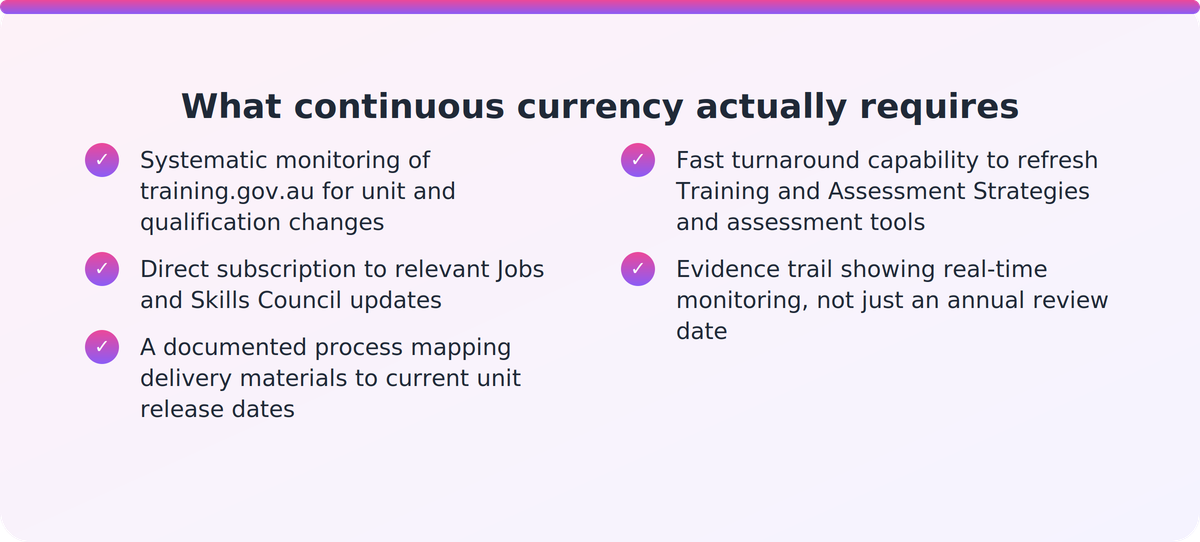
Closing the gap: what continuous currency actually requires
The compliance answer isn't a better spreadsheet. It's a shorter distance between "a unit changes" and "delivery reflects it." In practice, that means:
Building a real currency process
Key takeaways
- The Standards for RTOs 2025 are the live benchmark for the 2026 Annual Declaration on Compliance — audits check actual unit versions against delivery evidence, not stated policy.
- Jobs and Skills Councils (e.g. AUSMASA, BuildSkills Australia, Future Skills Organisation) run overlapping revision projects by design, since JSCs exist to make VET more industry-responsive.
- Most RTOs still detect training package changes informally — via a trainer, a newsletter, or an auditor — which means delivery is often already non-current by the time it's noticed.
- ASQA's audit focus has shifted toward continuous self-assurance and Performance Assessments, not periodic annual review.
- From FY2026, static or off-the-shelf content is flagged as falling short of engagement and pacing expectations, even when unit codes are technically up to date.
Our take
The uncomfortable truth in this reform is that more frequent change is the intended outcome, not a side effect. JSCs were built to speed up revision; expecting that pace to slow down is wishful thinking. The real bottleneck for most RTOs isn't awareness — plenty of providers do eventually hear about a change. It's how long it takes, once they know, to rebuild Training and Assessment Strategies, assessment tools and learner-facing materials to match. If that rebuild cycle still runs on the same instructional design timelines that produced the original content, currency will keep slipping no matter how good the monitoring gets. The providers who stay ahead of this will be the ones who treat content refresh speed as a compliance capability in its own right, not an afterthought to detection.
A reasonable next question for any RTO leadership team: if a unit changed today, how long would it actually take to get delivery current — and would you know before ASQA did?
FAQ
What is training package currency, and why does it matter under the Standards for RTOs 2025? Training package currency means an RTO's Training and Assessment Strategies, assessment tools and delivery materials match the current, non-superseded version of each unit of competency and qualification on training.gov.au. Under the Standards for RTOs 2025, this is now a directly auditable requirement — ASQA checks the delivered version against documented evidence, not just whether a review policy exists.
Who actually updates training packages, and how often does this happen? Jobs and Skills Councils (JSCs) — including bodies such as AUSMASA, BuildSkills Australia and Future Skills Organisation — run the revision projects, not ASQA. Because JSCs were established in 2023 to make VET more industry-responsive, multiple overlapping revision projects can be underway across different units and qualifications at any given time.
How does ASQA actually check training package currency during an audit? ASQA compares the specific unit-of-competency version referenced in an RTO's Training and Assessment Strategy and assessment tools against the version actually being delivered to learners. A mismatch — delivering against a superseded unit — is treated as a checkable compliance breach, particularly under the 2026 Annual Declaration on Compliance process.
Is updating the unit code enough to stay compliant? No. From FY2026, ASQA's expectations extend to the quality of the learning experience itself — engaging, well-paced, logically structured delivery. Static or off-the-shelf content that simply references the correct unit code but hasn't been meaningfully refreshed can still fall short of these outcome standards.
Why do so many RTOs still find out about training package changes late? Most providers still rely on informal detection — a trainer mentioning a change, a peak body newsletter, or an ASQA auditor raising it during a visit — rather than a systematic monitoring process against training.gov.au and JSC project updates. This means delivery is often already running against superseded requirements before anyone notices.