Training Package Currency: A Moving Target for RTOs
13 August 2026 · 7 min read

Training Package Currency: A Moving Target for RTOs
Training package currency used to be a document-management task: swap the old PDF for the new one, update the file register, done. Under the 2025 Standards for RTOs, that's no longer enough — ASQA wants proof that your assessment tools, trainer matrices and validation records reflect current units of competency, not just that a policy says they should.
Why this lands squarely on your desk
You own the Annual Declaration on Compliance (ADC), due 3–31 March each year, signed only by the CEO but built entirely on the evidence trail you assemble. That declaration now asks you to state — proactively — where the RTO stands against every Outcome Standard and Compliance Requirement, before ASQA ever asks. There's no waiting for an audit to surface a gap.
Assessment validity, reliability, sufficiency and training-package alignment remain the most common source of non-compliance findings in the sector. When a Jobs and Skills Council (JSC) updates a training package and your mapping, assessment tools or trainer-competency evidence lag behind, that's not a hypothetical risk — it's a documented, recurring failure point auditors keep finding. And because currency evidence typically lives across trainer files, validation spreadsheets, shared drives and inboxes, you're usually the only person who can see the whole picture — which makes you the bottleneck for every review, and the one left explaining the gap.
What "currency" actually means now
The 2025 Standards for RTOs commenced 1 July 2025, replacing the 2015 Standards, and are structured around three parts: the Outcome Standards, the Compliance Requirements (including the Fit and Proper Person Requirements), and a separate Credential Policy. None of these documents are the binding instrument in themselves — the legally enforceable requirements sit on the Federal Register of Legislation, with ASQA and the Department of Employment and Workplace Relations (DEWR) publishing guidance material to interpret them.
The defining shift in that guidance is away from prescriptive checklists and toward demonstrated practice. ASQA has been explicit that it now expects evidence systems work in real delivery and assessment contexts — not that a policy exists describing how they should work. For currency specifically, that means an auditor isn't satisfied by a training package register showing the right version number. They want to see that your assessment tools were actually updated to match, that trainers can show they understand what changed, and that validation records reflect the current unit, not the one it replaced.
The Jobs and Skills Council blind spot
Here's the structural catch: training packages are developed and maintained by industry-led Jobs and Skills Councils, not ASQA. ASQA regulates against the package; it doesn't necessarily flag every update as it lands. Compliance teams are advised to track each relevant JSC directly — through newsletters and release notes — rather than assume a change will surface through the regulator's own channels. If your monitoring depends on ASQA telling you a package has moved, you're already behind.
Trainer currency: non-negotiable, with no fixed clock
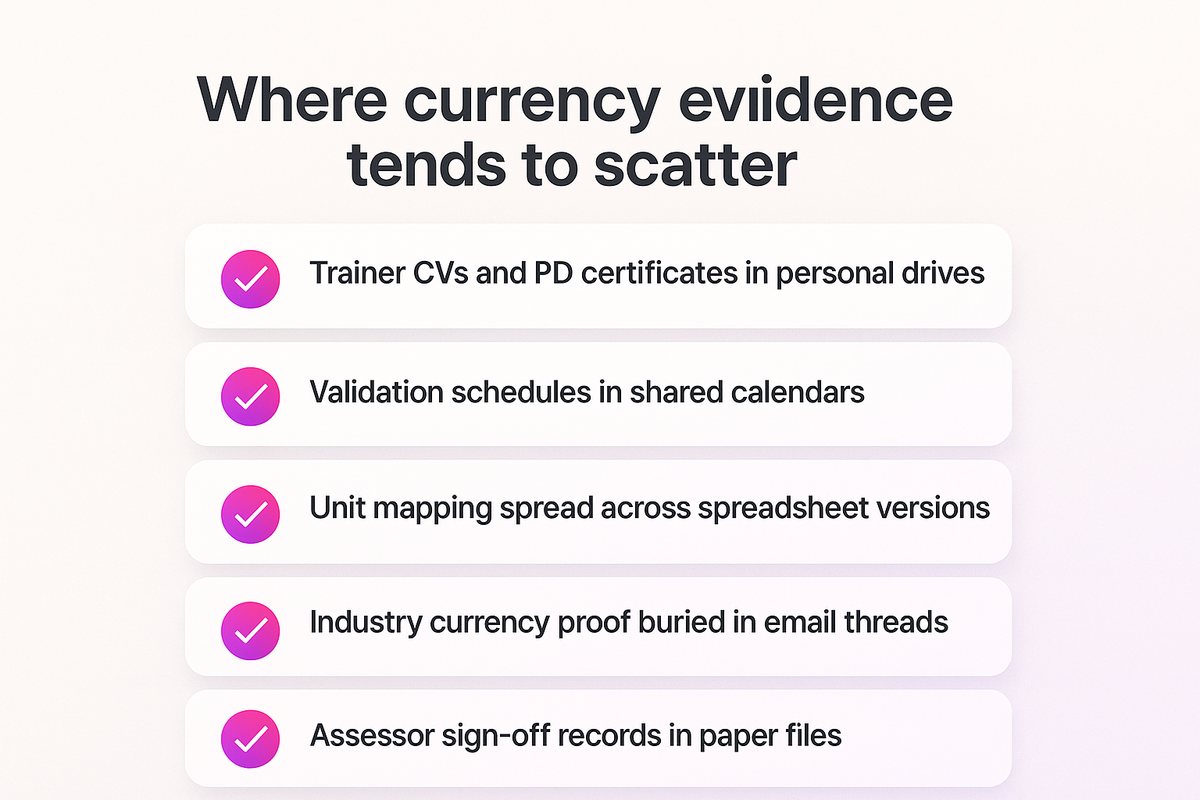
Trainer and assessor currency is a firm requirement under the Standards, but there's no single, standard currency period or activity list that applies across every training package. What counts as "current" industry practice for one qualification can look completely different for another. That ambiguity is exactly why currency evidence tends to fragment — into CVs, professional development certificates, workplace visit notes and email confirmations, scattered across whoever happened to collect them.
The Annual Declaration changes the timing of the risk
The ADC's design — a declaration submitted before any trigger event, with an explicit opportunity to disclose gaps upfront — pushes the whole compliance function toward proactive self-assurance. That's a genuine shift in incentive. Previously, an untracked currency gap was a risk that might surface at your next audit. Now it's something you're being asked to actively confirm you don't have, on a fixed date, every year.
From annual review to continuous monitoring
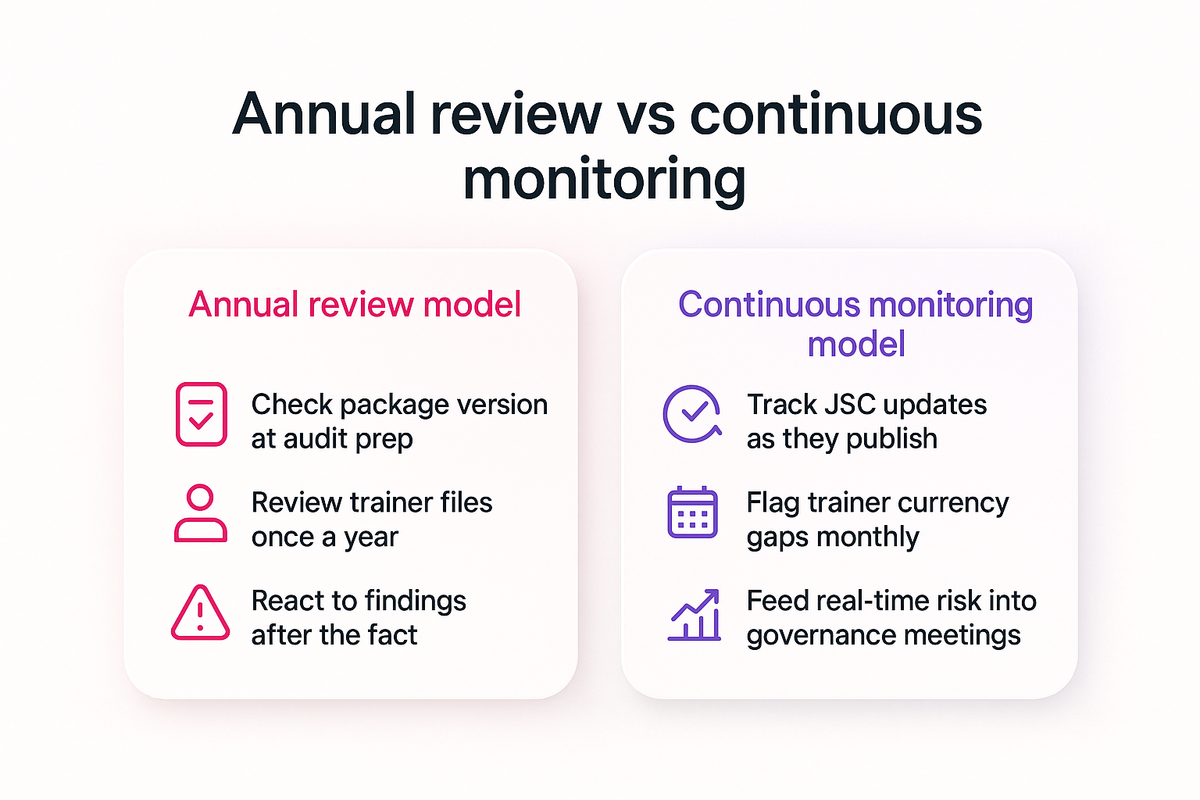
Quality Area 4 of the 2025 Standards requires ongoing, systematic monitoring and evaluation for continuous improvement, not a once-a-year check-in. Combined with ASQA's stated move to a risk-based, increasingly targeted regulatory approach for 2026, that means an RTO with weak internal tracking of training package currency carries a higher risk profile before an audit is even triggered — simply because the visible signals (governance minutes, monitoring logs, disclosed gaps) suggest less oversight.
It's also worth naming what this isn't: purely an individual RTO failing. The Rapid Review that shaped the 2025 Standards specifically recommended stronger feedback loops between ASQA, industry bodies and providers on training package currency and implementation. Regulators and reviewers already recognise this as a structural gap in the system — which doesn't remove your obligation, but it does mean you're not managing a personal shortcoming when you flag it as a systemic risk to your board.
Key takeaways
- The 2025 Standards for RTOs judge demonstrated practice, not policy documents — currency evidence needs to show your assessment tools and trainer records actually reflect the current unit, not just that a register says they should.
- Training packages are updated by Jobs and Skills Councils independently of ASQA — track each relevant JSC directly rather than waiting for the regulator to flag a change.
- Trainer currency has no uniform standard period across training packages, which is precisely why it fragments across drives, inboxes and spreadsheets.
- The Annual Declaration on Compliance (due 31 March) forces proactive disclosure of gaps before an audit, changing when — not just whether — currency risk becomes visible.
- Quality Area 4 expects continuous monitoring, not an annual review cycle; a risk-based regulator will read weak tracking as a higher-risk signal on its own.
Our take
The honest read here is that ASQA has shifted the burden of proof onto Compliance Managers without giving them a matching system of record. There's no central currency calendar, no single JSC feed, no standard trainer-currency period — you're expected to build and maintain that infrastructure yourself, then produce it on demand. That's a reasonable regulatory ask given how often assessment misalignment shows up in audit findings, but it's worth naming plainly to your CEO and board: continuous currency monitoring is now a resourcing question, not a checklist item you tick once a year. If you're the only person who can see the full picture across trainer files, validation schedules and unit mapping, that's not a personal failing — it's a system waiting to be built.
FAQ
Do the 2025 Standards for RTOs specify how often a training package needs to be reviewed for currency? No. The Standards require ongoing, systematic monitoring under Quality Area 4 and demonstrated alignment to current units of competency, but they don't set a fixed review interval. Jobs and Skills Councils update packages on their own schedules, so currency needs to be tracked continuously rather than on a set annual date.
Who is actually responsible for telling RTOs when a training package changes? The Jobs and Skills Council that owns the package publishes the update — ASQA doesn't act as the notification channel. RTOs are advised to monitor each relevant JSC's own communications, such as newsletters and release notes, directly.
Does the Annual Declaration on Compliance require evidence of training package currency specifically? The ADC requires the CEO to declare compliance or non-compliance against Outcome Standards and Compliance Requirements broadly, which includes assessment and trainer/assessor obligations tied to current units of competency. Given assessment compliance is consistently the sector's most common non-compliance finding, currency evidence is a natural focus area when preparing the declaration.
Is trainer currency assessed against the same criteria across every training package? No. There's no single standard for currency periods or required activities across training packages, so trainer currency needs to be assessed against what's relevant to each specific package and industry context, rather than a single organisation-wide rule.