Training Package Currency: Why RTO Managers Own This Risk
25 August 2026 · 8 min read

Training package currency used to be a once-a-year housekeeping job: check training.gov.au, tick a spreadsheet, move on. Under the 2025 Standards for RTOs, it's a governance obligation you answer for personally — and ASQA's shift to auditing evidence of practice rather than policy documents means a currency gap now reads as a systemic failure, not an oversight.
Why this lands on your desk
You're accountable for audit outcomes under the 2025 Standards' Outcome Standards, Compliance Requirements and Credential Policy — three separate instruments, not one rulebook you can file and forget. A superseded unit sitting in your assessment tools isn't just untidy; it's a Fit and Proper Person question about whether you're actually governing the training you're delivering.
At the same time, non-trade completion rates have fallen for three years running, and Jobs and Skills Councils keep pushing mid-cycle updates through sectors you deliver in. Every one of those updates lands as unplanned re-mapping work on a team that's already stretched. This is the collision point: rising compliance expectations, softening completion outcomes, and a resourcing base that hasn't grown to match.
The 2025 Standards moved the goalposts
The 2025 Standards for RTOs commenced on 1 July 2025, replacing the Standards for RTOs 2015. They're built around three components: legislated Outcome Standards, legislated Compliance Requirements (including the Fit and Proper Person Requirements), and a separate Credential Policy covering trainer, assessor and validator credentials (ASQA, DEWR).
The practical shift for you is this: from 2026, ASQA's regulatory activity and audits assess providers against these new instruments, not legacy policy text. Providers who haven't updated their systems, documentation and delivery models to reflect the new focus on demonstrated outcomes and evidence of practice carry heightened non-compliance risk — and training package currency is one of the clearest places that evidence either exists or doesn't.
Training package components are classified as current, superseded or deleted. That classification discipline existed under Clauses 1.26–1.27 of the 2015 Standards and continues conceptually under the 2025 framework's currency and credential obligations. If your assessment tools still reference a superseded unit, that's not a technicality — it's evidence your quality system isn't tracking what it's supposed to.
Currency isn't static — JSCs keep moving the target
Here's the part that catches Managers out: ASQA doesn't write the training products, Jobs and Skills Councils do, working to Annual Training Product Development Plans under the Training Package Organising Framework. That means currency isn't something you check once a year against a static list — it's a moving target set by bodies operating on their own schedules.
Right now, JSCs have live projects running that will hit multiple RTOs mid-cycle:
- Digital capability units — including generative AI and cyber security — being added to the BSB Training Package
- Hydrogen fuel cell electric vehicle units being developed for the AUR Training Package
- A review of 28 units of competency in mining and civil construction to reflect modern work practices
If you deliver in any of these areas, none of this is optional or schedulable around your convenience. Each update forces re-mapping, re-assessment and re-training work you didn't budget time for.
The completion-rate cost of getting this wrong
NCVER data shows a mixed picture that should worry anyone managing completions. The 6-year trade apprenticeship completion rate has climbed to 58.7% for the 2019 cohort, continuing a positive trend since 2015. But the 4-year non-trade completion rate fell to 42.7% for the 2021 cohort — the third consecutive annual decline, linked to changes in government incentives and shifts in the occupational training mix.
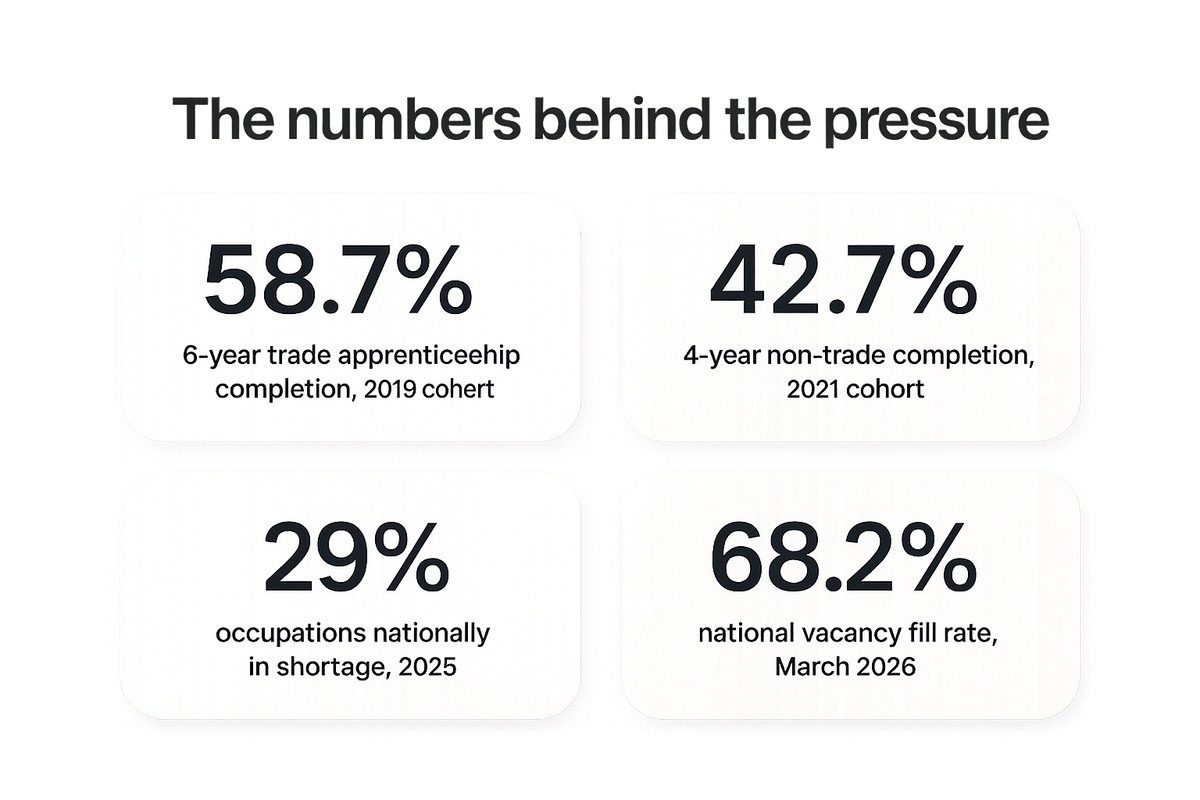
Delivering against superseded or drifting content adds avoidable attrition risk to a metric you're already judged on. Learners disengage when training feels disconnected from current industry practice, and assessors lose confidence in tools that no longer map cleanly to the unit. Layer that on top of a national skills picture where the 2025 Occupation Shortage List found around 29% of assessed occupations in shortage, and the national vacancy fill rate fell to 68.2% by March 2026 — worst in trades, health, technology and community services, and worse again regionally — and the mission stakes are as real as the audit stakes. Outdated content doesn't just risk a finding; it risks the skilled workers the shortage list says the country needs.
The resourcing reality nobody's fixing for you
Industry Skills Australia's VET Workforce Project describes an ageing, resource-constrained trainer and assessor workforce, a shortage of qualified Teach, Train and Assess professionals in regional and remote areas, and rising time and cost pressure on trainers to maintain their own vocational currency as digital transformation accelerates. That compounds directly with the resourcing strain of keeping assessment and training content aligned to updated units — you're asking a shrinking, ageing workforce to absorb more currency work, faster.
There's no clean fix for that in a blog post. But naming it matters, because it changes how you should be resourcing this function: not as a task someone does when they have a spare afternoon, but as a line item with a named owner and a recurring cadence.
Treat currency as a discipline, not a project
Sector governance commentary is blunt about this: continuous improvement is a cornerstone requirement under the 2025 Standards, not an optional extra. Providers with weak governance frameworks are exposed at audit across four areas — compliance, staffing, financial and reputational risk — and training package currency touches all four at once. A currency gap is a compliance finding, a staffing gap (who's meant to be tracking this?), a financial risk (re-work costs more than staying current), and, if it surfaces publicly, a reputational one.
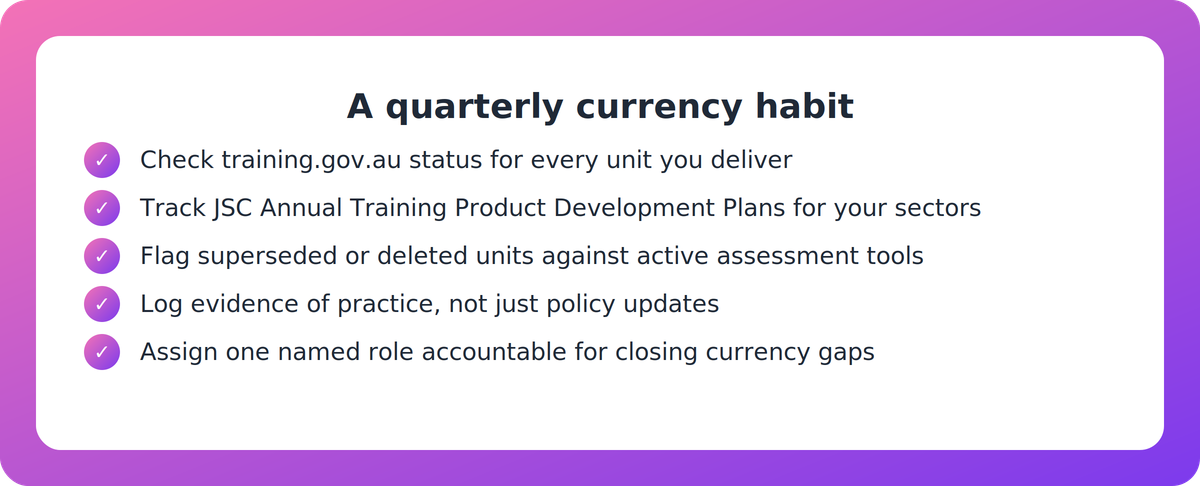
The fix isn't heroic. It's a standing quarterly check against training.gov.au status, a watch list of JSC Annual Training Product Development Plans for your sectors, and a named person accountable for closing the loop when something moves from current to superseded. Small, boring, recurring — and exactly the kind of evidence of practice ASQA is now looking for.
Key takeaways
- The 2025 Standards for RTOs (effective 1 July 2025) fold currency into Outcome Standards, Compliance Requirements and the Fit and Proper Person Requirements — it's a governance issue, not document control.
- From 2026, ASQA audits evidence of practice against the new instruments, so a currency gap surfaces as a systemic finding, not a minor oversight.
- Jobs and Skills Councils, not ASQA, drive mid-cycle updates via Annual Training Product Development Plans — live projects in BSB, AUR and mining/civil construction show currency is continuous, not annual.
- Non-trade completion rates have fallen for three consecutive years; outdated content adds avoidable attrition risk on top of an already-softening metric.
- With around 29% of occupations nationally in shortage, currency gaps carry a mission cost as well as an audit cost.
Our take
Most RTOs still run currency checks as an annual event because that's how the old Standards trained everyone to think. The 2025 framework doesn't just tighten the rules — it changes what counts as evidence, and an annual snapshot doesn't hold up when an auditor asks for practice, not policy. The Managers who come through 2026 audits cleanly won't be the ones with the tidiest register; they'll be the ones who can show a live, working habit of tracking JSC activity and closing gaps as they appear. That's a resourcing and governance decision, and it belongs on your desk now, not after the first adverse finding.
FAQ
What does 'training package currency' actually mean under the 2025 Standards? It means your units of competency, assessment tools and training materials match the current status of the training package — current, superseded or deleted — and that you can show evidence of ongoing practice maintaining that alignment, not just a policy stating you do.
Who updates training packages — ASQA or the government? Neither, directly. Jobs and Skills Councils develop and revise training products under Annual Training Product Development Plans, working within the Training Package Organising Framework. ASQA regulates against the Standards; it doesn't write the content.
How often should we check training package status? Given JSCs run their own update schedules — current examples include mid-cycle changes in BSB, AUR and mining/civil construction units — a quarterly check against training.gov.au, paired with a watch on JSC plans for your sectors, is more realistic than an annual review.
Does a currency gap really put Fit and Proper Person status at risk? The 2025 Standards frame currency and credential obligations as part of the same Compliance Requirements that include Fit and Proper Person Requirements. A pattern of unaddressed currency gaps speaks to governance capability, which is exactly what that requirement tests.