Training Package Updates for Instructional Designers
11 August 2026 · 7 min read

A training package used to have a shelf life you could roughly predict — build the resources, map them once, revisit at the next accreditation cycle. That predictability is gone. Under the 2025 Standards for RTOs and the new Training Package Organising Framework, some qualifications will be redesigned within months while others sit untouched for years, and the only safe assumption left is that any given unit of competency could be reopened without warning.
Why This Lands on Your Desk
You own the mapping between learning resources and units of competency. That's always been true. What's changed is what ASQA now checks when it audits that mapping.
The 2025 Standards for RTOs, which commenced 1 July 2025 and replaced the 2015 Standards, shift the compliance test from written policy toward demonstrated evidence of practice in real delivery and assessment contexts (ASQA). A policy document saying you review resources annually is no longer enough. ASQA has confirmed that audits conducted in 2026 will assess against the 2025 Standards directly — so if your mapping documentation, delivery models or assessment tools haven't caught up, that's a live non-compliance finding, not a paperwork gap you can patch retrospectively.
Add to that the fact that Jobs and Skills Councils (JSCs), which now do the technical drafting of training package products, report quarterly on active review projects — including reviews of superseded units of competency and regulatory-driven updates such as the Transport Security Protection qualification. Those reports are a preview of your workload, months before the changes land in your inbox.
The Standards Changed the Test, Not Just the Paperwork
This matters for how you prioritise your time. Previously, a well-written learning guide that hadn't been touched in three years might survive an audit if the mapping document technically still referenced the right unit code. Under the 2025 Standards, an auditor is more likely to ask you to demonstrate how a learner actually meets each performance criterion — and if the training package behind that unit has moved on, your evidence trail breaks at exactly the point someone checks it.
There's also a new checkpoint upstream of you: the independent Training Package Assurance Body now reviews JSC-developed training package products against national standards and policy before they're finalised. That's one more stage where a qualification you've built resources for can shift, and one more reason to track release schedules rather than wait for a superseded-unit notice to reach your RTO.
Currency Is Now a Moving Target, Not a Fixed Shelf Life
The purpose-led, principles-based approach in the new Training Package Organising Framework (effective 1 July 2025) means industries transition at their own pace. Some sectors will see rapid redesign; others will run on existing structures until there's a specific trigger for change. For you, that means a single, predictable review cycle across your qualification portfolio is no longer a realistic planning assumption.
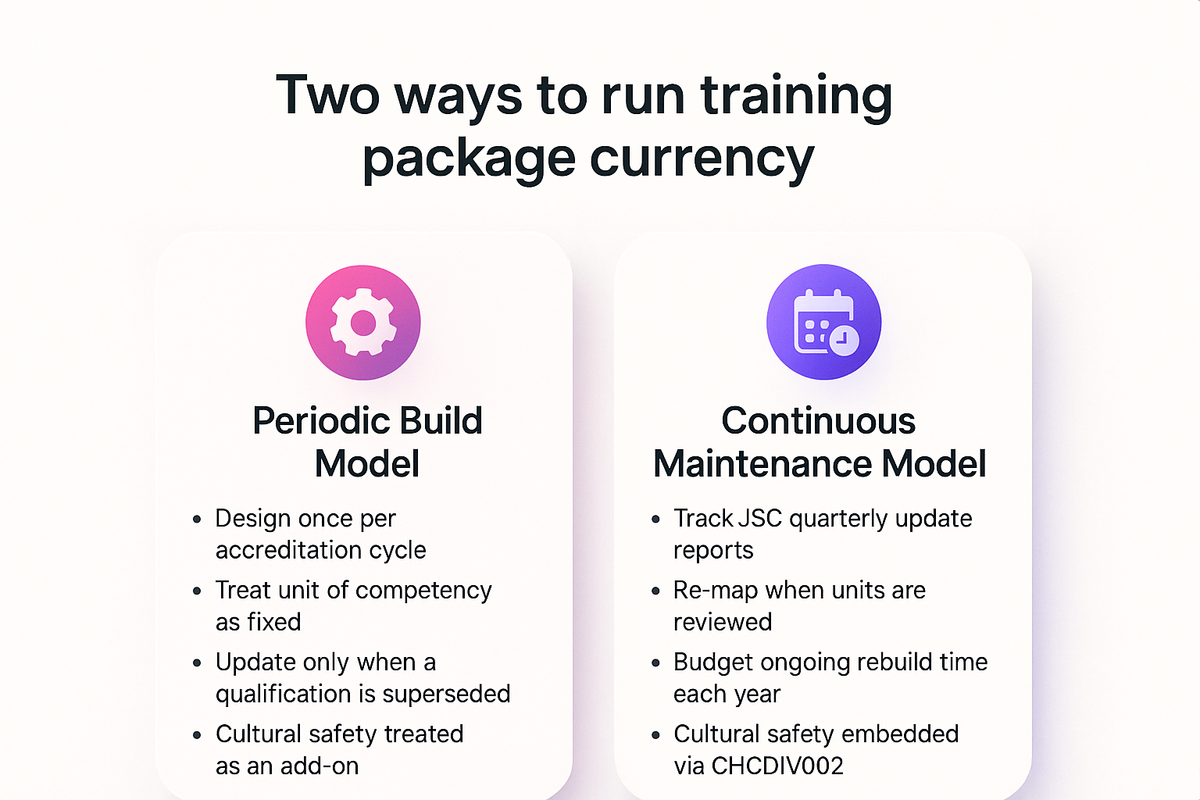
The practical shift looks like this:
What Maintenance Actually Looks Like This Quarter
Treat currency tracking as a recurring line item, not a project you close out. A few things worth building into your working rhythm:
- Skim JSC quarterly update reports for qualifications your RTO delivers, not just the ones flagged as superseded.
- Keep a live register of which units of competency your resources map to, with a lightweight version-check date against the Training Package Assurance Body's published product list.
- Log design and mapping work as trainer/assessor currency evidence where relevant — the RTO Outcome Standards 2025 explicitly recognise reviewing and contributing to training package updates as accepted evidence of maintaining industry currency, which means your update work has compliance value beyond the resource itself.
- Budget rebuild time as an ongoing cost centre, not a one-off project fee, when you're planning resourcing for the year ahead.
Cultural Safety Moved From Nice-to-Have to Named Unit
Cultural safety used to be something good instructional designers folded in because it was the right thing to do. It's now a codified, mappable requirement. Unit of competency CHCDIV002 (Promote Aboriginal and/or Torres Strait Islander cultural safety), alongside the Commonwealth Aboriginal and Torres Strait Islander Cultural Capability Framework, gives you a specific standard to design against and evidence — not a discretionary add-on that gets deprioritised when a deadline tightens.
That's a gift, in a way. A named unit with defined performance criteria is far easier to defend at audit than a general statement about inclusive practice. But it also means cultural safety content now sits inside your currency-tracking system alongside every other unit — if CHCDIV002 or the framework behind it is revised, your resources need to move with it.
Where Generative AI Actually Helps — and Where It Doesn't
A broader survey of 144 instructional design practitioners found the standout benefit of generative AI in this field was time saved on drafting, feedback and ideation — useful, given how much of the maintenance workload described above is repetitive re-drafting against updated criteria. But the same research, echoed in Australian VET practitioner commentary, is clear that accuracy verification and learner personalisation still need human pedagogical judgement. AI can help you turn around a first-pass update fast; it can't tell you whether that update actually meets the revised performance criteria or lands with the cohort in front of you.
Key takeaways
- The 2025 Standards for RTOs test demonstrated evidence of practice, not policy documents — stale unit mapping is now a direct audit finding.
- The Training Package Organising Framework means qualifications no longer share a predictable review cycle; some will change fast, others won't, and you need to track both.
- JSC quarterly reports and the Training Package Assurance Body's review process are early-warning signals for upcoming rebuild work — worth monitoring proactively.
- Reviewing and contributing to training package updates now counts as trainer/assessor currency evidence under the RTO Outcome Standards 2025.
- CHCDIV002 and the Commonwealth Aboriginal and Torres Strait Islander Cultural Capability Framework make cultural safety a mappable, auditable design requirement, not a discretionary extra.
Our take
The uncomfortable truth in all of this is that instructional design in VET has quietly become an ongoing maintenance discipline, even though most teams are still resourced and budgeted like it's a series of one-off builds. That mismatch is where compliance risk actually accumulates — not from bad design, but from good design that nobody had the time or budget to revisit once the training package underneath it moved. If there's one thing worth taking to your next planning conversation, it's this: ask to see currency tracking treated as a recurring cost, with its own time allocation, rather than something absorbed into the next project's scope when it's already overdue.
FAQ
When did the 2025 Standards for RTOs take effect, and what's different for instructional design? The 2025 Standards for RTOs commenced 1 July 2025, replacing the 2015 Standards. They shift ASQA's compliance test from written policy to demonstrated evidence of practice, meaning unit-of-competency mapping now has to hold up against real delivery and assessment evidence, not just documentation.
How do I find out when a training package I've mapped resources against is being reviewed? Jobs and Skills Councils publish quarterly reporting on active review projects, including work on superseded units of competency and regulatory-driven updates. The independent Training Package Assurance Body also reviews JSC-developed products before finalisation — both are worth monitoring directly rather than waiting for a formal supersession notice.
Does updating training resources count toward my trainer/assessor currency requirements? Yes. Under the RTO Outcome Standards 2025, reviewing and contributing to training package updates is explicitly recognised as accepted evidence of maintaining industry currency, so logging this work has compliance value beyond the resource output itself.
Is cultural safety training now compliance-mandatory, and which unit covers it? Cultural safety is embedded in the training package system via unit of competency CHCDIV002 (Promote Aboriginal and/or Torres Strait Islander cultural safety), supported by the Commonwealth Aboriginal and Torres Strait Islander Cultural Capability Framework — giving instructional designers a structured, mappable requirement rather than a discretionary inclusion.