Unit of Competency Assessment Software: 2025 Guide
18 August 2026 · 8 min read

Unit of competency assessment software is built to map assessment tasks against a unit's elements, performance criteria, knowledge evidence and performance evidence — not just to draft content quickly. A general LMS or authoring tool can spit out a quiz or a workbook, but it can't trace that quiz back to a specific unit requirement the way a validator or an ASQA auditor needs to see. That traceability is the real line between the two categories, and it's the first thing an RTO should test before buying anything.
What separates assessment software from a general LMS
Most learning platforms are built to deliver and track content: enrol a learner, push out modules, record completion. That's a genuinely different job from assessment design. Unit-of-competency assessment software exists to answer one question a general LMS was never built to answer: can you show, task by task, exactly which unit requirement each piece of evidence covers?
A content-authoring tool can help a trainer write clearer instructions. It won't produce a mapping matrix that lets a validator sit down with a unit of competency and confirm every element, performance criterion, piece of knowledge evidence and piece of performance evidence has been addressed somewhere in the tool. No regulator prescribes a fixed matrix format — but the mapping still has to be accurate, complete, and match the assessment tool as it actually exists, so a validator can trace requirement through to task and benchmark.
Meeting the 2025 Standards for RTOs and ASQA's assessment benchmarks
The 2025 Standards for RTOs commenced 1 July 2025, replacing the 2015 Standards, and are organised around Outcome Standards and Compliance requirements. The shift matters for software buyers because auditors are now more focused on demonstrated outcomes and evidence of practice than on paper-based policy documents. A tool that only generates a nicely formatted assessment isn't enough — an RTO needs to be able to demonstrate, in practice, that its assessment process meets the benchmark.
That benchmark hasn't changed in substance: it's still the Principles of Assessment (fairness, flexibility, validity, reliability) and the Rules of Evidence (validity, sufficiency, authenticity, currency), both embedded throughout the Standards. Any software's output is ultimately judged against these principles — not against a vendor's marketing claims. Whatever tool an RTO chooses, it should make it easier to demonstrate fairness and validity in an audit, not harder.
ASQA has also flagged increasing scrutiny of workplace assessment quality specifically, including targeted reviews of alignment to performance criteria and performance evidence, assessor vocational competency, and the quality assurance applied before and after delivery. Software supports these processes; it doesn't replace them.
Traditional units and the new ASK format under TPOF 2025
The updated Training Package Organising Framework (TPOF) also commenced 1 July 2025. It introduces a new 'Application of Skills and Knowledge' (ASK) unit format that sits alongside the traditional elements-and-performance-criteria structure. Both formats are expected to coexist for some time, as qualifications are progressively updated rather than converted all at once.
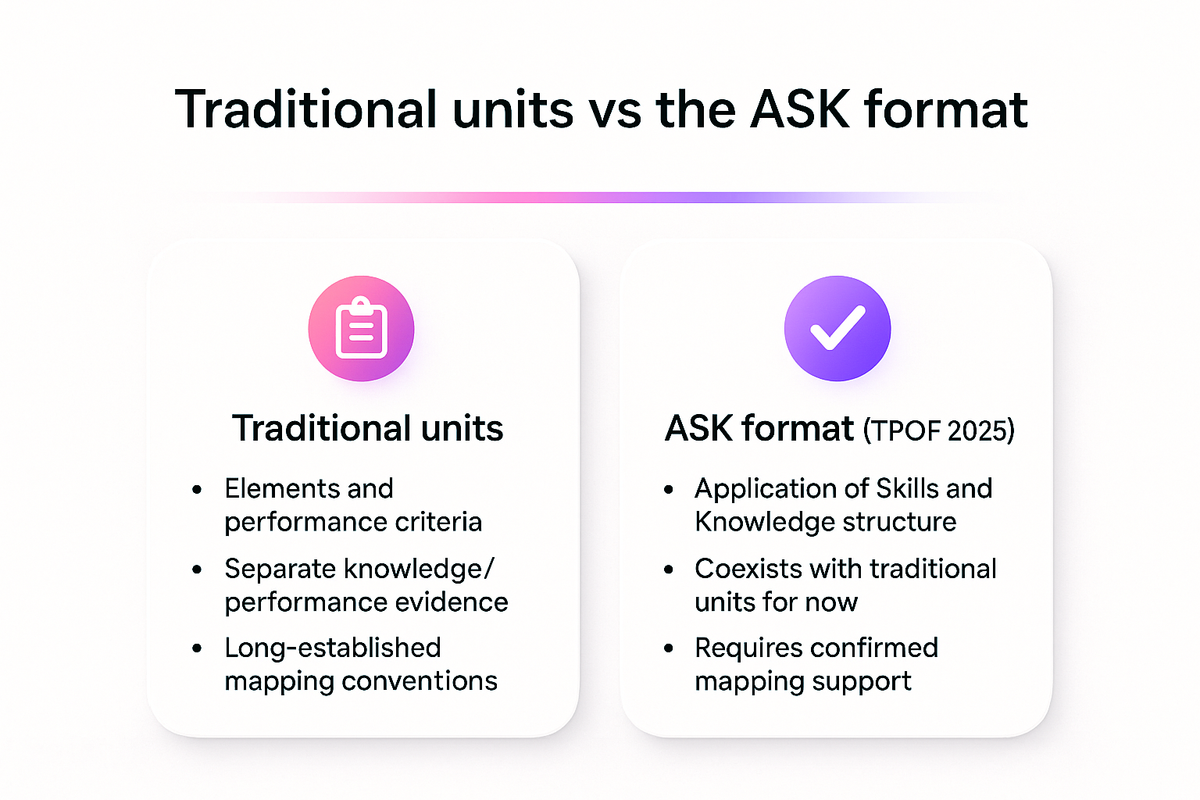
That coexistence period is a genuine buying consideration. An RTO's scope will likely include a mix of traditional units and ASK-format units for years, not months. Before signing anything, confirm the software can map to both structures without forcing a separate workflow or a manual workaround for one format.
Where AI fits — and where the assessor still signs off
AI can genuinely speed up the mechanical parts of assessment writing: drafting tasks, structuring a mapping matrix, generating parallel versions for different delivery contexts. Some platforms, including Supahuman's VETos, are built specifically to map generated assessments against a unit's elements, performance criteria, knowledge evidence and performance evidence once a training package is loaded, and to produce that mapping in a form intended for pre-use validation — see VETos's assessment mapping approach for how that's described.
None of that changes who makes the competency call. AI-generated or AI-mapped assessment content still has to be validated by a qualified assessor against the Principles of Assessment and the Rules of Evidence before it's used, and every competency decision still rests with that assessor's professional judgement. A tool that frames formative feedback as coaching rather than marking — and doesn't make competency decisions on a learner's behalf — is drawing that line correctly. Buyers should be wary of any vendor language that suggests otherwise.
Recognition of Prior Learning deserves the same scrutiny. Good platforms treat RPL as a proper assessment pathway, evidenced against the same performance criteria as standard delivery, rather than a bolt-on form.
What to weigh before you buy
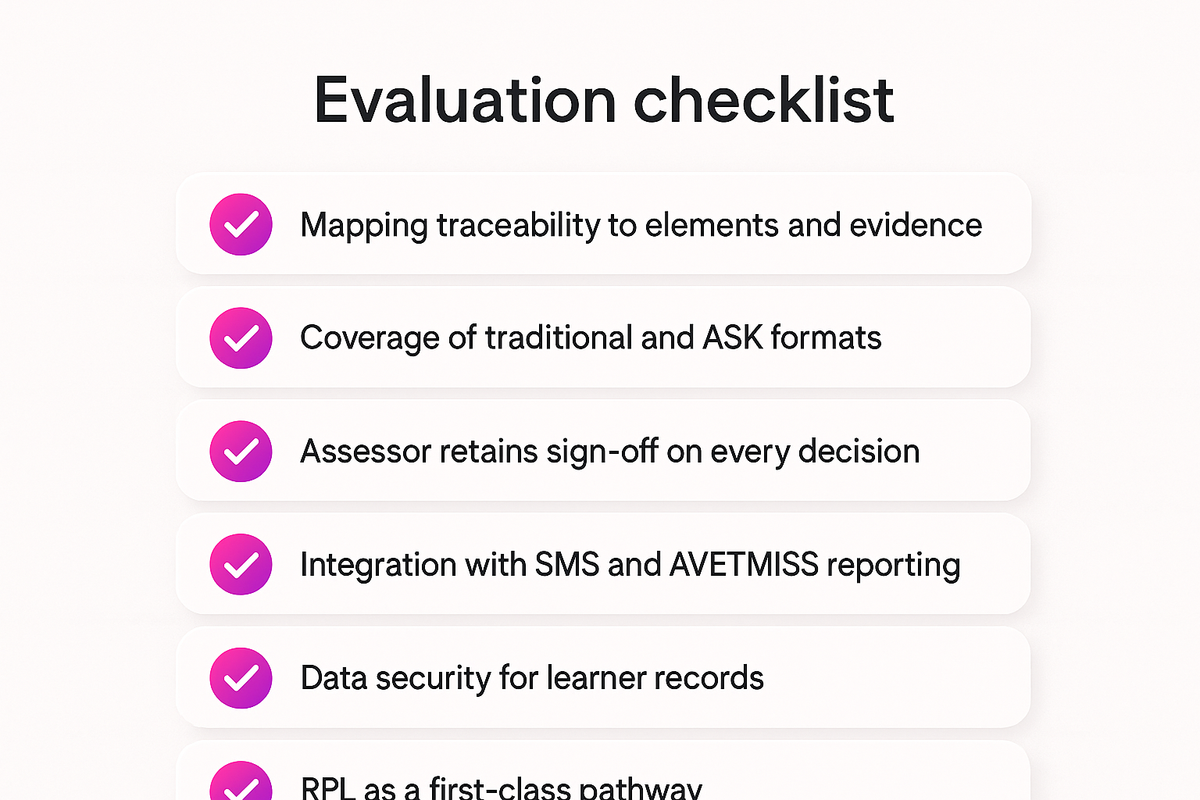
A fair evaluation looks past the demo and checks the fundamentals:
- Mapping traceability — can you trace every element, performance criterion, knowledge evidence and performance evidence item through to a specific task and benchmark?
- Format coverage — does it handle both traditional units and the ASK format, without a separate process for each?
- Human sign-off — does the workflow clearly preserve the qualified assessor's role in validating and finalising every assessment, rather than presenting AI output as a finished decision?
- System integration — does it work reasonably with your student management system, AVETMISS reporting and USI processes?
- Data security — how is learner and assessment record data stored and protected?
- RPL support — is RPL a first-class workflow evidenced against the same performance criteria, or an afterthought?
- Vendor track record — does the vendor have a demonstrated process for keeping pace with ASQA and training package updates?
- Fit for scope — is pricing and implementation effort proportionate to your portfolio size and complexity?
Key takeaways
- Unit-of-competency assessment software is defined by traceable mapping to elements, performance criteria, knowledge evidence and performance evidence — not by drafting speed alone.
- The 2025 Standards for RTOs shifted audit focus toward demonstrated outcomes and evidence of practice, so software needs to help prove practice, not just produce paperwork.
- Both traditional units and the new ASK format will coexist under TPOF 2025 for some time; confirm a tool handles both before you buy.
- AI can draft and map assessment content faster, but a qualified assessor must still validate every output against the Principles of Assessment and Rules of Evidence and make the final competency call.
- Treat RPL, system integration, data security and vendor responsiveness to regulatory change as core evaluation criteria, not add-ons.
Our take
The category is genuinely useful, but it's easy to buy the wrong thing by focusing on how fast a tool generates content rather than how well it proves coverage. An RTO under the 2025 Standards is being assessed on demonstrated outcomes, so a mapping matrix a validator can actually follow matters more than a slick authoring interface. Our honest view: any vendor — including us — should be judged first on whether their output survives a validator's scrutiny and keeps the assessor firmly in charge of the competency decision, and only second on speed.
FAQ
What actually separates unit-of-competency assessment software from a general LMS or content-authoring tool?
The difference is traceable mapping. A general LMS delivers and tracks content; unit-of-competency assessment software links each assessment task back to specific elements, performance criteria, knowledge evidence and performance evidence, so a validator can trace requirement through to task and benchmark.
How does this software need to align with the 2025 Standards for RTOs and ASQA's assessment principles?
The 2025 Standards for RTOs, which commenced 1 July 2025, are structured around Outcome Standards and Compliance requirements with a stronger focus on demonstrated outcomes. Any assessment output is still judged against the Principles of Assessment (fairness, flexibility, validity, reliability) and the Rules of Evidence (validity, sufficiency, authenticity, currency) embedded in the Standards.
Will the software handle both traditional units and the new ASK format?
It should. The updated Training Package Organising Framework, effective 1 July 2025, introduces the Application of Skills and Knowledge (ASK) unit format alongside traditional units, and both are expected to coexist as qualifications are progressively updated. Confirm mapping support for both before purchasing.
If AI generates or maps an assessment, does that remove the need for a qualified assessor to validate it?
No. Whatever automation is used, a qualified assessor must still validate the assessment against the Principles of Assessment and Rules of Evidence and sign off the competency decision. AI can assist mapping and drafting, but it doesn't replace that professional judgement or compliance accountability.
Does this kind of software support Recognition of Prior Learning?
It should treat RPL as a genuine assessment pathway, evidenced against the same performance criteria as standard delivery, rather than a separate or lesser process — that's a reasonable marker of a well-built platform.
If you're comparing options, start by asking each vendor to walk you through a real mapping matrix for one of your own units, in both traditional and ASK format if it applies to your scope. That single test tells you more than any feature list. You can see how VETos approaches assessment mapping and pre-use validation at vet.supahuman.com.