Unit of Competency Coverage Mapping: Think Scope-Wide
27 August 2026 · 6 min read

Unit of Competency Coverage Mapping: Think Scope-Wide
Most Registered Training Organisations validate compliance one unit of competency at a time — but the coverage gaps that trigger ASQA findings often sit between units, not inside them. With Application of Skills and Knowledge (ASK) format units now coexisting with traditional units across scopes since the 1 July 2025 Training Package Organising Framework update, that blind spot is getting wider, not smaller.
Where unit-by-unit checks miss the real gaps
Most RTOs run validation the same way: pull up a unit of competency, check the assessment tool against its elements and performance criteria, sign off, move to the next unit. That process feels thorough — because for the unit in front of you, it is.
The problem shows up sideways, not inside any single unit:
- Contextualisation drifts between units mapped to the same qualification. One assessor writes a workplace scenario, another writes a classroom scenario, and nobody notices the qualification itself has become inconsistent.
- Evidence-gathering methods get duplicated across units that could reasonably have shared one instrument.
- An element or performance criterion occasionally goes unmapped somewhere in the qualification, because nobody reviewed the whole training package end to end — only the units, one at a time.
None of this is visible from inside a single unit's assessment file. It only shows up when you look at the qualification as a whole.
Why the ASK-format transition raises the stakes
This gets harder from 1 July 2025 onward. The Training Package Organising Framework update introduced ASK-format units, which sit alongside the traditional elements-and-performance-criteria structure. Most RTOs will be running scopes with both formats present for years, as training packages are progressively reviewed and updated.
Two structures on the same scope means two different ways of describing outcomes for a validator to reconcile. Unit by unit, that reconciliation problem is invisible — each unit's own format looks internally consistent. It's not a flaw in either format. It's a gap that only becomes visible when you look at the whole scope at once.
What ASQA validators are actually judging
Under the Standards for RTOs 2025, validation isn't really about whether a unit's paperwork is tidy. It's about whether the RTO can demonstrate outcomes across a qualification — that learners genuinely meet every element and performance criterion the AQF qualification requires, not just that each unit file looks complete in isolation.
That means a mapping matrix a validator can actually trace across an entire qualification matters more than how quickly any single unit's assessment tool was drafted. Fast per-unit content generation solves the wrong problem if the coverage gaps live between units, not within them.
How scope-level mapping actually works
VETos was built around this specific gap. Instead of treating each unit of competency as a standalone document, it models an entire training package — qualifications, units, elements and performance criteria — as one connected structure.
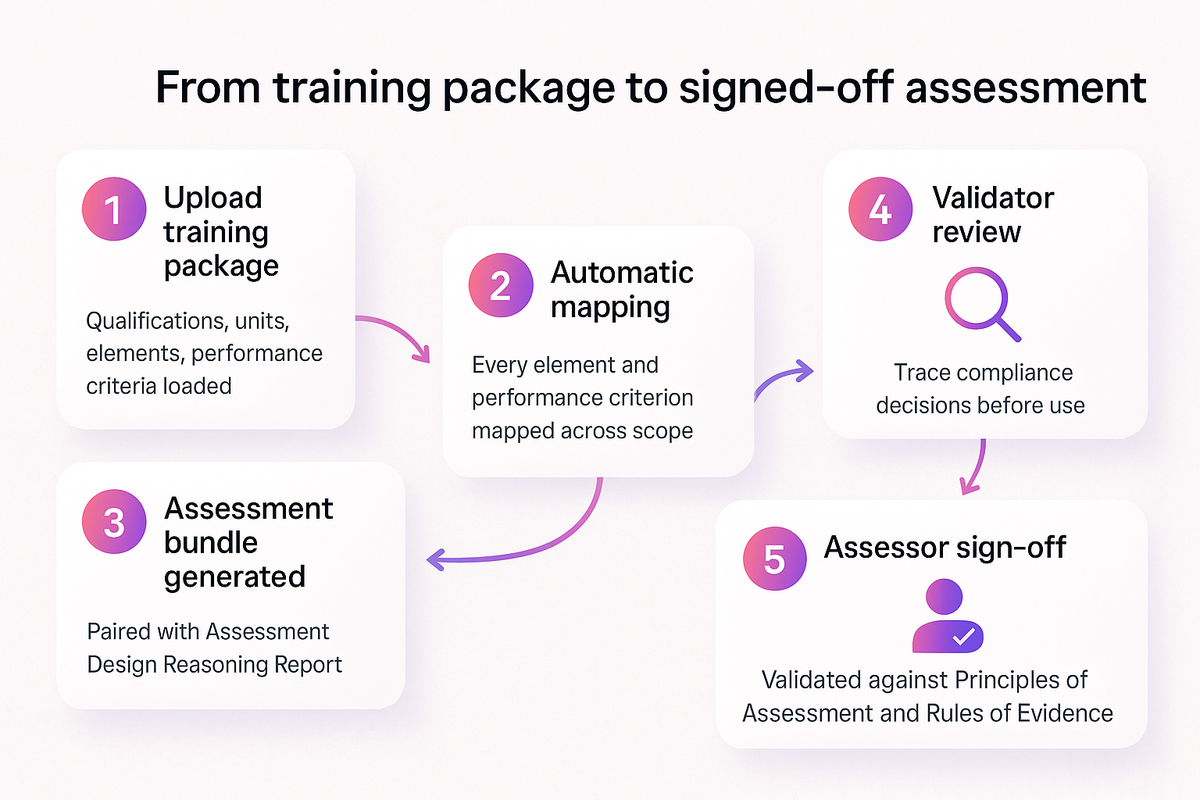
Once you upload or select a training package, VETos maps every element and performance criterion automatically. That gives a coverage view across the whole qualification, not a stack of separate unit checklists you have to reconcile by hand.
Each assessment bundle it produces comes with an Assessment Design Reasoning Report — documentation of the compliance decisions behind that assessment, structured for a validator to review before the assessment is used with a learner. That's a deliberate design choice: the mapping is meant to support validation before use, not give a validator something to reverse-engineer after the fact.
What stays with the assessor
None of this replaces professional judgement. A qualified assessor still has to validate against the Principles of Assessment and the Rules of Evidence, and still has to sign off the competency decision. Scope-level visibility is there to inform that judgement — surfacing where coverage is thin or inconsistent before validation day — not to make the decision for anyone.
If anything, seeing the whole scope makes the assessor's job more defensible. They're reviewing a documented reasoning trail and a mapped qualification, rather than reconstructing coverage logic from a folder of individual unit files.
Key takeaways
- Unit-by-unit validation misses cross-unit issues: inconsistent contextualisation, duplicated evidence gathering, and elements that quietly go unmapped across a qualification.
- The 1 July 2025 Training Package Organising Framework changes mean traditional and ASK-format units will coexist on most scopes for years — a structural mismatch unit-by-unit review can't catch.
- The Standards for RTOs 2025 judge demonstrated outcomes across a qualification, so a traceable scope-wide mapping matters more than fast unit-level drafting.
- VETos models a whole training package — qualifications, units, elements and performance criteria — as one structure, mapping every element and performance criterion automatically once the package is loaded.
- Every assessment bundle ships with an Assessment Design Reasoning Report for validator review; a qualified assessor still validates against the Principles of Assessment and Rules of Evidence and signs off competency.
Our take
The unit-by-unit habit is understandable — training packages are published unit by unit, so RTOs built processes to match. But audits rarely fail on one unit in isolation; they fail on patterns across a qualification that nobody was looking at as a whole. As ASK-format units roll out over the next few years, the cost of not viewing scope holistically is going to climb, not fall. Tools that surface that view early are solving a compliance problem, not just a productivity one.
FAQ
What's the difference between unit-level and scope-level coverage mapping? Unit-level mapping checks whether one unit's assessment tool covers that unit's own elements and performance criteria. Scope-level mapping checks the same thing across every unit in a qualification or training package at once, so inconsistencies between units — not just within them — become visible.
Why does the 1 July 2025 change to training packages matter for coverage mapping? The Training Package Organising Framework update introduced ASK-format units alongside the traditional elements-and-performance-criteria structure. Most RTOs will have both formats on their scope for years as packages are progressively updated, which makes scope-wide checking more important than reviewing each unit format on its own terms.
Does whole-of-scope mapping replace the validator's role? No. A qualified assessor still has to validate assessment against the Principles of Assessment and the Rules of Evidence, and still signs off the competency decision. Scope-level mapping and supporting documentation are there to inform that judgement with a clearer audit trail, not to substitute for it.
What is an Assessment Design Reasoning Report? It's documentation that accompanies an assessment bundle in VETos, setting out the compliance decisions behind how that assessment was designed. It's intended to give a validator a trail to review before the assessment is used, rather than something they reconstruct from scratch after the fact.
How does VETos map coverage across a training package? Once an RTO uploads or selects a training package in VETos, the platform models qualifications, units, elements and performance criteria as one connected structure and automatically maps every element and performance criterion — giving a coverage view across the whole qualification rather than separate per-unit checklists. More detail is available at vet.supahuman.com.