Design to the Unit of Competency, Not the Brief
29 September 2026 · 7 min read
The content brief is not your compliance anchor. If your learning resources trace back to a stakeholder brief rather than to the unit of competency's elements, performance criteria and assessment conditions, you've built a course that photographs well in a design review and fails an ASQA audit.
That's not a hypothetical risk. It's the specific thing Standards 10.2, 10.3 and 3.3 of the Standards for RTOs 2025 are built to test.
Why this lands on your desk
You own the call that decides whether training and assessment materials are built up from the unit — elements, performance criteria, assessment conditions — or retrofitted downward from a marketing or stakeholder brief. That's a design decision, but it's also the exact thing an ASQA auditor checks first.
When a unit changes, or when a trainer's currency lapses against a specific training product, the rebuild lands on you. Sector research from Skills Insight has already flagged the cost and effort of developing and maintaining training and assessment materials as a live viability risk for RTOs — some providers are reportedly walking away from qualifications altogether because the maintenance burden doesn't pencil out. Every hour you spend re-justifying content that should have been unit-anchored from day one is an hour that research is describing as a sector-wide cost problem, happening on your desk.
Two starting points, two audit outcomes
Brief-first design starts with what a stakeholder wants learners to feel, know or be able to say. It's intuitive, and it's fast to storyboard. But nothing in that process guarantees the resource maps cleanly to a performance criterion, and an auditor doesn't mark you on intuition.
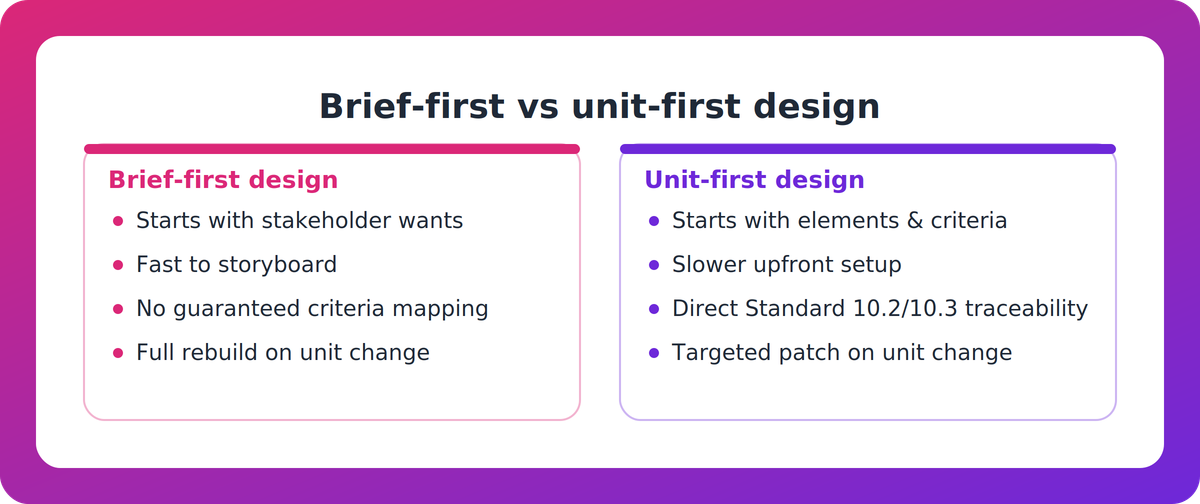
Unit-first design starts with the unit of competency itself: the elements, the performance criteria, the assessment conditions, and — for accredited courses — the requirement under Standard 10.2 and 10.3 that the course be based on a nationally endorsed unit of competency, or on a module developed specifically for that course, with skills and knowledge expressed as such. Everything else — scenario, narrative, media, assessment task — gets built on top of that scaffold, not alongside it.
The second approach takes a little longer to set up. It is dramatically faster to defend at audit, and dramatically cheaper to update when a unit is reviewed, because the mapping already exists.
The Standard 3.3 trap: unit currency and trainer currency are linked
Standard 3.3 requires that training and assessment be delivered by people with current industry skills and knowledge relevant to the specific training product — not generic sector experience, the specific unit or module in front of them. That's a compliance trigger your design choices can trip without you noticing.
If your resources are built from a brief that drifts from the actual unit content, the trainer delivering it is no longer demonstrably current against what's being assessed — even if they're perfectly qualified in the broader occupation. Unit-first design keeps the trainer's currency argument and the resource's compliance argument pointed at the same document.
Brief-first design is how maintenance debt gets built
Every time a unit of competency is updated, reviewed or superseded, brief-first resources need to be re-interpreted from scratch, because there was never a direct mapping to lose in the first place. Unit-first resources need a targeted patch, because you know exactly which element or performance criterion moved.
That difference compounds. It's the difference between a maintenance task and a redesign project, repeated across every qualification you hold on scope.
The ground is moving under the unit itself
DEWR's qualification reform agenda is explicitly shifting the VET system away from unit-by-unit fragmentation and toward qualification-first design — building a coherent body of skills and knowledge rather than stacking long elective lists onto units built for narrow tasks. For an Instructional Designer, that means the units you're designing against today are themselves being reshaped by the reform, not fixed reference points you can safely paraphrase into a brief and forget.
If your design assets are scoped to the unit's actual components — not to a brief that summarised it once — they survive that reshaping with far less rework. If they're scoped to the brief, the reform effectively resets your maintenance clock to zero.
Cultural competency is unit-mapped, not generic
Cultural safety content is one of the clearest places brief-first design breaks down. CHCDIV002 (Promote Aboriginal and/or Torres Strait Islander cultural safety) is currently under active review by HumanAbility as part of the 2025 Community Services Qualification Review. If your cultural competency material sits as a generic module bolted onto multiple qualifications — rather than mapped to the specific elements and performance criteria of the unit it serves — you have no defensible trail when that unit is revised.
Treating cultural safety as unit-anchored from the outset isn't a compliance nicety. It's the only version of that content that keeps working when the unit itself changes.
Key takeaways
- Standards 10.2 and 10.3 of the Standards for RTOs 2025 require accredited courses to be based on nationally endorsed units of competency, or modules developed specifically for the course — design from the unit up, not the brief down.
- Standard 3.3 links trainer currency to the specific training product, so brief-drift in your resources can quietly undermine your trainer currency evidence too.
- Sector research (Skills Insight, 2025) already flags training and assessment material maintenance as a viability risk — brief-first design compounds that cost rather than reducing it.
- DEWR's qualification-first reform is reshaping the units themselves, so design assets scoped tightly to unit components hold up better through reform than assets scoped to a summarising brief.
- Cultural competency units such as CHCDIV002, under active review by HumanAbility, only stay compliant if the content is mapped to the unit's own elements and criteria, not delivered as a generic add-on.
Our take
The honest tension here is time. Unit-first design asks you to slow down at the start — read the elements, performance criteria and assessment conditions properly before a single storyboard gets drawn — when every stakeholder wants the brief turned around fast. That upfront discipline is exactly what an ASQA audit and a unit review both reward, and exactly what a content-brief shortcut can't fake.
We'd also note this is where new production tools genuinely help, not by replacing that discipline but by making it cheaper to act on. When generating a contextual role-play or coached practice scenario no longer takes weeks of production, there's less incentive to skip straight to the brief just to hit a deadline — you can build the unit-anchored version in the time you'd otherwise have spent justifying the shortcut. That's part of what we're building toward at Supahuman, but the underlying design discipline holds regardless of what tooling you use to execute it.
FAQ
Does every learning resource need a direct line back to a specific unit of competency? For accredited courses, yes — Standard 10.2 and 10.3 of the Standards for RTOs 2025 require the course to be based on a nationally endorsed unit of competency or a module developed specifically for that course, with skills and knowledge expressed accordingly. Non-accredited or supplementary resources still benefit from the same traceability, since it's what makes updates and audits fast.
How does Standard 3.3 actually affect instructional design decisions? Standard 3.3 requires trainers and assessors to hold current industry skills and knowledge relevant to the specific training product being delivered. If your resources drift from the unit's actual content, you weaken the evidence trail that a trainer's currency matches what's being taught and assessed.
What should change now that DEWR is moving toward qualification-first reform? Scope your reusable design assets to the unit's individual elements and performance criteria rather than to a broader qualification narrative or brief. That granularity is what survives repackaging as units are consolidated or restructured under the reform.
Is cultural competency content still valid if it's generic across qualifications? Not reliably. Units such as CHCDIV002 are under active review by HumanAbility, and cultural safety content needs to be traceable to that specific unit's elements and performance criteria to remain defensible at audit.