NZ Unit Standard Assessment: Why 2026 Doubles the Load
14 July 2026 · 6 min read

Unit standard assessment development in New Zealand was already stretched thin by manual, per-standard workflows well before 2026. Now the sector-wide restructure — Te Pūkenga's disestablishment, ten new regional polytechnics, and eight Industry Skills Boards replacing Workforce Development Councils — lands at exactly the moment NZQA requires providers to build and moderate against unit standards and skill standards in parallel. The practical effect: more compliance bodies, the same manual methods, and years of dual-track assessment obligations layered on top.
What's actually changing on 1 January 2026?
From 1 January 2026, legislation disestablishes Te Pūkenga and transfers its programmes and staff to a network of ten regional polytechnics. At the same time, eight new Industry Skills Boards (ISBs) take over from the Workforce Development Councils, picking up responsibility for:
- Developing and maintaining unit standards
- Running national external moderation
- Issuing consent-to-assess endorsement
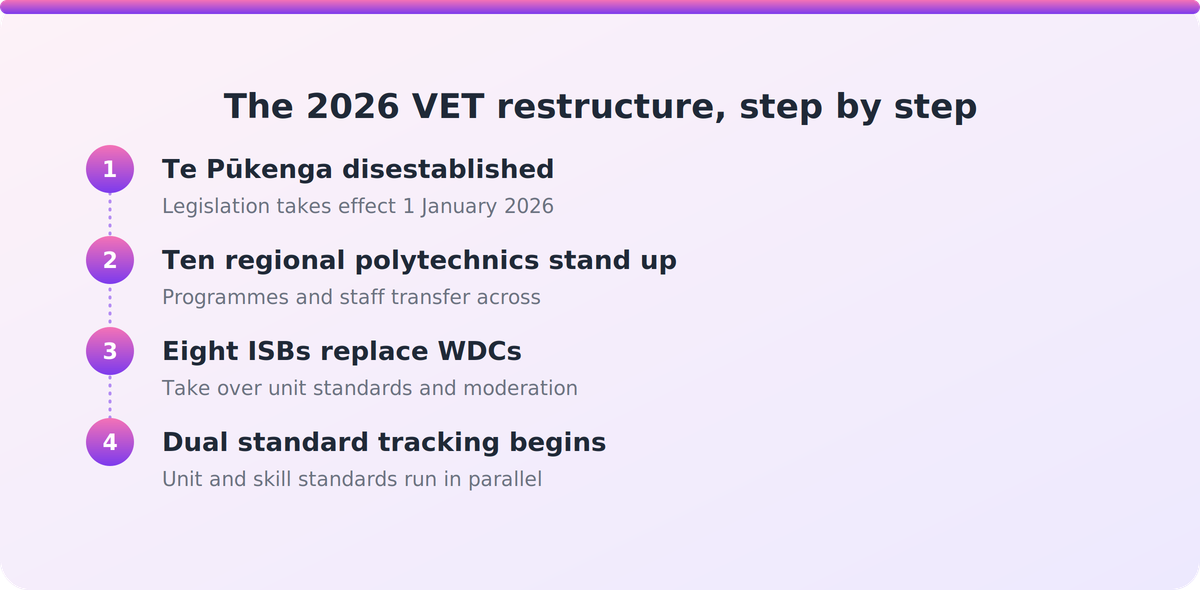
That's a structural shift in who owns standards and who signs off on assessment quality, spread across more regional entities than the sector has worked with before (Ministry of Education; ohuahumahi.nz).
Why doesn't the unit-to-skill-standard shift just replace the old system?
Because it isn't a clean swap — it's an overlap. NZQA's DASS listing guidelines confirm that skill standards are progressively replacing unit standards, with Standard Setting Bodies expected to run transition periods of roughly two years. During that window, providers must design, assess and moderate against both standard types concurrently, not migrate once and move on.
Muka Tangata's May 2025 provider guidelines add a further layer: a distinct assessment-design and moderation framework specifically for skill standards, sitting alongside — not replacing — existing unit standard obligations. For a single qualification, that can mean two compliance tracks running at once, each with its own documentation and moderation expectations.
How big is the manual workload already?
This is the part providers feel first-hand, and the numbers back it up.
- A regional provider building a new Level 6 programme needed more than 100 new assessments and learning guides — a task that typically takes three months and multiple contributors to complete.
- SupaHuman's 'Drowning in Admin' analysis estimates hundreds of hours a year go into manual edits alone across a provider's standard set, every time NZQA issues an amendment.
- A separate hidden cost: mismatches between theory and practical assessment modes routinely add hours of rework per assessment, well before the unit-to-skill-standard transition adds its own overhead.
None of this is new stress — it's the baseline. What changes in 2026 is the number of bodies each provider now has to satisfy with that same manual output.
What does this mean for provider operations?
The knock-on effects are already familiar to anyone running assessment and moderation cycles:
- Inconsistent compliance across programmes as amendments get actioned unevenly
- Higher audit risk when documentation lags behind standard changes
- Staff burnout as educators are pulled off teaching and into document administration
- Slower programme launches, since a single new qualification can mean weeks of assessment writing before a single learner enrols
Fragmenting standard ownership across ten polytechnics and eight ISBs doesn't remove any of these pressures — it multiplies the number of parties each provider has to keep in step with, at a time when fewer centralised resources exist to help absorb the load.
Key takeaways
- From 1 January 2026, Te Pūkenga is disestablished, replaced by ten regional polytechnics, with eight Industry Skills Boards taking over unit standard development, national moderation and consent-to-assess endorsement.
- NZQA's skill standard transition runs roughly two years per standard, meaning providers must maintain unit standards and skill standards in parallel, not sequentially.
- Muka Tangata's May 2025 guidelines add a second, skill-standard-specific assessment and moderation framework on top of existing unit standard obligations.
- Real provider data shows over 100 assessments and learning guides needed for a single new Level 6 programme, typically a three-month, multi-contributor effort.
- Manual amendment cycles already cost providers hundreds of hours a year — a cost the 2026 restructure is set to compound, not relieve.
Our take
The 2026 restructure was framed as simplification — fewer, larger polytechnics and clearer industry governance through the ISBs. For assessment development, though, it's the opposite of simplification. Providers now answer to more regional bodies while carrying two live standard types through the same qualifications for years. Treating this as a temporary bump to absorb with existing manual processes misreads the scale of it: the per-standard, per-contributor build model was already buckling before the restructure, and doubling the compliance surface without doubling the resourcing is a structural problem, not a staffing one. Providers who start mapping their standard sets against both the unit standard and skill standard tracks now — rather than waiting for each ISB to clarify expectations — will spend the transition period building, not backfilling.
FAQ
What happens to unit standards after 1 January 2026? Unit standards don't disappear immediately. NZQA's transition to skill standards runs over roughly two-year periods per Standard Setting Body, so providers will assess against both unit standards and skill standards concurrently for several years, not switch over in one step.
Who takes over unit standard development from the Workforce Development Councils? Eight new Industry Skills Boards (ISBs) replace the Workforce Development Councils from 1 January 2026, taking on unit standard development, national external moderation, and consent-to-assess endorsement (Ministry of Education; ohuahumahi.nz).
Do skill standards use the same assessment and moderation process as unit standards? No. Muka Tangata's May 2025 provider guidelines set out a distinct assessment-design and moderation framework for skill standards, which sits alongside existing unit standard requirements rather than replacing them.
How much manual work does unit standard assessment development actually take? Provider case data shows a single new Level 6 programme can require over 100 new assessments and learning guides, typically a three-month effort across multiple contributors, plus hundreds of hours a year in manual edits after NZQA amendments.
Does the move to ten regional polytechnics reduce the compliance burden on providers? Not on current evidence. It fragments standard ownership across more regional bodies at the same time providers must run two standard types in parallel, which increases rather than reduces the number of compliance relationships to manage.