Unit Standard Assessment Generator Software (NZ Guide)
11 August 2026 · 8 min read

The right unit standard assessment generator software for a New Zealand PTE or ITP is the one that tracks NZQA's actual standards data precisely — including the current shift from unit standards to skill standards on the Directory of Assessment and Skill Standards (DASS) — and that keeps a clear, auditable human review step before anything goes near moderation. Speed matters, but accuracy against the standard and a defensible sign-off trail matter more, because your provider registration and consent to assess depend on both.
What this software actually does
Unit standard assessment generator software uses AI to draft assessment instruments, marking guides and sometimes training material, mapped to a specific unit standard or skill standard on NZQA's framework. Each standard on the DASS is defined by outcome statements, performance criteria and range statements, and carries its own Consent and Moderation Requirements (CMR) document set by the relevant standard-setting body — often a Workforce Development Council, NZQA itself, or the Ministry of Education. A generator tool worth paying for has to work within that structure, not just produce generic-looking assessment content that happens to mention the right unit standard number.
In practice, this category sits alongside — not instead of — the assessor's own expertise. NZQA's guidance on academic integrity and AI is explicit that generative AI is not acceptable for external, exam-style assessment, and for internal tertiary assessment providers are expected to run a coherent assessment and moderation system with current integrity policies covering acceptable AI use. That framing should shape how you evaluate every vendor in this space.
What to look for when evaluating options
Buyers should weigh several things beyond how polished the AI output looks:
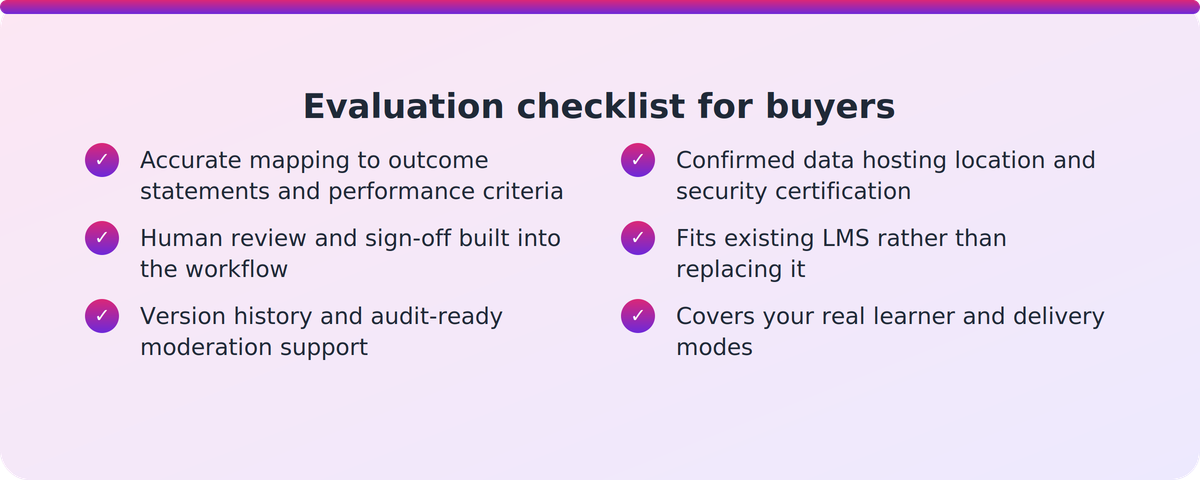
- Standards mapping accuracy — does the tool map to the specific outcome statements, performance criteria and range statements of the actual unit standard or skill standard, not a generic template?
- Human review built in, not bypassed — can assessors and moderators easily edit, query and sign off content before it's used, with that review visible in the workflow?
- Moderation and audit support — version history, assessor guides, and change logs that hold up against NZQA's CMR and national moderation expectations.
- Data hosting and security — where learner and assessment data sits, and what security standards apply, matters for any NZ provider handling learner information.
- Fit with existing systems — does it sit alongside your LMS and document workflows, or demand a full platform switch?
- Coverage of your actual learner base — classroom, workplace, distance, ESOL and LLN learners all need materials pitched differently.
- Evidence versus marketing — vendor claims about time saved or compliance guaranteed are common in this category; ask for specifics and treat case studies as illustrative rather than as NZQA endorsement, because no independent NZQA audit of a specific AI assessment-generator product has been published.
- Off-framework flexibility — if you also deliver micro-credentials or non-NZQA content, check the tool isn't locked to registered standards only.
Handling the unit-standard-to-skill-standard transition
NZQA is progressively replacing unit standards with skill standards on the DASS, and standard-setting bodies typically allow a two-year transition window once a skill standard is listed. This is not a one-off event — it's an ongoing process across different industry domains, and it's one of the more concrete ways to stress-test a vendor's claims.
Ask any vendor directly:
- How does the tool flag when a unit standard you rely on is being superseded?
- Can it draft against the new skill standard once listed, rather than leaving you to rebuild manually?
- Does it help you upgrade existing assessment and training material as the conversion happens, or does that fall back on your staff?
With the Consent to Assess Against Standards on the DASS Rules 2026 and the Private Training Establishment Rules 2026 both taking effect on 19 January 2026, currency of a tool's compliance features is a near-term, practical concern — not an abstract one.
Can AI-generated assessments go straight to moderation?
No — and any vendor implying otherwise should be treated with caution. NZQA's position is that generative AI isn't suitable for external assessment, and for internal assessment, providers must maintain their own moderation system and keep integrity policies current on AI use. Independent research on AI-generated assessment content reinforces this: institutions remain responsible for the accuracy, fairness and validity of what they issue, and human judgement needs to be strengthened by AI tools, not replaced by them. A workflow that routes ambiguous items back to a qualified assessor, and logs the human decision, is what gives you defensible evidence at moderation — the AI output on its own is a draft, not a finished, compliant instrument.
Data security and hosting
Because this software handles learner information and assessment content tied to formal qualifications, hosting location and security posture are legitimate purchasing questions, not technical footnotes. Ask where data is stored, what security certifications apply, and what approval gates exist between AI drafting and anything being finalised or submitted. Some platforms in this category, including VETos, describe hosting on AWS in Australia with controls aligned to ISO 27001 and the NZ Information Security Manual, alongside human-approval steps in the workflow — details worth verifying directly with any vendor rather than taking on faith.
Where a tool like VETos fits
VETos is one example of software in this category. It's described as generating assessments and study guides mapped to specific NZQA unit standards and graduate profile outcomes, producing assessor guides alongside them, and tracking the unit-standard-to-skill-standard transition so materials can be drafted against new skill standards or upgraded as existing standards convert. A moderation-support feature is described as comparing assessor judgements for consistency and generating validation reports — positioned as support for human moderation, not a substitute for it. In a documented NZ PTE case, staff reported course-creation timelines dropping from four-to-six weeks to minutes, with educators still central to reviewing and finalising the content. These are vendor-reported claims worth verifying in your own evaluation, the same as any product in this category.
Key takeaways
- Judge unit standard assessment generator software on standards-mapping accuracy and transition handling first, speed second.
- NZQA guidance rules out generative AI for external assessment and expects providers to keep moderation systems and AI-use policies current for internal assessment — no tool changes that obligation.
- The unit-standard-to-skill-standard shift on the DASS is ongoing; ask vendors specifically how they detect and handle superseded standards.
- Check data hosting, security certification and human-approval gates before assuming a platform meets NZ provider expectations.
- Treat vendor case studies and time-saved claims as illustrative, not as independent or NZQA-endorsed findings — verify directly.
Our take
This category will keep growing because the admin burden of writing assessments and keeping them current against NZQA's changing standards is real and well documented. But the providers who get value out of these tools are the ones who treat AI output as a strong first draft, not a finished, moderation-ready artefact — the accountability for accuracy, fairness and validity stays with the qualified human, standard by standard, decision by decision. Buy for standards-tracking discipline and audit-trail clarity ahead of glossy demos, and be sceptical of any vendor who suggests the human sign-off step is optional.
FAQ
What should a PTE or ITP look for in unit standard assessment generator software to stay aligned with NZQA requirements? Look for accurate mapping to the outcome statements, performance criteria and range statements of the specific unit or skill standard, explicit handling of standards changes, and a workflow that keeps human review and sign-off visible ahead of moderation — not just fast-looking output.
Can AI-generated assessments be used directly for NZQA moderation, or do they still need human review and sign-off? They still need human review. NZQA guidance treats generative AI as unsuitable for external assessment and expects providers to maintain a moderation system and current AI-use policy for internal assessment — the qualified assessor remains accountable for what's submitted.
How does this kind of software handle the shift from unit standards to skill standards on NZQA's Directory of Assessment and Skill Standards? NZQA is progressively replacing unit standards with skill standards, usually with a two-year transition window. Ask vendors directly whether their tool flags superseded standards, drafts against new skill standards once listed, and helps upgrade existing materials as the conversion happens.
Is learner and assessment data secure, and where is it hosted, if a PTE/ITP adopts an AI-based generator? This varies by vendor and should be checked directly — ask about hosting location, security certifications (such as ISO 27001), and what approval gates exist between AI drafting and final, submitted content.
Are vendor claims about compliance and time savings in this category independently verified? Generally no. No independent NZQA audit of a specific AI assessment-generator product was found in the available research, so case studies and time-saved figures should be treated as vendor-reported and verified during your own evaluation.
If you're comparing options, ask each vendor to walk you through their standards-mapping and transition handling on a real unit standard from your own portfolio, and check where human review sits in their workflow — that one conversation tells you more than any feature list.