Best Unit Standard Assessment Software for NZ PTEs
9 July 2026 · 8 min read

The best unit standard assessment software for a New Zealand PTE in 2026 maps assessments directly to standards on NZQA's Directory of Assessment and Skill Standards (DASS), works across both unit standards and the newer skill standards, and sits inside the quality management system the 2026 Quality Assurance Rules require. It should also make life easier for the assessor who signs off every assessment — not replace their judgement. NZQA does not certify or endorse any third-party software as "compliant," so that accountability stays with your organisation regardless of what you buy.
What unit standard assessment software actually does
At its core, this category of software drafts, maps and organises assessment content against registered standards — then helps a provider prove coverage. Unit standards sit on the NZ Qualifications and Credentials Framework (NZQCF) and carry performance criteria: the specific, critical pieces of evidence an assessor must check before making a competency judgement (LearningWorks; NZQA). Good software should make that mapping visible, not bury it.
The faster, more visible part of the job — drafting assessments, training material and assessor guides — is genuinely useful. Providers we've spoken with report spending 40-plus hours manually building a full assessment and resource set for a single unit standard, across classroom, workplace and distance delivery. But speed on its own isn't the test. The real test is whether the tool keeps up with what NZQA is changing underneath it.
The 2026 shift: unit standards, skill standards, and the NZQCF
NZQA is progressively transitioning from unit standards toward skill standards, and skill standards will become mandatory where a qualification or micro-credential specifies them (NZQA). This isn't a full replacement overnight — many programmes will run unit standards and skill standards side by side for some time.
That means software built only around unit standards has a shelf life. A tool worth buying in 2026 should:
- Handle both unit standards and skill standards without a separate workflow for each
- Pull current data from DASS rather than a static, outdated standard library
- Flag when a standard it's referencing has been reviewed, replaced or is mid-transition
It's also worth noting that some NZQA guidance is itself still mid-transition, partly due to the Education and Training (Vocational Education and Training System) Amendment Act 2025, which is shifting terminology from Workforce Development Councils (WDCs) to Industry Skills Boards (ISBs). Any vendor claiming certainty here should be treated with a healthy degree of scepticism — verify directly with NZQA where it matters.
What to look for: an evaluation checklist for NZ PTEs
A fair comparison between tools comes down to a handful of practical questions:
- Does it map directly to DASS unit standards and/or skill standards, elements and performance criteria, with a visible audit trail of coverage?
- Does it support — rather than sit outside — your consent-to-assess documentation, Consent and Moderation Requirements (CMR), and preparation for national external moderation?
- Can every output be reviewed, edited and signed off by a qualified assessor before it reaches a learner, rather than used unchecked?
- Does it fit inside the quality management system your organisation must have (or build, by 1 January 2027) under the Quality Assurance of Tertiary Education Providers Rules 2026?
- Does it support the record-keeping the PTE Rules 2026 require — permanent academic records and 12 months' retention of assessment materials?
- Is there independent evidence of NZ outcomes, or only vendor-supplied case studies?
- Does it cover the delivery contexts your PTE actually runs — workplace, classroom, distance, ESOL and LLN learners — and Field Māori or cultural requirements where relevant?
- Does it integrate with the LMS and document systems you already use, or create a second, parallel workflow?
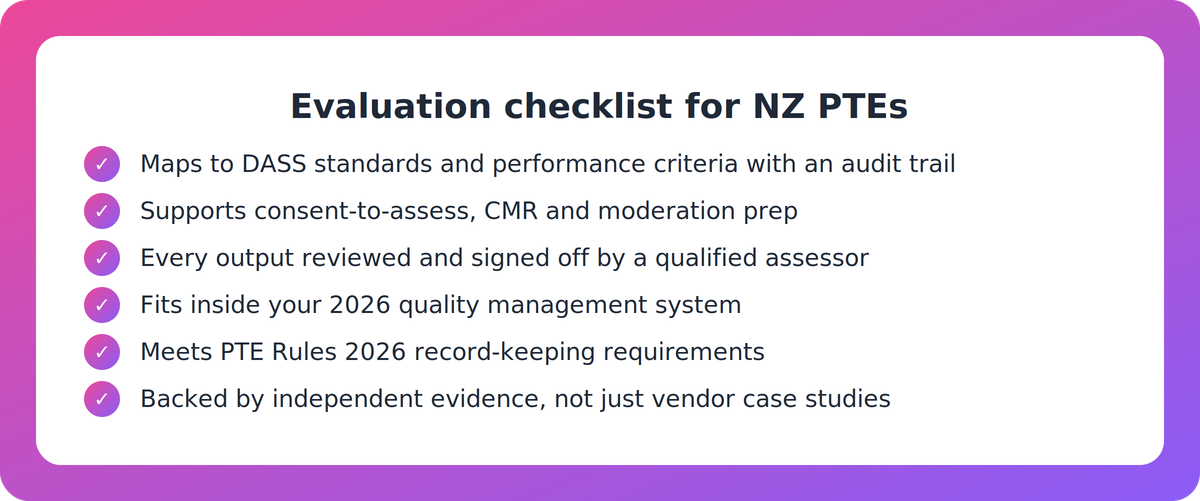
None of these criteria are about how clever the AI sounds. They're about whether the tool reduces your compliance workload without creating a new one.
Software supports consent-to-assess, CMR and moderation — it doesn't replace them
This is worth stating plainly: no software gives a PTE consent to assess, satisfies CMR on its own, or stands in for national external moderation. Consent to assess against standards, and the standard-specific CMR that comes with it, remain provider obligations set by NZQA (NZQA). National moderation exists to confirm that a provider's assessment judgements are pitched at the national standard — a process software can prepare evidence for, but cannot complete on a provider's behalf.
Good assessment software should make that preparation easier — organising evidence by standard, flagging gaps against performance criteria, drafting the assessor guide alongside the assessment. What it shouldn't do is imply that ticking a box in the software equals meeting a CMR requirement. If a vendor's marketing suggests their tool is "NZQA compliant," ask them to point to where NZQA has said that — because NZQA does not certify third-party software.
How AI-generated assessment content should be validated before use
AI can draft an assessment against a unit standard or skill standard in minutes rather than hours. That's a real, useful shift for PTEs stretched across multiple qualifications and delivery modes. But a draft is a draft — it still needs a qualified, accountable assessor to check it against the standard, the learner context and the provider's own quality requirements before it goes anywhere near a learner or a moderation file.
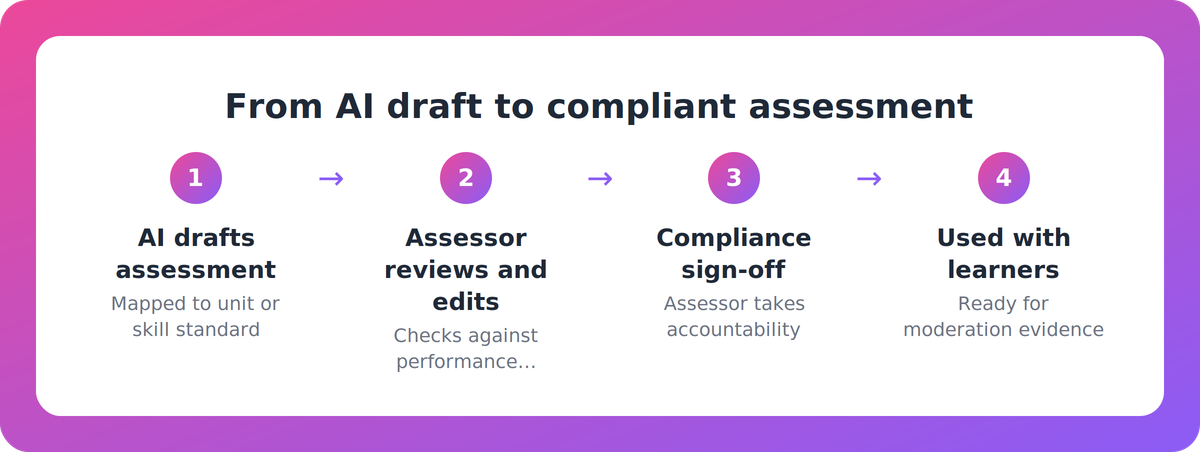
SupaHuman's VETos is one example of a tool built this way: it maps unit standard elements and performance criteria automatically and drafts assessor guides alongside the assessment, but describes educators as reviewing and refining that output rather than starting from a blank page or using it unchecked. Mast Academy, a named NZ PTE covering 22 qualifications and more than 400 NZQA-aligned unit standards, reports cutting course creation from a stated six-week manual process to minutes using this approach — a genuinely useful data point, but a single vendor-published case study rather than independently verified research. Treat any similar claim from any vendor the same way: ask what's been checked, by whom, and against what standard.
Where this fits inside your 2026 quality management system
From 2026, tertiary providers need a quality management system covering all aspects of their education and training, with full implementation required by 1 January 2027 under the Quality Assurance of Tertiary Education Providers Rules 2026 (NZQA). Assessment software that sits completely outside that system — a disconnected drafting tool with no link to your records, your moderation evidence, or your review sign-off process — adds a compliance gap rather than closing one.
The PTE Rules 2026 also require permanent academic records (name, date of achievement, grade) and retention of all student assessment materials, or full copies, for at least 12 months after course completion (NZQA). Ask any vendor how their outputs feed into your record-keeping — not just how fast they generate content.
Key takeaways
- Unit standard assessment software should map directly to DASS standards, performance criteria and (increasingly) skill standards — with a visible audit trail, not a black box.
- NZQA is transitioning from unit standards to skill standards; software built for one alone will age quickly through 2026 and beyond.
- No software satisfies consent-to-assess, CMR or national moderation on its own — these remain provider and assessor obligations under NZQA rules.
- AI-generated assessments must be reviewed, edited and signed off by a qualified assessor before use with learners or submission for moderation — always.
- Weigh vendor case studies (including our own) as one data point, not proof of compliance; NZQA does not certify third-party software.
Our take
The category is genuinely useful — most PTEs are drowning in assessment and resource creation, and AI-assisted drafting can claw back real hours. But 2026 raises the bar: a tool that only knows unit standards, or that generates content disconnected from your quality management system and record-keeping obligations, will cost you more time than it saves once NZQA's transition and rule changes fully land. Buy for the compliance architecture first, and the speed second.
FAQ
What should a PTE look for in software to stay aligned with NZQA's DASS and NZQCF under the 2026 Rules? Look for direct mapping to standards on NZQA's Directory of Assessment and Skill Standards, visible coverage of performance criteria, and a fit with your provider's own quality management system under the Quality Assurance of Tertiary Education Providers Rules 2026 — not just fast content generation.
Can the software handle both unit standards and the newer skill standards? It should. NZQA is progressively transitioning from unit standards to skill standards, and skill standards will be mandatory where specified in a qualification or micro-credential, so software built around unit standards alone will fall behind.
Does assessment software remove the need for consent-to-assess, CMR and national moderation? No. Consent to assess, standard-specific Consent and Moderation Requirements, and participation in national external moderation remain provider obligations set by NZQA. Software can organise and prepare evidence for these processes, but it cannot complete them on a provider's behalf.
How is AI-generated assessment content checked before it's used with learners? A qualified, accountable assessor must review, edit and sign off every AI-drafted assessment against the relevant standard and the provider's own requirements before it's used with a learner or submitted for moderation — the AI assists the draft, the human remains responsible for the compliance decision.
Does NZQA certify or endorse assessment software as compliant? No. NZQA does not certify or endorse third-party software; compliance is always a provider-level responsibility, so any vendor claiming official NZQA sign-off should be questioned directly.