Validation Schedule for RTOs: The Annual Trap
30 September 2026 · 6 min read
An annual validation event looks like diligence, but it is a calendar habit, not a quality system. Nothing in the research behind this piece confirms that the Standards for RTOs 2025 require one. The better test of your validation schedule is whether effort follows risk, stays independent, and reaches assessment practice before a trainer or learner feels the problem.
Why this lands on your desk
You own assessment quality across your trainers. When validation happens in one burst, inconsistency tends to surface after a cohort has already been assessed. You are then the person explaining it, and fixing it means re-marking, re-issuing or re-training.
There is also the people problem. Validation has to be done by people independent of the design and delivery of what is being validated. That is how secondary commentary reads the 2025 Standards, and it needs checking against ASQA. In practice it pulls scarce trainer time into an extra task.
The Credential Policy adds another layer. ASQA describes it as an enforceable policy that operates alongside the Standards and sets out the credentials needed to deliver training and assessment and to undertake validation of assessment. So who can validate is a staffing decision as well as a compliance one.
And the numbers sit on your desk too. NCVER reports 845,165 qualification completions in 2025, down 4.8%. Any gap between assessment practice and learner progress gets noticed.
What the Standards actually say, and what we couldn't confirm
Here is what is solid. The Standards for RTOs 2025 commenced on 1 July 2025 and apply to all ASQA-regulated RTOs. They have three parts: the Outcome Standards, the Compliance Standards and the Credential Policy (ASQA; DEWR).
Here is what needs verifying. Vendor commentary from eSkilled, which is not a primary source, says the five-year maximum validation cycle remains but the approach is now risk-based. It says sample size is a risk-based judgement. If that reading holds, an annual cycle is something you chose, not something you were handed.
Another vendor blog says ASQA has flagged RTOs for not maintaining a validation plan or system that reviews training product risk and determines sample size and scope. We couldn't confirm that against ASQA's own publications. Treat it as a prompt to go and check, not as a finding.
So read two things yourself: the Outcome Standards text and ASQA's Practice Guide on validation. DEWR notes the policy documents themselves don't impose legal obligations, and ASQA publishes Practice Guides to set out its regulatory expectations. We did not retrieve either document, so this piece does not paraphrase them.
How the annual burst fails in practice
The problem isn't that annual validation is wrong. It's that a fixed date decides your priorities instead of your risk.
- Lag. A problem in a unit assessed in February may not be seen until the validation event, months and cohorts later.
- Even spreading. Every product gets similar attention, whether it's a stable unit with a long clean record or a new one with a new trainer.
- Bunching. Independent validators are pulled from delivery all at once, in a workforce that is casualised and stretched.
- Paper outcomes. The event produces a report. Whether assessment tools, trainer practice and learner experience change is a separate question.
The workforce data explains why scarcity matters. Jobs and Skills Australia (October 2024) reports that 48.5% of the VET workforce is in Teach, Train and Assess roles (2021 Census), with an average age of 48.1 for those roles. The Productivity Commission found the VET workforce has more part-time, casual and older workers than the general labour force, and that trainers must be 'dual professionals' with both industry currency and educational capability.
NCVER research reports near-unanimous agreement that trainer and assessor shortages continue across almost every industry. That release is several years old, so check for newer data. Even so, if expert validation time is scarce, spending it evenly across a calendar is hard to justify.
Building a validation schedule around risk
You don't need a new framework to start. You need a defensible reason for what gets validated, when, and by whom.
- Rank your products by risk. Consider new or recently changed tools, units with new or casual assessors, and units where learner progress stalls.
- Set sample size and scope as judgements you can explain. Write down why a sample is the size it is.
- Map validator eligibility to the Credential Policy. Confirm who is credentialed and independent for each unit before you book anyone.
- Stagger the work. Smaller, earlier validations take less from delivery than one big event.
- Close the loop with a deadline. Every finding goes back to the assessment tool or trainer practice, with an owner and a date.
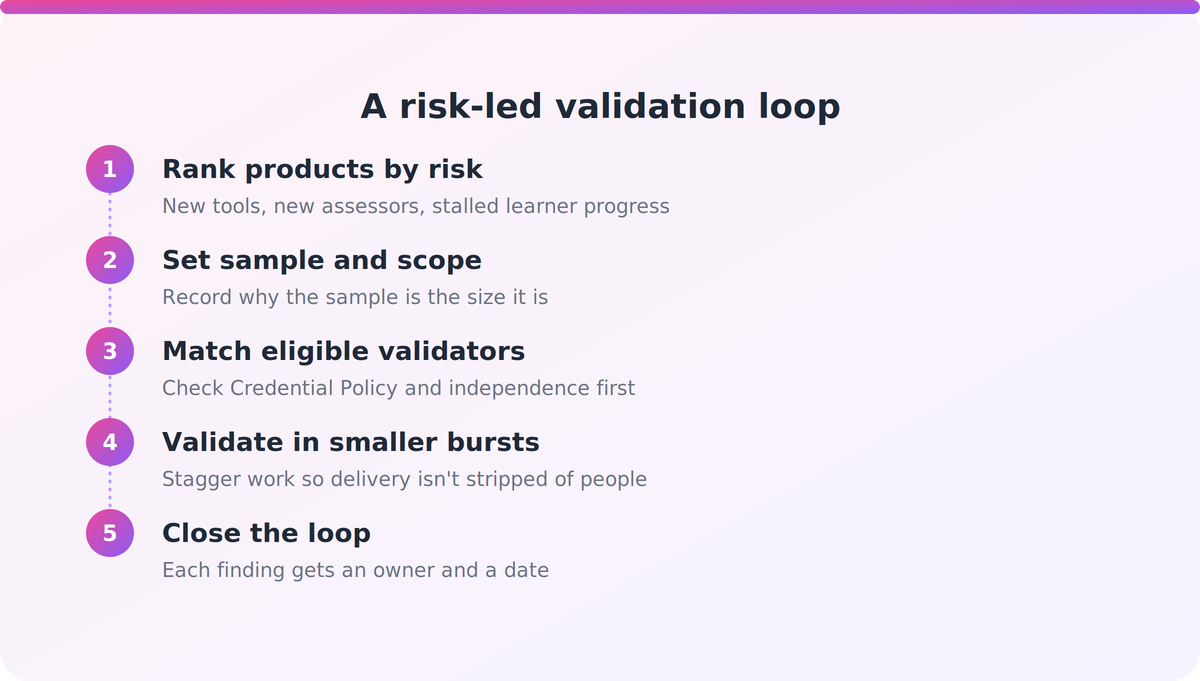
The fifth step is where most schedules quietly fail. A finding that sits in a report has not improved anything.
Key takeaways
- The Standards for RTOs 2025 commenced on 1 July 2025. The research did not confirm an annual validation requirement, so treat an annual event as a design choice.
- Secondary commentary suggests validation is now risk-based, with the five-year maximum cycle retained. Verify this against ASQA's Practice Guide and the Outcome Standards.
- The Credential Policy covers who may undertake validation, so validator eligibility is a workforce decision.
- Scarce, independent validation time belongs where risk is highest, not spread evenly across the year.
- A validation finding only counts once it changes an assessment tool or trainer practice.
Our take
We think the annual event persists because it's easy to show. It has a date, a report and a sign-off. Risk-based validation asks more of you: a rationale, a record of your judgements, and follow-through.
That is also what makes it defensible. Completion and outcome figures are soft (NCVER's 2025 data show employment improvement among completers down 2.0 percentage points to 62.4%), and we wouldn't claim validation frequency drives either. But when assessment quality is questioned, "we validate every December" is a weaker answer than "we validated this unit early because the risk was high, and here is what changed."
A first step for this quarter: pick your three highest-risk units and ask how long a problem in each would take to reach you. If the honest answer is "until the next validation event", your schedule is a habit.
FAQ
Do the Standards for RTOs 2025 require annual validation?
The research behind this piece did not confirm that they do. Secondary commentary says the five-year maximum cycle remains and the approach is risk-based. Confirm against the Outcome Standards and ASQA's Practice Guide on validation.
Who can undertake validation under the 2025 Standards?
ASQA says the Credential Policy sets out the credentials needed to undertake validation of assessment. Secondary commentary adds that validators must be independent of design and delivery. Check both points against ASQA's primary material before you assign validators.
How should I decide sample size for validation?
Secondary commentary describes sample size as a risk-based judgement. Whatever you decide, document your reasoning so you can explain it. Read ASQA's Practice Guide for its expectations.
Where should I look for authoritative guidance?
Start with ASQA's pages on the 2025 Standards and its Practice Guides, and DEWR's Standards for RTOs pages and FAQ. Treat vendor blogs as prompts to check, not as sources of record.