VET Employment Outcomes Reporting: What ASQA Wants Now
22 September 2026 · 6 min read
ASQA no longer wants to read your policy on employment outcomes. It wants to see the evidence that your training actually produces them — completions, jobs, further study, the lot — and it wants that evidence sitting ready before an auditor ever asks for it.
That's the real change buried in the Standards for RTOs 2025, and it's the one most managers are still catching up to.
Why This Hits Your Desk
You already carry completion rates, quality and risk as personal metrics. What's changed is who's measuring them and how. The 2025 Standards, in force since 1 July 2025, replaced the 2015 framework specifically to correct what ASQA itself described as an undue focus on prescriptive compliance at the expense of organisational practices that deliver quality outcomes. Translation: a tidy policy folder used to be enough to survive an audit. It isn't now.
At the same time, ASQA has named Provider Governance, Market Conduct, Non-Genuine Operators, and the Quality, Sufficiency and Fitness-for-Purpose of Training Delivery as its 2026-27 risk priorities. Outcome evidence sits inside every one of those categories. And you're doing this with the same trainer headcount, the same hours in the week, and a compliance workload that's grown, not shrunk. That's the squeeze this piece is about.
The Shift From Policy to Proof
The structural design of the 2025 Standards separates Outcome Standards from compliance requirements — a deliberate split. Industry compliance commentary on the change is consistent: auditors are now looking for evidence that practice matches what the RTO says it does, not relying on the existence of a written policy as proof of quality.
For an RTO Manager, that means your evidence trail matters more than your document library. If your policy says you track graduate employment outcomes, an auditor now expects to see how you tracked them, what you found, and what you changed as a result — not just the policy stating that you do.
The National Numbers You Can Actually Use
Here's the part of this story that's genuinely good news, and worth having ready for your own board or governance reporting. NCVER data for 2025 shows 94.8% of trade completers and 89.2% of non-trade completers were employed after finishing their apprenticeship or traineeship. Even non-completers post relatively strong employment and further-study outcomes — a reminder that completion isn't the only outcome measure worth tracking and reporting.
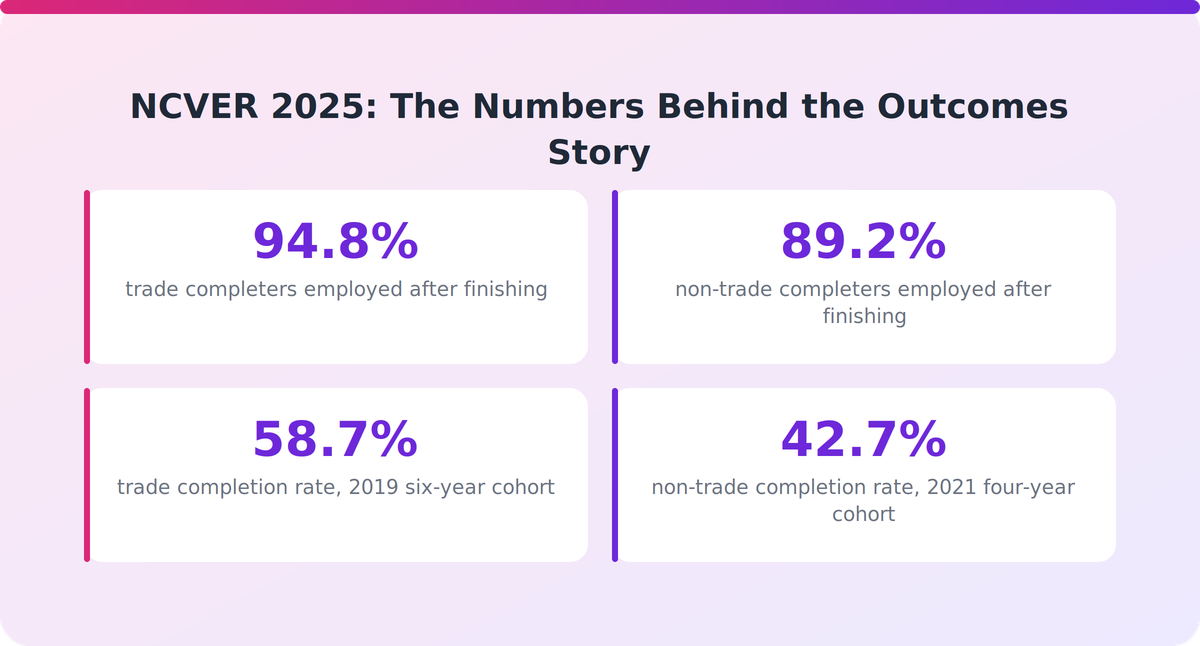
But the completion trend itself is split by sector, and it's worth knowing which way your delivery mix is heading. Six-year trade completion rates rose to 58.7% for the 2019 cohort — the sixth consecutive annual increase. Non-trade four-year completion, by contrast, fell to 42.7% for the 2021 cohort, the third consecutive decline, linked to shifts in government incentives and the occupational mix of enrolments.
If your RTO runs non-trade qualifications, that decline is a pattern ASQA will already be aware of at a sector level. Waiting for an auditor to raise it isn't a strategy.
The Trainer Shortage Nobody's Solving For You
Outcome evidence doesn't materialise on its own — it takes people who can deliver, assess and follow up on graduates. A Jobs and Skills Council report from Skills Insight found the inability to find qualified trainers is the main barrier stopping RTOs from expanding scope, with recruitment often happening informally, by word of mouth, rather than through any structured pipeline.
DEWR's earlier changes to the Standards, introduced from March 2024 ahead of the full 2025 reform, were explicit workforce relief — including provisions letting secondary-qualified teachers deliver training under supervision across VET contexts. That's a regulator acknowledging the resourcing gap you're managing. It's not a fix for it.
This is the honest tension in the current environment: the evidence bar has gone up while the workforce available to generate that evidence hasn't grown at the same pace. There's no clean answer here — only the discipline of building outcome-tracking into delivery from day one, rather than reconstructing it under audit pressure.
What Enforcement Is Actually Punishing
This isn't theoretical risk. ASQA's investigation program led to the cancellation of qualifications and statements of attainment for more than 21,000 former students between late 2024 and early 2025, concentrated among providers found to have serious integrity failures. That's not a paperwork penalty — it's students losing credentials and providers losing standing.
The common thread in those cases is a gap between what was claimed and what could be shown. That's precisely the gap the 2025 Standards were built to close.
Key Takeaways
- The Standards for RTOs 2025 shifted audit focus from policy existence to demonstrated practice — auditors now expect evidence that outcomes match what your policy claims.
- NCVER 2025 data gives RTO Managers real numbers to work with: 94.8% of trade completers and 89.2% of non-trade completers were employed post-completion, and non-completers show meaningfully strong outcomes too.
- Completion trends diverge by sector — trade completion is rising (58.7% for the 2019 six-year cohort) while non-trade completion is falling (42.7% for the 2021 four-year cohort, a third straight decline).
- ASQA's 2026-27 risk priorities put governance and training delivery quality directly in audit scope, meaning outcome evidence gaps are now a named regulatory target, not a side issue.
- Trainer shortages remain the primary constraint on delivery capacity and, by extension, on your ability to generate the evidence auditors now expect.
Our Take
The uncomfortable truth in this reform is that ASQA has simply started auditing for what good RTO Managers already knew mattered: whether learners actually get skills, get through, and get employed. The Standards catching up to that reality is arguably overdue.
What it demands operationally is a genuine change in habit — outcome tracking that runs continuously through delivery, not a report assembled the week before an audit notice arrives. Providers that already treat completion and employment data as a live management signal, rather than an annual compliance artefact, will find this shift far less disruptive than those still running on policy alone.
FAQ
Do the Standards for RTOs 2025 require a specific employment outcomes report? The Standards are structured around Outcome Standards plus separate compliance requirements, designed to correct the previous framework's heavy focus on prescriptive documentation. The practical implication, confirmed by industry compliance commentary, is that auditors now expect evidence your practice matches your stated outcomes — not a single mandated report format.
Is completion rate still the main metric ASQA cares about? No. NCVER data shows non-completers also achieve relatively strong employment and further-study outcomes, which is exactly why completion alone isn't treated as the only valid measure. Tracking and reporting broader outcome data — employment, further study, non-completer pathways — gives a fuller and more defensible picture.
How does the trainer shortage affect our audit readiness specifically? A Jobs and Skills Council (Skills Insight) report identifies the inability to find qualified trainers as the main barrier to RTOs expanding scope. Fewer trainers means less capacity to generate, verify and document the outcome evidence now expected under the 2025 Standards, widening the gap between resourcing and compliance expectation.
What are ASQA's current risk priorities I should be watching? For 2026-27, ASQA has named Provider Governance, Market Conduct, Non-Genuine Operators, and Quality/Sufficiency/Fitness-for-Purpose of Training Delivery as its risk priorities — all of which directly implicate whether an RTO can evidence real outcomes rather than describe intended ones.