Australia's VET Engagement Crisis Isn't About Learners
21 September 2026 · 6 min read
Australia's VET Engagement Crisis Isn't About Learners
Australia's peak vocational bodies keep framing patchy apprenticeship completions as a motivation problem — but the data doesn't support it. NCVER figures show over half of apprentices who started in 2020 didn't finish within four years, and most who left early say a change to their job, not their attitude, would have kept them in training.
What the completion data actually shows
The headline numbers look like a crisis of interest in vocational learning. Look closer and they point somewhere else.
- NCVER data cited by the ABC show 52% of apprentices and trainees who started in 2020 did not complete within the expected four years.
- NCVER's 2025 completion data show non-trade traineeship attrition has climbed to a record 56%, with only 43% of that cohort completing.
- Overall VET enrolments remain strong — NCVER's *Total VET Students and Courses 2025* counted 5.1 million students in the system.

That last point matters. People are still choosing vocational pathways in large numbers. They're not walking away from training itself — they're walking away partway through it.
Why 'disengagement' is the wrong diagnosis
If learners were simply losing interest, we'd expect early dropout to correlate with dissatisfaction about the *training*. It doesn't.
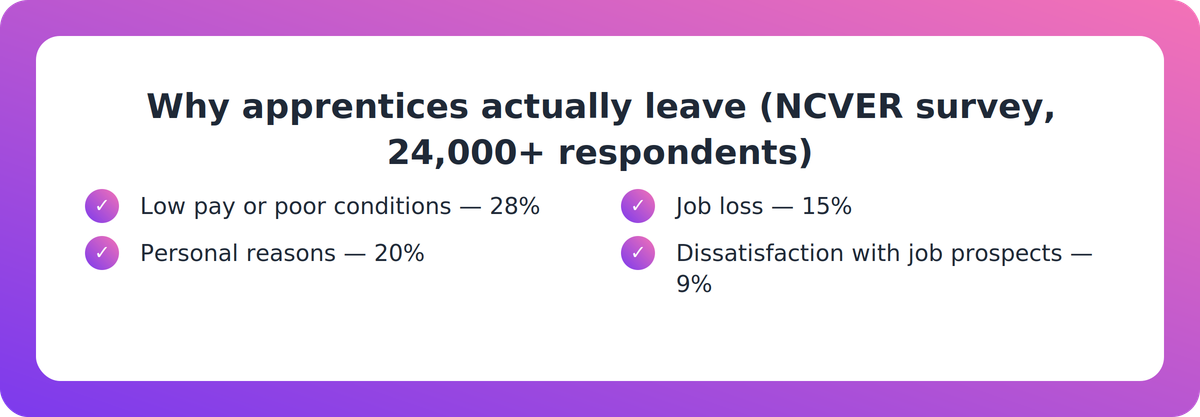
An NCVER survey of more than 24,000 apprentices found non-completion is concentrated in workplace and personal circumstance, not classroom experience:
- 28% cited low pay or poor conditions
- 20% cited personal reasons
- 15% cited job loss
- 9% cited dissatisfaction with job prospects
Even more telling: of apprentices who left early, 85% said something could have helped them finish — most commonly a change to their job or workplace (ABC News, 25 August 2026). That's not a cohort that's given up on learning. It's a cohort that hit a fixable barrier and left anyway, because nothing changed in time.
The commencement and incentive squeeze
The pipeline into training is also tightening, which compounds the completion problem.
From January 2026, Australian Government incentives for employers taking on apprentices and trainees were reduced outside the housing and new energy sectors. In the following year:
- Trade apprenticeship commencements fell almost 10%
- Traineeship commencements fell over 18% (Australian Industry Group, year to September 2025)
Construction shows the sharpest edge of this. In the year to March 2026, more apprentices quit the trade (28,125) than completed it (28,020). Master Builders Australia's *Future Workforce Blueprint* responds with structural proposals — mandatory supervisory standards among them — not learner-facing engagement campaigns. That framing choice is itself a signal of where the industry believes the fix actually lives.
What the first-year experience data adds
A ministerially launched National First Year Experience Report reinforces the same read from a different angle. It found most apprentices want to stay in their trade, and most employers genuinely try to retain them. The deciding factor isn't willingness on either side — it's inconsistent first-year workplace support and wellbeing gaps that show up before either party can course-correct.
Put simply: the intent to complete is there on both sides of the employment relationship. What's missing is consistent scaffolding in the first twelve months, when the risk of leaving is highest.
Where training design fits into the fix
This is where it gets relevant for Registered Training Organisations (RTOs) operating under the Standards for RTOs 2025. Jobs and Skills Australia has already questioned whether completion-rate metrics still capture genuine engagement with training packages and units of competency, or simply track administrative progress through a qualification structure.
That's a fair question. Units of competency were built to standardise what's assessed, not to replicate the pressure, pacing or ambiguity of a real job. When training is delivered as a sequence of discrete competencies rather than a rehearsal for what the workplace will actually throw at someone, the gap between 'competent on paper' and 'confident on the job' widens — and that gap is exactly where the NCVER data shows people leaving.
None of this replaces the need for better pay, better supervision, and steadier incentives — those are policy and industry-relations problems, not delivery problems. But RTOs and corporate learning and development teams do control one lever directly: how closely training mirrors the actual conditions a learner will face on day one, week one, and month one on the job. Practice that's contextual to a real trade, role or client scenario — rather than generic content mapped loosely to an AQF qualification — gives learners a rehearsal for the exact friction points the research identifies as decisive.
Key takeaways
- NCVER data show 52% of the 2020 apprentice/trainee cohort didn't complete within four years, and non-trade traineeship attrition has hit a record 56%.
- 85% of early leavers say a workplace or job change could have kept them in training — this is a structural signal, not a motivation gap.
- Reduced government incentives outside housing and new energy have coincided with double-digit falls in commencements, adding pressure upstream of completion.
- A ministerially launched National First Year Experience Report confirms most apprentices want to stay; inconsistent first-year support is what actually determines who does.
- Jobs and Skills Australia is questioning whether unit-of-competency-based completion metrics reflect real job readiness — a design question RTOs can act on now.
Our take
The engagement framing is convenient because it puts the burden on the learner. The evidence puts it on the system: pay, supervision, incentives, and training design built around administrative units rather than job performance. RTOs can't fix wages or workplace culture, but they can close part of the readiness gap by building assessment and practice around what a first-year worker will genuinely face, not just what a training package specifies. That's a modest claim, not a silver bullet — but it's the one lever inside a provider's control, and the data suggests it's currently underused.
FAQ
Is Australia's VET completion problem really about learner disengagement? No. NCVER and ABC-reported data show most early leavers wanted to finish — 85% said a change to their job or workplace could have kept them in training. The evidence points to structural workplace factors, not lost interest in learning.
What are the biggest reasons apprentices leave training early? An NCVER survey of over 24,000 apprentices found 28% cited low pay or poor conditions, 20% personal reasons, 15% job loss, and 9% dissatisfaction with job prospects.
Why have apprenticeship and traineeship commencements fallen? Australian Government incentives for employers taking on apprentices and trainees were reduced from January 2026 outside the housing and new energy sectors. Trade apprenticeship commencements fell almost 10% and traineeship commencements fell over 18% in the following year, according to the Australian Industry Group.
What does the National First Year Experience Report say about retention? The ministerially launched report found most apprentices want to stay and most employers try to retain them, but inconsistent first-year workplace support and wellbeing gaps are what actually determine whether they complete.
How does training design under the Standards for RTOs 2025 relate to completion rates? Jobs and Skills Australia has questioned whether completion metrics tied to units of competency reflect genuine job readiness. Training built around real workplace scenarios, rather than administrative progress through a training package, may better prepare learners for the conditions that currently drive early exits.