VET Trainer Shortage Australia: Retention Beats Hiring
5 October 2026 · 6 min read
Australia's VET trainer shortage is mainly a retention and workforce-structure problem, not a shortage of applicants. Trainers are ageing, casualised and underpaid relative to other teachers, and many are leaving. TAFEs and RTOs can't recruit fast enough, so they need to multiply the reach of the trainers they already have.
How bad is the VET trainer shortage in Australia?
Bad, and it isn't new. Jobs and Skills Australia's VET Workforce Study (October 2024) found VET teachers had been in shortage nationally, and in every state and territory, for two years.
The same study estimated about 3,800 more teachers were needed over five years, with projected employment growth of 21% by 2033. Skills Insight (2025) adds a sharper point: VET teacher numbers shrank by 11–18% over the last decade, even as demand grew.
A caveat on the data. The JSA study is now about two years old, and some of the more recent figures below come from secondary or advocacy sources. Check anything you plan to quote against current JSA, NCVER and ASQA releases.
Is it a recruitment problem or a retention problem?
Retention is the sharper edge. The JSA study describes a workforce that is older (almost 50% over 50), highly casualised and paid less than teachers in other sectors. People who leave often move into better-paid teaching roles.
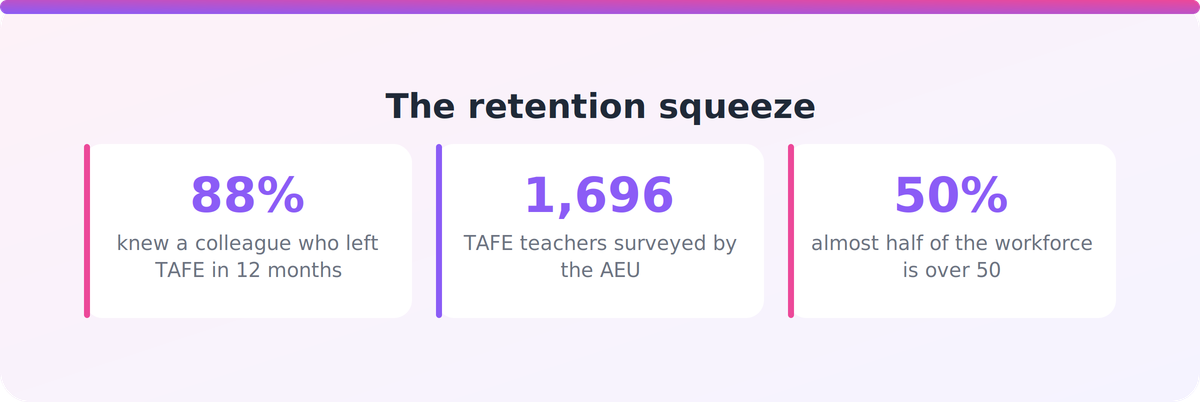
The Australian Education Union surveyed 1,696 TAFE teachers (around February 2026):
- Nearly two-thirds had considered leaving in the past year.
- 88% knew a colleague who had left TAFE in the past 12 months.
- The union points to workload intensification, insecure employment and uncompetitive pay.
This is a union source, so read it as advocacy. But the sample is large, and it matches the JSA picture. Pouring new hires into a leaking bucket doesn't fix the bucket.
Why can't RTOs just hire their way out?
Three things get in the way.
Money is uneven
Funding has shifted between providers. A Vivacity analysis argues Fee-Free TAFE has left private RTOs competing for a shrinking pool of subsidised enrolments. It cites Victoria's 35% metropolitan subsidy cut and 91 courses removed from the training needs list.
CDRG, an opinion piece with secondary figures, cites 685,000+ Fee-Free TAFE enrolments and some NSW private providers losing 70% or more of their funded places. Treat those numbers with care. The direction is clear though: many RTOs have tight salary budgets.
Compliance sets the pace
The Standards for RTOs 2025 took effect on 1 July 2025. Applicants need qualified trainers and assessors lined up before they lodge. VET Advisory Group warns that rushed hiring raises ASQA risks, including unauthenticated credentials, scope misalignment and gaps in industry currency.
The pathway is slow
The Certificate IV in Training and Assessment is required before teaching. SmartCompany (about 2021, older but still structurally relevant) noted only just over half of VET practitioners were in ongoing full-time roles. Industry experts take time to credential, and casual work makes it harder to keep them.
Where is demand pressure heaviest?
Trades and care. Secondary reporting of JSA March quarter 2026 fill rates shows 55.1% for Technicians and Trades Workers and 70.8% for Community Workers. Verify those against JSA primary data before citing them.
If those fields stay hard to fill, the demand for people who can teach them won't ease either.
What can providers do besides hiring?
Start from a different question: how far does one good trainer's expertise reach? Much of a trainer's week goes on repetitive practice supervision, such as running the same role play for the fifteenth learner. That is the part of the job that's hardest to scale and easiest to burn out on.
Some practical moves:
- Protect trainer time for judgement. Keep humans on assessment decisions, feedback and mentoring.
- Extend practice beyond the classroom. AI-supported role plays and simulations let learners rehearse customer, client or care conversations between sessions, with coaching built in.
- Tailor scenarios to the unit and the workplace. Practice built around real units of competency and local contexts beats generic modules.
- Keep compliance in the loop. Any AI-supported practice should map to the training package and sit within your assessment system, not around it.
- Measure what sticks. Track repeat practice and improvement, not just completion.
This isn't about replacing trainers. It's about giving each one more reach, so the workload that drives people out of the profession shrinks instead of growing. Tools such as Nova are built around this idea of coached practice at scale.
Key takeaways
- JSA (2024) found VET teachers in shortage in every state and territory for two years, with about 3,800 more needed over five years.
- The workforce is ageing, casualised and paid less than other teachers, so retention is the bigger lever.
- An AEU survey of 1,696 TAFE teachers found nearly two-thirds had considered leaving in the past year.
- Funding pressure and the Standards for RTOs 2025 limit how fast any RTO can hire safely.
- Extending trainer capacity through scalable practice and simulation is a practical complement to recruitment.
Our take
More job ads won't close this gap. Not while workload, pay and insecure contracts push experienced trainers out as fast as new ones arrive. We think the providers that cope best will treat trainer time as the scarcest asset, and design learning so a single trainer's expertise reaches many more learners. Hiring still matters. It just can't carry the load alone.
Where in your own delivery does trainer time go on repetition rather than judgement? That's usually the best place to start.
FAQ
What does the VET trainer shortage in Australia look like in numbers?
JSA's VET Workforce Study (October 2024) found VET teachers in shortage nationally and in every state and territory for two years. It estimated about 3,800 more were needed over five years, with employment growth of 21% projected by 2033. Skills Insight (2025) reports numbers shrinking by 11–18% over a decade.
Why are VET trainers leaving?
The AEU survey of 1,696 TAFE teachers cites workload intensification, insecure and casualised employment and uncompetitive pay. JSA (2024) also found leavers often move into better-paid teaching roles. The AEU is a union, so its findings are advocacy-oriented, but the sample is large.
Why can't RTOs simply hire more trainers?
Funding is uneven, so salary budgets are constrained for many RTOs. The Standards for RTOs 2025, in effect from 1 July 2025, expect qualified trainers and assessors to be in place. VET Advisory Group warns rushed hiring raises ASQA risks around credentials, scope and industry currency.
Can AI help with the trainer shortage?
It can extend capacity, not replace trainers. AI-supported role plays and simulations give learners coached practice between sessions, freeing trainers for assessment judgement and feedback. Anything used should align with the relevant training package and your RTO's assessment system.
How reliable are the figures on the shortage?
The main authoritative source, JSA (2024), is about two years old. Several newer figures come from consultancies, a union or secondary summaries. Check current numbers with JSA, NCVER and ASQA before relying on them.