Vocational Training Completion Rates NZ: Design, Don't Chase
6 October 2026 · 7 min read
Completion is not a year-end number. Under NZQA's annual self-review model, it is the sum of hundreds of in-flight decisions about assessment design, moderation and early intervention, and those decisions sit with you. If your first look at completion is in December, the only thing left to design is the explanation.
Why this lands on your desk
NZQA's integrated Quality Assurance Framework went live on 1 January 2026. NZQA is not starting new external evaluation and review processes or consistency reviews, though those already underway will be completed. The EER category rating system has ceased.
What replaces it is annual self-review. Providers submit a summary report and meet NZQA to discuss their improvement plan. From July 2026, all non-university tertiary providers delivering education and training undertake self-review, including Industry Skills Boards (ISBs) delivering work-based training.
You own delivery and assessment practice, so you supply much of the evidence in that report. Your learners' progress and the support around it are the story the report has to tell.
What the 2026 rules put in your hands
The Quality Assurance of Tertiary Education Providers Rules 2026 require an up-to-date quality management system and annual self-reviews. The system must cover programme management, assessment and moderation, and complaints and appeals. Providers must also meet the Pastoral Care Code of Practice 2021. If you didn't have a compliant system on 1 January 2026, you have until 1 January 2027 to create one.
NZQA can also give notice to monitor particular qualifications or programmes, which may include site visits. That is a reason to be able to explain any single programme at any point in the year, not just the portfolio at year-end.
Programme approval criteria ask for assessment that is fair, valid, consistent and appropriate. They also ask for an effective system for moderating assessment materials and decisions. Consent and moderation requirements extend to the skills and knowledge of your teachers and assessors and to learner access to resources.
None of that is a completion target. All of it shapes whether learners finish.
Sector completions are rising, so flat is visible
Ministry of Education data, announced through the Beehive, shows the number of students completing a provider-based tertiary qualification rose 8% in 2025 on 2024. Domestic completions rose 5.9% to 123,200. PTEs recorded the largest subsector increase at 12%, with Level 1 certificates up 14% and Level 4 certificates up 13%.
Two cautions. This is a ministerial release summarising Education Counts data, and the page we retrieved was undated. It also tells you nothing about how your provider compares, and we won't pretend otherwise. Use your own programme data, not the sector headline, as your benchmark.
Still, a rising tide makes a flat result harder to explain away, to your board and in your own self-review.
Four in-flight decisions that shape completion
Retention is rarely rescued in the last month of a programme. The decisions that matter get made earlier, and they are yours.
Design assessment so it is fair before it is marked
Inconsistent assessment across trainers is a quality risk and a learner experience problem. If two trainers interpret the same unit standard differently, learners meet different hurdles. Settle the interpretation before delivery starts: agreed assessment materials, agreed assessor guidance, agreed decision rules.
Put moderation on the delivery calendar
Post-hoc moderation finds problems after learners have already been affected. Pre-assessment checks of materials and scheduled checks of decisions during delivery let you fix issues while learners are still enrolled. That is the difference between a moderation finding and a moderation save.
Make progress visible every week
A learner who has quietly fallen behind is a completion risk you can't see. Decide what "on track" means for each programme, such as assessments attempted against plan or contact and engagement, and review it on a fixed rhythm. Keep it simple enough that trainers actually use it.
Protect the capacity that makes the rest possible
The sector is in flux. Te Pūkenga has been disestablished, replaced by regional polytechnics and ISBs from 1 January 2026, and sources differ on the exact timing. The Spinoff reported the loss of over $80m in funding and a significant share of staff. We can't draw a causal line from that to completion. But trainer workload is the practical constraint on everything above, so treat it as a design input, not a footnote.
Check these in-flight signals this quarter
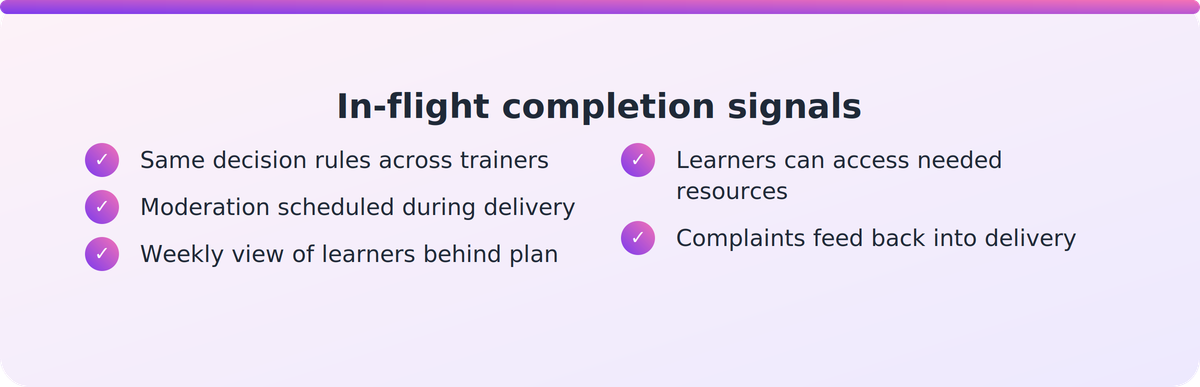
- Are trainers assessing the same unit standard to the same decision rules?
- Is moderation scheduled during delivery, or only after it?
- Can you see, this week, which learners are behind plan?
- Do learners have the resources they need to attempt assessment?
- Can you show how a complaint or appeal fed back into delivery?
Standards are moving, so consistency is your anchor
Since 1 January 2026, the eight ISBs develop and maintain industry qualifications and unit standards. They also handle national external moderation, consent-to-assess endorsement and micro-credential approval. Standards and moderation expectations may shift as the arrangements bed in.
You can't control that. You can control whether your internal assessment practice is consistent enough to absorb a change without chaos. Version control matters here: when a standard is revised, every trainer should be working from the same current materials.
Keep records that tell the learner's story
PTEs must keep all student assessment materials, or full copies, for at least 12 months from completion under the PTE Rules 2026. Treat that as a floor, not a filing exercise.
Clean, version-controlled records show what a learner was asked, how they were assessed and how they progressed. That is exactly the evidence a self-review conversation with NZQA, or a monitoring notice, will draw on.
Key takeaways
- Under NZQA's annual self-review model, completion is evidence of in-flight delivery quality, not a number reported after the fact.
- The 2026 rules require a quality management system covering programme management, assessment and moderation, and complaints and appeals.
- Fair, valid, consistent assessment and effective moderation are programme approval criteria, and they also shape whether learners finish.
- Sector completions rose in 2025, but provider-level benchmarks weren't in the data, so measure against your own programmes.
- With ISBs now setting moderation and consent requirements, consistent internal practice and version-controlled records are your stability.
Our take
The old rhythm of a periodic external review let many providers treat quality as an event. Annual self-review removes that option. It also hands the Head of Training something useful: a regular, legitimate reason to ask whether delivery is working while there is still time to change it.
Our view is that the best completion strategy is rarely a retention initiative. It is boring, upstream work: assessments that mean the same thing to every trainer, moderation that happens early, progress that is visible weekly, and workloads that leave trainers room to notice a struggling learner. Completion then follows from delivery that functions.
We don't know how any one provider's numbers will move. We do think the question "how will we explain this in December?" is the wrong one to start from.
FAQ
Does NZQA set a completion rate target for PTEs?
The material we reviewed doesn't describe a completion target in the 2026 rules. It describes a self-review process covering programme management, assessment and moderation, and complaints and appeals. Your own completion evidence supports that conversation.
What changed with NZQA's quality assurance on 1 January 2026?
The integrated Quality Assurance Framework went live. NZQA is not beginning new external evaluation and review processes or consistency reviews, and the EER category rating system has ceased. Providers now complete an annual self-review summary report and meet NZQA to discuss their improvement plan.
How does moderation affect completion?
Programme approval criteria require an effective system for moderating assessment materials and decisions, and for fair, valid, consistent and appropriate assessment. Moderation that catches problems during delivery helps keep learners' assessment experience consistent. That is a design argument, not a measured causal claim.
How long must a PTE keep assessment materials?
The PTE Rules 2026 require PTEs to keep all student assessment materials, or full copies, for at least 12 months from completion. Version-controlled records also help show how learners progressed.
A first step
Pick one programme and ask what you would need to know in week four to predict a December completion problem. If you can't see it today, start there.